Orizon8 turns two oscillators into one voice

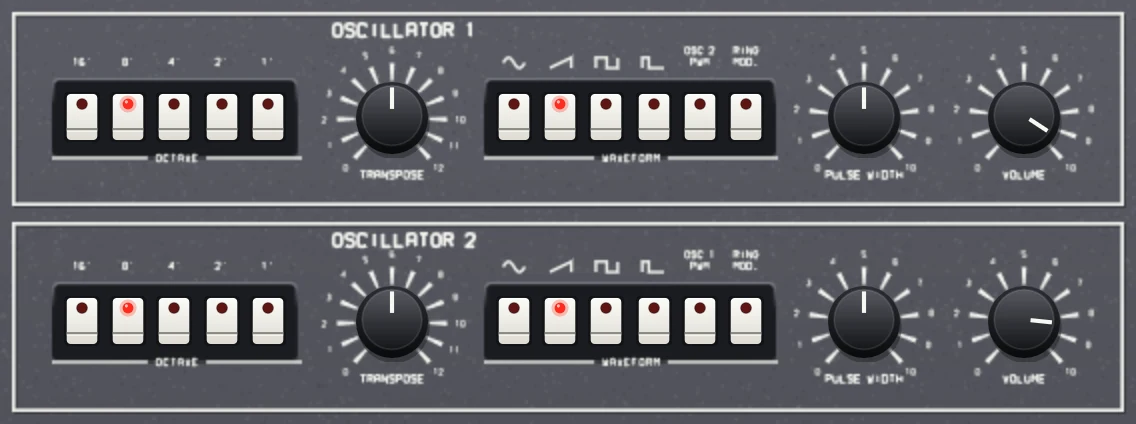
Tune OSC 2 a fifth above OSC 1, press RING and turn the two oscillators’ VOLUME down. The fifth stops being a fifth. What is left sounds close to a bell: hard, metallic, and its pitch comes from the gap between the two notes, not from either of them.
Ring is one of three ways the two oscillators can talk to each other. The other two are sync and cross-mod, and each one does something different.
Sync: OSC 2 becomes the timbre control
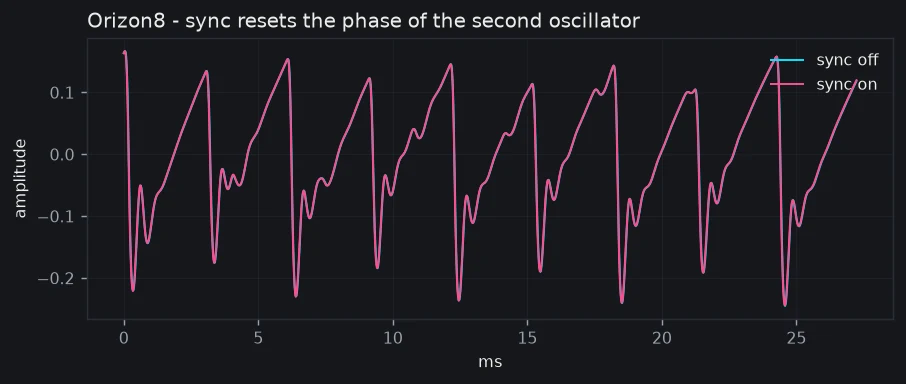
Switch sync on and OSC 1 takes charge. Every time it starts a new cycle, OSC 2 is sent back to the start of its own, wherever it had got to. The pitch you hear is OSC 1’s, and the tone depends on how the two relate. So OSC 2 becomes the control you play: step its TRANSPOSE, sweep its DETUNE or let the LFO move its pitch, and the tone changes while the note stays where it is. It is the classic hard-sync lead, steered with one knob.
Ring: two notes, one metallic sound
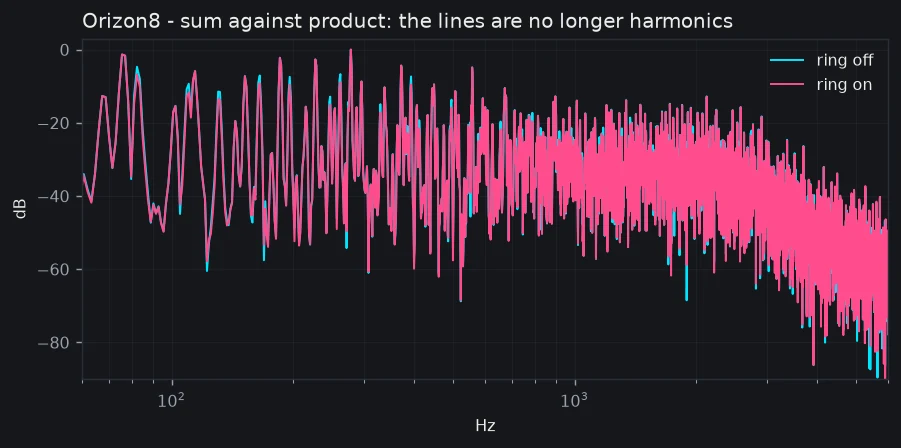
The ring in Orizon8 is a simple on/off circuit. It checks which side of zero each oscillator is on and puts out +1 when they disagree and -1 when they agree. It is not a multiplier, and it only ever outputs those two values, so the wave has hard edges and flips each time either oscillator crosses zero. There is no depth knob on the panel: pressing RING brings the ring in at a strong level, and you balance it with the two VOLUME knobs.
On the patch we measured (two triangle waves a fifth apart, filter wide open, ring brought in strongly), everything above about 8 kHz goes from almost nothing to a clear part of the sound. That is a lot to get from a circuit that only ever says +1 or -1.
Cross-mod: the pulse moves, the pitch stays
The third coupling is the quiet one. OSC 1 pushes OSC 2’s pulse width in and out, not its frequency, so OSC 2’s pitch does not move. For this to work, OSC 2 must be on the pulse wave: saw, triangle and square have no pulse width to move. Careful, too: two pulse waves on exactly the same note move together, and the change is tiny. Detune OSC 2 or move it away from OSC 1, press the PWM button on OSC 2’s row (the one that says OSC 1), and the tone starts to change while the note stays put. Try it on a pad.
Where it stays clean, and where it bites
Orizon8 smooths the sharp edges of the saw and pulse waves, and builds its triangle from a smoothed square, to keep the grit of aliasing down on high notes. The cut that sync makes and the one-bit ring are not smoothed, and the oscillators are not oversampled. So on high notes, sync and ring can add a rough, digital edge, and it is not removed.
Load Orizon8, tune OSC 2 a fifth up and press RING. Then switch to sync and move OSC 2’s DETUNE.
The instrument
