Edge8 and the eighties glass

Edge8 is glass in the top end, an attack with a burr on it, and a timbre that never pretends to be anything but a machine. Load Digital Bell and play one note above middle C: it rings clean and cold, and there is no sample behind it: every wave is built by our own code.
Warm is easy to come by. Edge8 gives you the other thing — a sound that is unapologetically artificial, cold and bright, made to stand out in a crowded mix. Ice Field is a slow, cold pad: try it under a whole verse. Gamelan takes the same family and makes it irregular and struck. Screamer is a lead with the treble left in: play it in octaves and stop apologising.
The wave envelope: the timbre moves while you hold the note
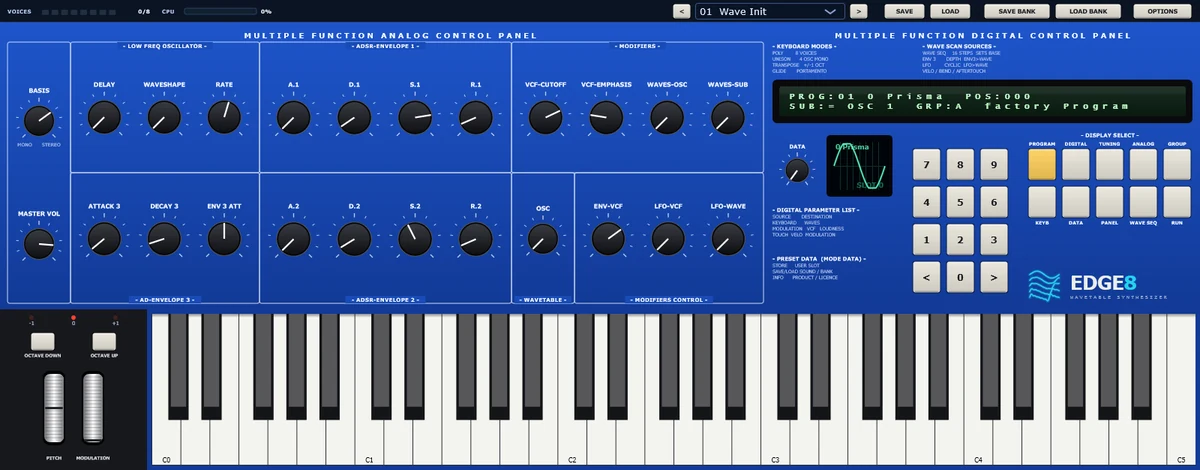
Turn up ENV 3 ATT, the amount of the wave envelope, and the held note starts to walk. The timbre changes while your finger is still down, and not because a filter is opening: the oscillator has moved somewhere else and is reading a different waveform. ATTACK 3 and DECAY 3 set how fast it travels. On pads and leads, leaning into a key you are already holding (aftertouch, if your keyboard sends it) pushes the wave forward too. Send velocity to the wave as well (VW, on the DIGITAL page) and the same chord played soft and then hard gives two different timbres, not just two volumes.
32 wavetables on one knob
The WAVETABLE knob picks the table: 32 of them, 64 slots long, drawn from a pool of 256 waves and named on the display as you turn past — Prisma, Vetro, Vocalizzo, Coro, Campanile, Grana, Ferro, Cristallo, Tempesta, Vertigine. The first sixteen stay in one family of sounds and morph it from one end to the other; the other sixteen turn into something else along the way. Risonanza is a peak that climbs the harmonic series, so you get a resonant sweep with the filter untouched. Vertigine lurches, and it will not behave.
The SSM2044 filter underneath
The sound then goes through a four-pole low-pass modelled on the SSM2044 chip: a model built from the chip’s datasheet, not a recording of one. Turn the resonance all the way up and it sings by itself. Try Edge8 over a soft analogue bass, or under a dry vocal.
The wave sequencer: 16 steps that play no notes
Its 16 steps do not name pitches; each one names a place inside the table. Hold a single note with the sequencer running and that note becomes a rhythmic figure made entirely of timbre. The ten Seq programmes start it for you; on any other sound, press RUN and then 1 on the keypad. Seq Step Bass locks hard sixteenths to the host tempo. Seq Glide Pad is the same idea melted, each position dissolving into the next. Seq Fast Grain runs at 24 steps a second, so fast that the rhythm blurs into a texture.
Hold one note, let the sequencer run, and you have stopped playing notes. You are playing timbre in time.
Eight voices as standard, 210 factory programmes, a 40×2 character display and a keypad, in VST3 and as a standalone application. Open Edge8 anywhere in the bank, turn up ENV 3 ATT, and hold the note.
The instrument
