Analogue polysynth - 8 voices
Orizon8
Orizon8
The panel says OSCILLATOR 1 and OSCILLATOR 2, but the engine computes them as one pair, sample by sample. That is the difference between a synth that adds two voices and one where the second knows what the first is doing.
v1.0.0

betadownload and try
Perpetual licence · 12 months of updates · full trial before you buy
In beta, and you try all of it
This is not a cut-down version: it is the complete instrument. We are asking you to use it and tell us what does not add up.
3 seconds at −18 dBFS · the clock restarts at every launch
v1.0.0
One licence covers both formats. 12 months of updates from purchase; the instrument keeps working afterwards.
One filter chip, 4 outputs.
Low-pass at 24 dB, band-pass at 12, band-pass at 24, high-pass at 12 - all taken from the same multimode structure rather than four separate filters bolted together. It is why the character stays the same as you change mode: you are moving where you tap, not what you are using.
The oscillators
A coupled pair, and a ring modulator that is honest about being digital.
4 waveforms per oscillator, 5 footages from 16' to 1', tuning of a full octave each way and 50 cent of fine detune on the second.
Hard sync
The first oscillator is master, the second slave: the slave phase resets on the master's wrap. Not a post effect - a consequence of the coupling.
Ring modulator
An exclusive-or of the two sign bits, not a four-quadrant multiplier. The output only ever takes two values, +1 and -1, so the wave has hard edges and flips each time either oscillator crosses zero.
Cross-modulation
Each oscillator can move the other's pulse width, sample by sample. It works on the pulse wave, and two pulse waves on exactly the same note barely change.
Who it is for
For big keyboard sounds that hold two ideas at once.
This instrument was built around the idea that a keyboard should be able to carry two complete voices at the same time.
Split and double
Two complete timbres live on the keyboard together, 8 voices divided four and four. Not a layer of one patch: two patches.
Performance
A two-axis joystick with spring return on both axes, a second LFO dedicated to it, and an arpeggiator with 5 modes over 4 octaves.
Sequenced music
4 tracks of 64 steps, layered, synced to the host or to their own clock.
The filter
4 modes, one structure.
A multimode filter with four outputs, plus drive, key-follow and an envelope amount that can be inverted. Cutoff, resonance, envelope amount and the mixer levels are all ramped over 30 ms on the audio thread, so automation has no steps in it.
- Low-pass 24 dB, band-pass 12, band-pass 24, high-pass 12
- Two independent ADSR envelopes, one for the filter and one for the amplifier
- White and pink noise, mixed with the two oscillators and the ring output

The sequencer
4 tracks, 64 steps each, layered.
Four tracks that play together rather than one after another, so a pattern can carry a bass line, a chord rhythm and a counter-melody at once. Each track keeps its own length, and the whole thing follows the host transport or runs on its own clock.
- 4 x 64 steps, layered rather than chained
- Arpeggiator with 5 modes, 4 octaves and latch
- Host sync or internal clock, chosen per instance

Modulation and effects
Two LFOs, a joystick, and the effects that finish the sound.
One LFO has a routing matrix of buttons - it goes where you press; the other is dedicated to the joystick, so moving the stick is a modulation and not just a bend. After the voices come the bucket-brigade stereo chorus in three settings and a reverb with 4 characters, spring plus three plates.

What is measured
158 rows, 14 metrics each.
The 80 factory presets plus 78 scenarios that each isolate one path through the DSP - the exclusive-or ring, hard sync, cross-modulation, pulse width per oscillator, the 4 filter modes, drive, key-follow, stereo spread, white and pink noise, both LFOs, the joystick, the keyboard modes, polyphony and voice stealing, the arpeggiator, the 4 reverbs and the three chorus settings.
The tolerances are fixed on measured noise, not by eye: the reference is the gap between a debug build and the golden generated in release - that is, the noise between two builds of the same code. Peak, RMS, stereo width, centroid, attack, decay and eight logarithmic bands, on every row, every run.


Specifications
Keep looking
Looking for something else?
The other instruments and effects are one click away.
Downloads
Try Orizon8
Windows downloads are installers (.msi, or the .exe inside a ZIP); macOS downloads are .pkg installers.
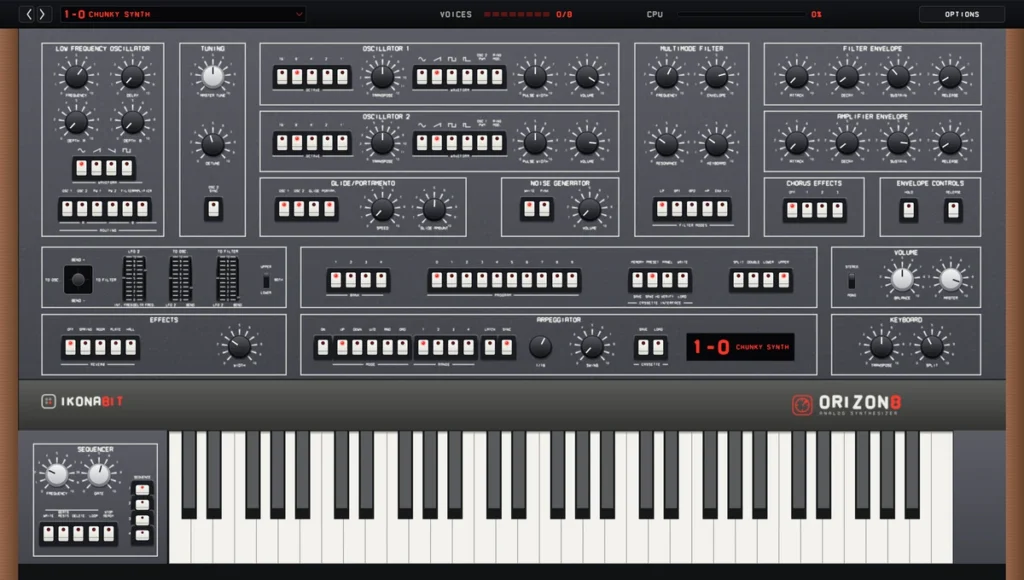
Orizon8
Two oscillators that talk to each other
The panel says OSCILLATOR 1 and OSCILLATOR 2, but the engine computes them as one pair, sample by sample. That is the difference between a synth that adds two voices and one where the second knows what the first is doing.
ikonabit-Orizon8-1.0.0 beta
VST3AUStandalone
File names
- ikonabit-Orizon8-1.0.0.msi
- ikonabit-Orizon8-1.0.0.pkg