Analogue polysynth - 6 voices
Aura106
Aura106
The shortest signal path in the catalogue. There is no modulation matrix to fill in and no wavetable to scan: you move a fader and you hear what it does. The character comes from three precise decisions, and all three are audible.
v1.0.0

betadownload and try
Perpetual licence · 12 months of updates · full trial before you buy
In beta, and you try all of it
This is not a cut-down version: it is the complete instrument. We are asking you to use it and tell us what does not add up.
3 seconds at −18 dBFS · the clock restarts at every launch
v1.0.0
One licence covers both formats. 12 months of updates from purchase; the instrument keeps working afterwards.
The resonance takes body away. Aura106 puts it back at the input, before the resonance loop.
A four-pole resonant filter loses about 14 dB of low end at full resonance. Here the gain is applied before the loop, which is why the sound stays full instead of whistling. How much gain is our choice, not a measurement of the original machine. The same engine hosts an uncompensated model that loses 13.96 dB: two characters, and this instrument chose one.
The instrument
One phase generator, 4 sources.
It is not an oscillator with a waveform selector. Saw and pulse leave the same phase generator in the same computation step, so they are always in phase with each other - switching both on gives a new timbre rather than a beating.
DCO
Saw, variable-width pulse, sub one exact octave down, and per-voice noise. All four sum freely; the sub cannot drift, because its phase step is exactly halved.
High-pass, 4 positions
The first position is not a cut: it is a bass boost of 9.1 dB below 59 Hz. Then flat, 226 Hz, 720 Hz. Warm pads use the first, noise percussion uses the third.
Chorus
Two bucket-brigade delay lines with fixed values, switched by two buttons. Not a chorus with rate and depth to set: the signature of the instrument, on or off.
Who it is for
For the work where fewer controls is the point.
Aura106 does one thing, and the reason to reach for it is that it does not ask you to build the sound before you can play it.
Pads, strings, brass
The classic register of a 6-voice polysynth with an integrated chorus. Bring up the fader, press the chorus, and it is already there.
Playing, not programming
32 controls on the panel, all of them on one page. Nothing is nested and nothing is modal.
Anyone tired of large instruments
The filter, the envelope and the chorus are the same shared modules used by the flagship. A small instrument here does not mean a lesser engine.
The filter
Four poles, and a body that does not collapse.
Four one-pole cells in cascade, zero-delay topology, a resonance loop saturated by a soft tanh, and a constant 2x internal oversampling - not adaptive, so the character is identical at every cutoff. Coefficients are smoothed over 3 ms, so turning the cutoff produces no zipper.
- Cutoff 5 Hz to 50 kHz on a logarithmic travel
- Envelope amount with a polarity switch, plus LFO and key-follow
- The output stage carries a fixed trim of -3.0 dB: full body made the old presets too loud, and the level is the negotiable part, not the timbre

Voices and memory
Poly, and a unison that is real.
UNISON turns the 6 voices into one monophonic voice sent to all 6 voice modules at once. They share one 8 MHz master and one divide number, so they sit at exactly the same frequency and cannot beat - what unison does here is play the note six times, not detune it. It stays centred, because widening is the chorus's job. The 128 factory programs are the machine's own, read from its factory data cassette in binary form rather than retyped from a chart; they are exposed to the host as programs, and the whole user bank travels inside the DAW project.

What is measured
177 rendered rows, and tolerances taken from the noise.
Every factory patch plus 49 scenarios that isolate the DCO, the high-pass, the filter, the chorus, polyphony and the VCA mode, rendered by the real processor at 48 kHz and compared against a versioned fingerprint on peak, RMS, stereo width, attack, release, centroid, fundamental and eight logarithmic bands.
A wide net always passes and looks at nothing. These tolerances were fixed on measured noise: tight enough to see a change of timbre, wide enough not to break over one unit in the last place of a fused multiply-add. On top of the comparison there is a parameter sweep that fails if an inert control appears in the automation list undeclared.

Specifications
Keep looking
Looking for something else?
The other instruments and effects are one click away.
Downloads
Try Aura106
Windows downloads are installers (.msi, or the .exe inside a ZIP); macOS downloads are .pkg installers.
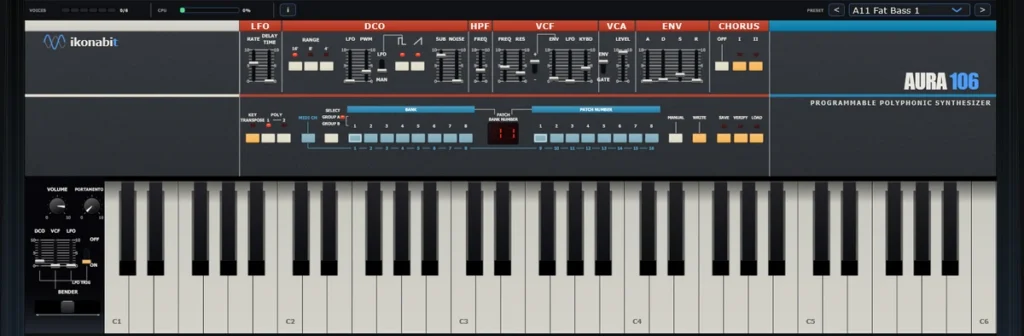
Aura106
Warm, and immediate
The shortest signal path in the catalogue. There is no modulation matrix to fill in and no wavetable to scan: you move a fader and you hear what it does. The character comes from three precise decisions, and all three are audible.
ikonabit-Aura106-1.0.0 beta
VST3AUStandalone
File names
- ikonabit-Aura106-1.0.0.pkg
- ikonabit-Aura106-1.0.0.msi