Inspired by: how we check the claim

Behind every instrument we make there is a real machine. Writing “inspired by” costs nothing, and a claim nobody can check is worth about what it cost.
So we built a checker that has to back that claim up. It reads the code of each product and compares it, item by item, with a hand-written card of what the original machine really did. Next to every result it writes where it found it: the file and the line. Each product gets a score.
It checks the specs. The sound is yours to judge
It counts what can be counted: how many voices an instrument plays at once, how many envelopes and filters it has, whether a feature is there or not. About the sound it says nothing, on purpose. What you read about an old machine is warm, glassy, aggressive: words, and an audio file cannot be compared with adjectives. The score is about the specification. Whether an instrument sounds good is for your ears to decide.
For you, that means knowing what is inside an instrument before you open it.
When it does not know, it says so
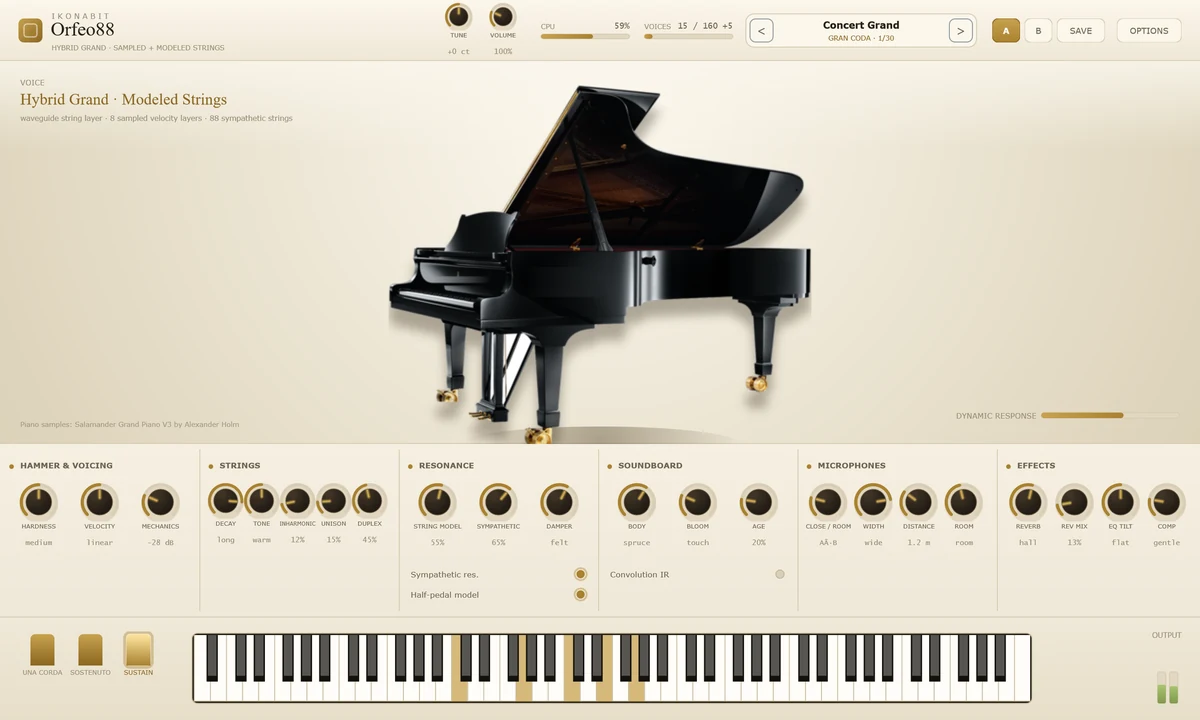
The most honest verdict is “I don’t know”, and it doesn’t count toward the score: a stated doubt beats an invented number. Take the acoustic piano: its heaviest item would be the range of the keyboard, but the string model works out its strings from the note it receives and never needs to know where the keyboard ends. The checker finds no such number, and it is right not to invent one.
It reads what the code declares
That is its most important limit: it reads what the code declares, not what it does, so after every flag someone still goes and looks. A feature switched on by hand in the plugin can look off in the shared settings. An oscillator built inside the plugin on purpose, so that it weighs nothing on the shared engine, can look missing. So the checker now tests two things together: that the code exists, and that it is really connected to the sound.
A choice is not a gap
The one-screen wavetable synth has no second filter and no third envelope, and its manual says so, in a section called “What isn’t here, and why”. The checker learned to recognise this: the declared choice. It stays measured, but it doesn’t count toward the score and it creates no work. Without it, the checker would end up asking us to undo a product decision, and nobody would believe it any more.
The clearest example is the Typhon: it has no granular oscillator, and we decided not to build one, because it would need a sample memory shared by all voices and doesn’t fit an engine that updates a note’s pitch an enormous number of times every second. The reason is written next to the results: a choice, not an oversight.
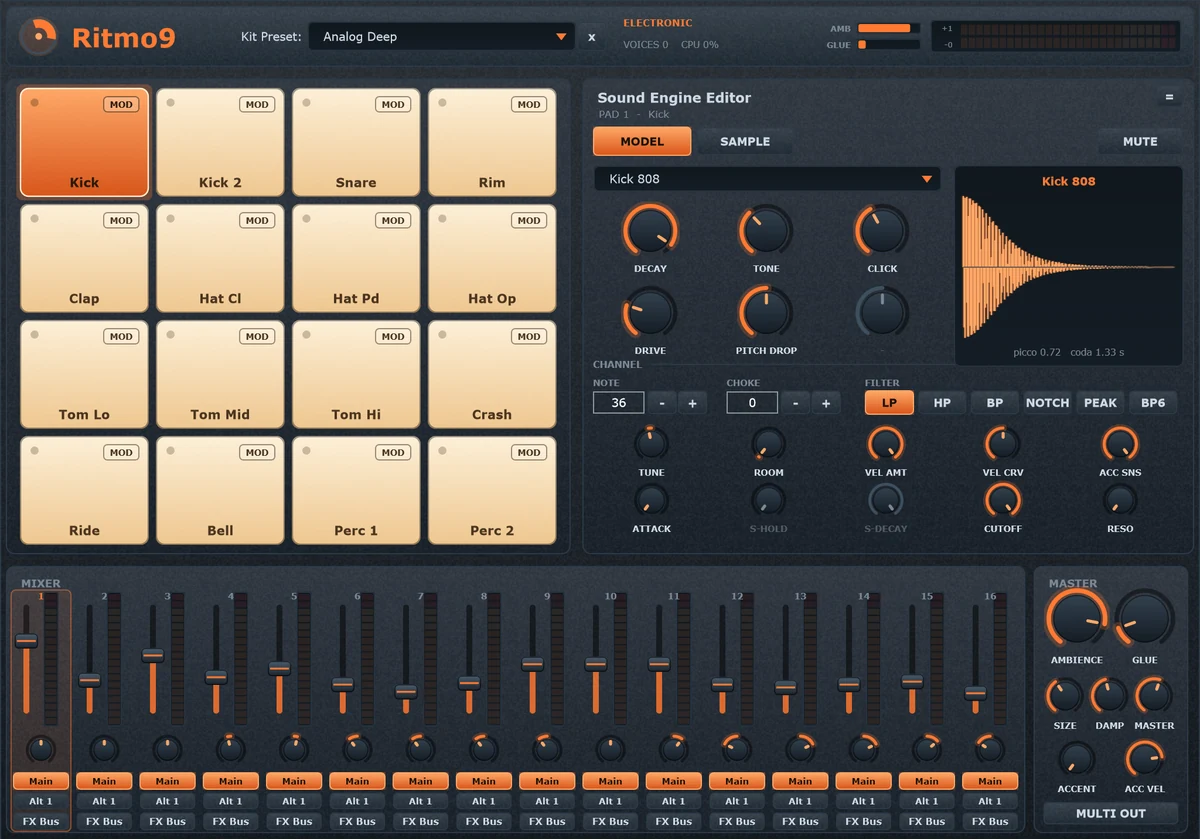
What it helped us see: the drum machine’s accent
The drum machine came out with a single difference: it had no global accent. “But it already has velocity!” It isn’t the same thing: velocity is per note and says how hard you played that one hit, while accent is a single amount that decides how much every marked hit leans in. With velocity alone, changing the accents of a pattern means rewriting note by note.
And we didn’t fix it with a plain volume fader. On the original machines the accent enters the trigger, the signal that starts the hit: an accented drum is not the same drum played louder, it has more attack and a longer tail. That is how we built it, for every drum model. Now a single control, ACCENT, changes the weight of every marked hit, and with the accent at zero the sound stays identical to before: we checked it sample by sample.
Why we like an honest score
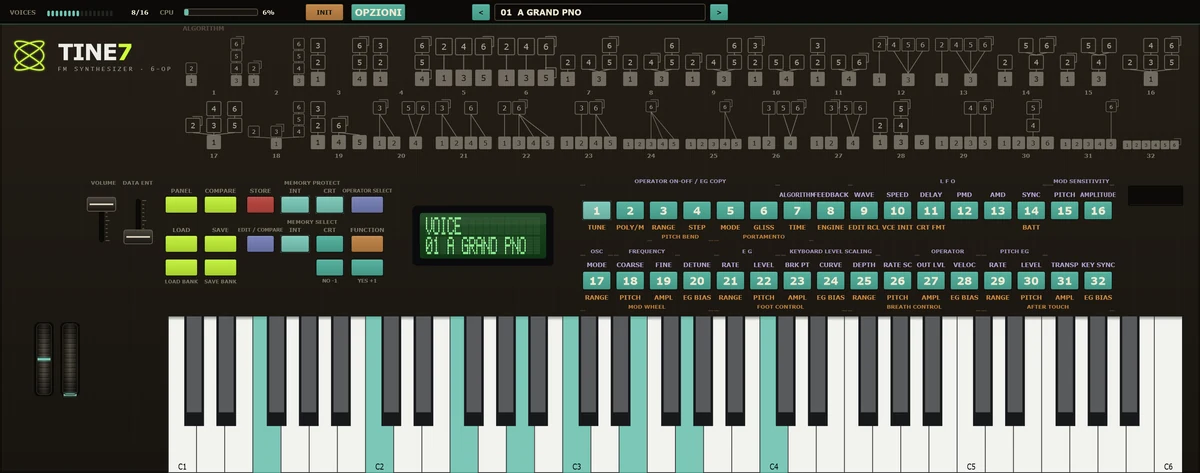
Across the catalogue, most items match the original, some go beyond it (the Tine7 has far more factory presets than the DX7 had), and some are different choices, each with its reason written beside it. Nothing is left unexplained.
A checker that only ever showed green would be decoration. This one can say “I don’t know”. It is the part we would keep if we had to throw the rest away.
A score you can’t contest is a score you can’t believe either.