Hybrid synthesizer
Typhon
Typhon
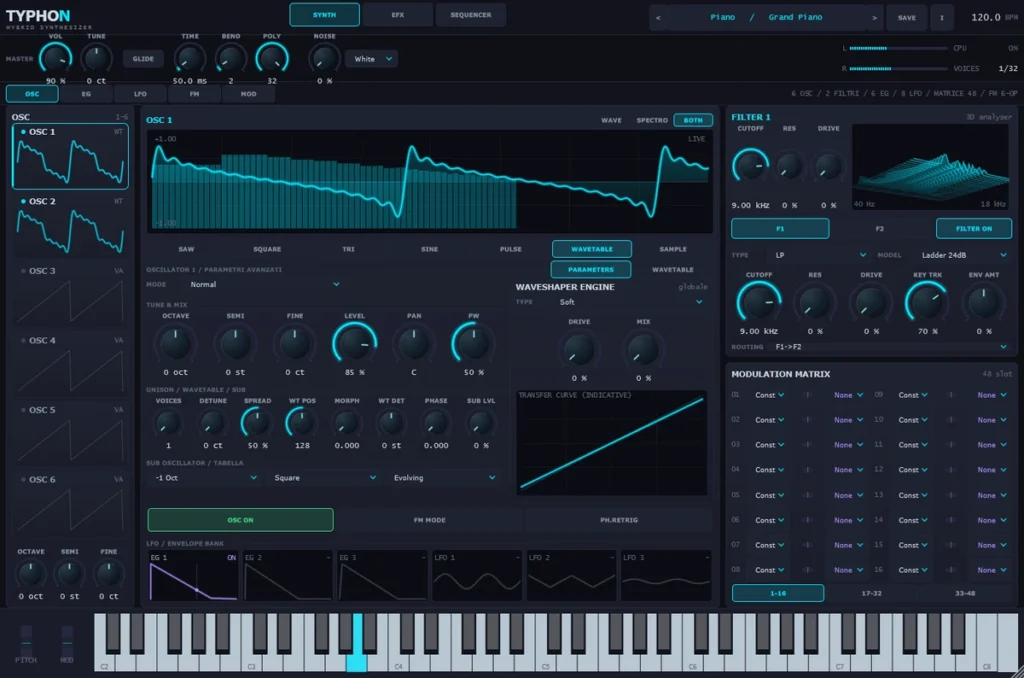
The largest instrument we make, and the one the engine was built for. Every oscillator can run virtual-analogue, wavetable or six-operator FM; the 13 effects sit in a chain you build yourself, and reorder while the note is still sounding.
v1.0.0


betadownload and try
Perpetual licence · 12 months of updates · full trial before you buy
In beta, and you try all of it
This is not a cut-down version: it is the complete instrument. We are asking you to use it and tell us what does not add up.
3 seconds at −18 dBFS · the clock restarts at every launch
v1.0.0
One licence covers both formats. 12 months of updates from purchase; the instrument keeps working afterwards.
Typhon is where the shared engine runs with nothing switched off.
The same filters, envelopes, oscillators and FM core appear across the catalogue. What you learn here transfers - and a correction made for one instrument arrives in all of them.
Three engines, six slots
None of the six is the main one
The six oscillator slots are identical. Each carries its own sub-oscillator, its own pan, and unison up to eight voices.
Virtual analogue
Saw, pulse, triangle and noise with true unison: detune and stereo spread set independently, up to eight voices per slot.
Wavetable
Twenty-five banks of 256 frames, band-limited by mip-map. Sweep the scan point with an envelope and the timbre transforms instead of stepping.
Six-operator FM
All forty-six algorithms, with four-level four-rate operator envelopes. It sits inside the same voice as the analogue path, not beside it.

Who it is for
Three ways of using the same instrument.
Typhon is large. That is a virtue for one kind of work and a cost for another, so it is worth saying plainly which is which.
Sound design
The reason for the 48-slot matrix. Anything can modulate anything, the 13 effects go in whatever order the sound asks for, and nothing has to be printed to be reused.
Production
120 presets in 12 categories, and 0.0236 ms of CPU per voice, so a heavy patch is a decision and not an accident.
Anyone with another of our instruments
The same filters, envelopes and FM core run underneath all of them. What you learn here you already know there.
Filters
Two sections, six models, five routings
Ladder and state-variable, two-pole and four-pole, each with its own way of breaking up when pushed. The two sections can run in series, in parallel, split across the stereo image, or one at a time.
- Series, parallel, stereo split, or either section alone
- Cutoff tracks the key, with its own amount per section
- Adaptive oversampling: the cost rises only when the sound asks for it

Sequencer and arpeggiator
Draw a curve first, decide what it moves afterwards
The sequencer is a polyphonic piano roll: every step holds a chord, not a single note, across 73 keys. Underneath it run eight modulation lanes you draw step by step - and each lane is a source in the modulation matrix, so you draw the shape first and choose what it controls later.
- Values are interpolated between steps, not stepped: a slow lane is a movement, not a series of jumps
- 8, 16, 32 or 64 steps at three resolutions; one number drives both the internal clock and the host conversion, so the same pattern runs at the same speed standalone and in the DAW
- Locks to the host transport and survives a jump in the timeline; releases held notes when the DAW stops
- Arpeggiator: six modes, swing and humanize continuous from 0 to 100 %, and a 16-step mode whose loop period can differ from the number of held keys - the accent moves on its own every cycle

Effects
You choose the order. While it plays.
13 effects, and not one of them has a fixed place. Pick the ones the sound needs, drag them into the order you want, and hear the difference straight away: an overdrive before the reverb is a different instrument from an overdrive after it. Nothing has to stop while you rearrange.
The thirteen
Sixty-two parameters, and no fixed order
Each effect carries its own bypass, its own mix and its own controls. What they do not carry is a position.
| Effect | Parameters | Effect | Parameters |
|---|---|---|---|
| Reverb | 4 | Granulator | 6 |
| Delay | 6 | Spectral | 4 |
| Chorus | 5 | Pitch shifter | 5 |
| Phaser | 5 | Bitcrusher | 4 |
| Flanger | 5 | Stutter | 4 |
| Distort | 5 | Resonator | 5 |
Any of the 13 joins or leaves the chain with one click; what you leave out costs nothing
Drag a slot to move it: the order you see is the order you hear
Reordering while audio runs is double-buffered and atomic: you rearrange while listening
The chain travels inside the project and inside user presets: the order comes back even if you never open the editor
How we know it still sounds right
Every build is compared against 2320 measurements
A synthesizer that changes its sound without being asked is a broken synthesizer. Before any release, the real processor renders all 121 factory presets plus 60 scenarios that isolate oscillators, filters, envelopes, LFOs, the matrix, FM, the waveshaper and each of the thirteen effects - and every measurement is compared with a versioned reference.
The audio path allocates nothing and locks nothing; the wavetable bank is built when the plugin is prepared, not at the first note. Under load the voice ceiling comes down above 80 % and recovers below 50 % - and notes already sounding are never cut short, they decay.


Specifications
Try it
Hear it before you decide.
The demo runs the full instrument with the factory bank. It stops making sound after twenty minutes; nothing else is held back.
Downloads
Try Typhon
Each download is the Windows installer, a single .msi file. It installs for all users, so Windows asks for administrator rights; under each release there is also the .exe installer, inside a ZIP.
Typhon
The largest instrument we make
The largest instrument we make, and the one the engine was built for. Every oscillator can run virtual-analogue, wavetable or six-operator FM; the 13 effects sit in a chain you build yourself, and reorder while the note is still sounding.
ikonabit-Typhon-1.0.0 beta
VST3Standalone
File names
- ikonabit-Typhon-1.0.0.msi