Obelyx8: eight voices, no two alike

Obelyx8 is an eight-voice polysynth in the spirit of the American machines of the early eighties. Every voice is modelled from its circuit, and we kept on purpose what a smooth digital synth would iron out: the eight voices are not copies of each other. Play the same chord twice and it does not come out quite the same.
Eight voices, each a little different
Each voice has its own volume, its own tiny tuning offset and its own random pitch wobble. Notes go to the voices in strict turns, 1, 2, 3 up to 8, and the count moves on even when the next voice is still sounding, so the ninth note takes over one that is still playing. Play a chord, let go, play it again: it usually lands on other voices, so it comes out a little different.
The noise source is shared by all eight voices. Play a chord with noise on and it piles up faster than it would with a separate noise for each voice.
Controls that move in small steps
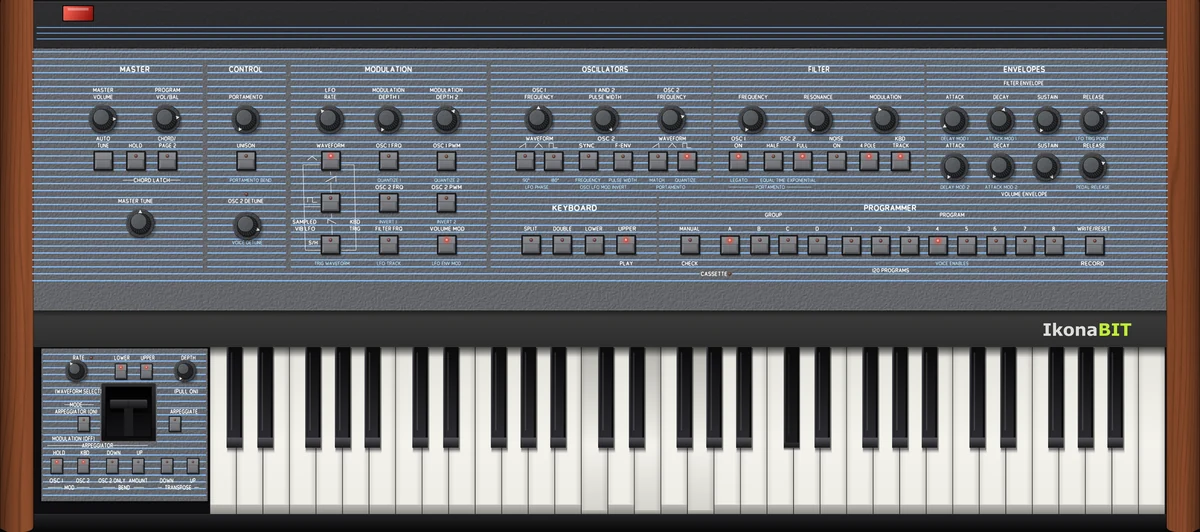
In Obelyx8 the controls do not glide smoothly: they update 100 times a second, and pitch moves in 192 steps to the octave, about 6 cents each. We modelled it that way on purpose, so slides and vibrato have a grain of their own. Portamento slides each note from the old pitch to the new one, from nothing up to 10 seconds, and has six variants you can combine: MATCH, QUANTIZE, BEND, LEGATO, EQUAL TIME and EXPONENTIAL. With keyboard tracking on, the filter follows the slide.
A mixer where every source touches the others
Each voice mixes seven sources: three waveforms from each of the two oscillators, plus noise. We model the mixer as a network of resistors, so the sources load one another. Switch on a second waveform and it does not simply add: it lowers the others a little. Turn oscillator 2 down with its HALF switch and oscillator 1 moves too. So several waveforms together do not sound like the sum of each one alone, and that is part of the sound.
Filter, envelopes, two modulation buses
The filter is a low-pass with four poles (24 dB per octave) or two poles (12 dB), and keyboard tracking can be switched on or off. Turn the resonance all the way up and the filter gets sharp, but it does not start to sing on its own. The two envelopes, one for the filter and one for volume, go from about a millisecond to more than ten seconds.
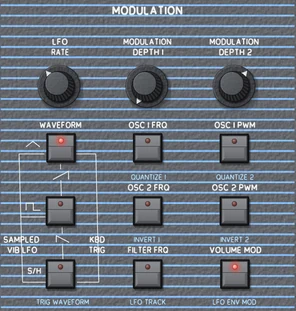
The LFO feeds two separate buses with three destinations each: pitch and filter on the first, pulse width and volume on the second. Each bus has its own depth, its own delay and attack up to 3.5 seconds, its own QUANTIZE, which turns the smooth sweep into steps, and its own INVERT. A second LFO, on the left-hand panel, is the vibrato you play with, and it only moves pitch.
Playing it
- CHORD turns a chord you hold into an instrument: every key replays it, moved by its distance from the lowest C.
- SPLIT gives the lower and upper halves of the keyboard a program each. DOUBLE puts two programs across the whole keyboard and shares the voices between them.
- Unison puts all eight voices on one note; HOLD keeps the notes down.
- An arpeggiator that gives each note a different voice, so the tail of one can carry on under the next. It runs at one fixed speed and does not follow the host tempo.
- A two-page panel: many knobs and keys have a second function on PAGE 2.
- 104 factory programs in a bank of 120 slots (16 are still empty), and WRITE stores your own over any of them.
VST3 and Standalone, 61 keys, one output on both channels. Play a chord, let go, play it again, and listen to what changed.
The instrument
