Compressor and dynamics
Zygos Lite
Zygos Lite
The VCA cell and the linear reference, with the full detector and its sidechain equaliser, iron on input and output, true-peak safety and auto-gain. What is gone is the multiband section, the physical chassis and the cell laboratory; what remains is the compressor you actually reach for.
v1.1.1

betadownload and try
In beta, and you try all of it
This is not a cut-down version: it is the complete instrument. We are asking you to use it and tell us what does not add up.
3 seconds at −18 dBFS · the clock restarts at every launch
v1.1.1
FREE forever: no purchase, no time limit. To unlock it you need an account: get your FREE licence there, enter your computer's machine code and you receive the licence file for that computer. Until then the plugin runs in demo mode, like every ikonaDSP plugin. Both formats included.
At the defaults, this is a bit-exact null too.
The signal comes out identical, sample by sample. A compressor that colours even at rest is not acceptable, and the exact null is the net that stops a colouration being introduced by inattention rather than by decision.
The cells
The transparent one, and the one you measure it against.
Two cells rather than six: the VCA, a log/antilog pair, and the linear reference, against which any colouration is visible.
VCA cell
The surgical one. Its non-idealities are modelled: tracking error between the two transistors, control feedthrough that depends on how fast the control moves, and a transconductance dip around zero whose distortion lives at low levels and vanishes on peaks.
Linear cell
The reference. Not a character, but the thing you compare a character to - and useful in its own right when the job is control rather than colour.
Same detector
Peak, true RMS and hybrid, with the full sidechain equaliser, exactly as in the full version.
Who it is for
For control, not for character.
Most compression in a mix is asked to hold something still. That does not need six physical models; it needs one good cell and an honest detector.
Buses and stems
The VCA cell with a real feedback topology, external sidechain, iron on input and output, and a null at the defaults you can verify by inverting.
Fast material
Oversampling up to 8x on the cell alone, with antiderivative anti-aliasing, so a hard transient does not fold back.
A way up
The parameters are the 130 of the full version with the same identifiers: a session built here opens there with everything in place.
The detector
3 detectors, and a real feedback loop.
Peak, true RMS and a hybrid, each preceded by a sidechain equaliser - with its bell turned up, the compressor becomes a de-esser - and both feedforward and feedback topologies, the feedback one a genuine loop rather than a softened curve pretending to be one.
- Peak, true RMS, hybrid, with a full sidechain equaliser
- Feedforward and feedback, the latter a real loop
- External sidechain input

What was left out
No crossover, no chassis, no laboratory. The iron stays.
Single band, so there is no crossover to choose. No power-supply sag or thermal state - the physical chassis belongs to the full version, and so does the cell laboratory. The transformers belong to the chain, not to the chassis, so they stay: iron on input and output, with core size and hysteresis, saturating on flux and therefore on the lows before the highs.

The panel
One band, six boxes, nothing that does not sound.
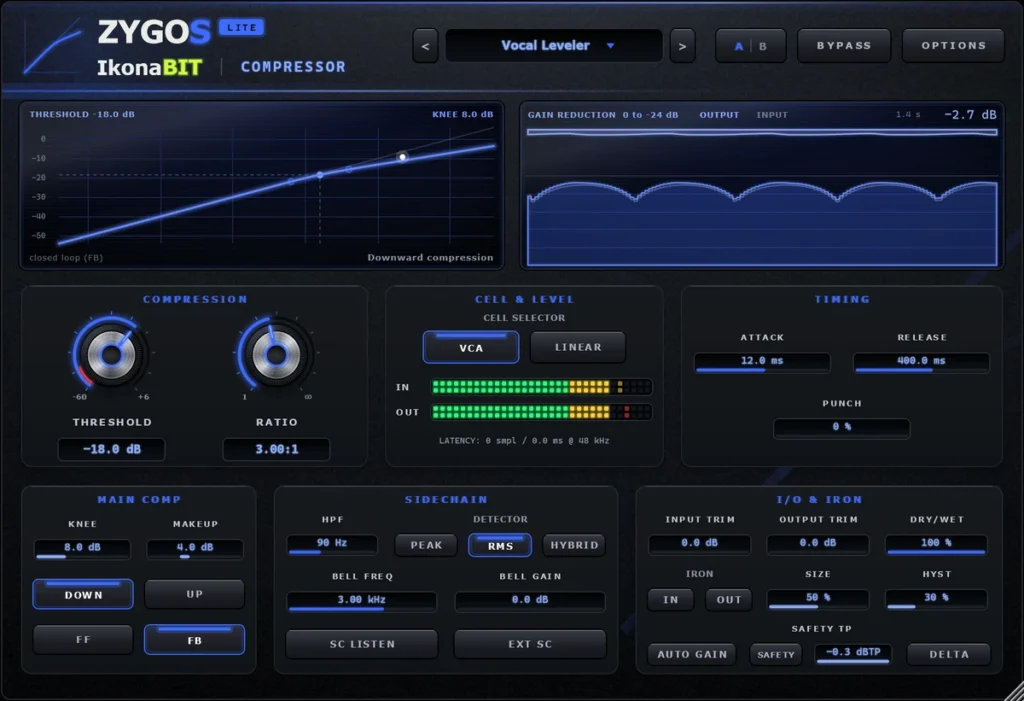
The top bar is the one shared by the whole line: presets with their arrows, A | B, BYPASS, OPTIONS - undo and redo are there too, from the keyboard. Under it the static curve, with threshold and knee written on it, beside a 1.4 s history of reduction, output and input. Then six titled boxes: COMPRESSION, CELL & LEVEL with the IN and OUT meters and the declared latency, TIMING, MAIN COMP, SIDECHAIN, and I/O & IRON. 27 parameters on the panel plus the bypass in the bar; what would be inert in this edition - bands, crossover, cell laboratory, chassis - is simply not shown.
- Exact bypass: the output is the delayed input, bit for bit, whatever the iron, the safety or the trims are doing
- A | B: two complete copies of the sound, saved with the session
- Undo and redo by gesture, 64 steps (Ctrl+Z / Ctrl+Y)
- Panel of 900 x 616, scalable from 50 to 200 %

What is measured
Zero latency at the defaults, and you pay only for lookahead.
Latency is zero samples at the factory values. The only thing that adds delay is the lookahead you ask for, up to 20 ms - 960 samples at 48 kHz - and it is declared exactly.
The anti-regression net covers 21 cases and is registered in the test runner. The parameter tree carries the 130 identifiers of the full version, so nothing has to be re-learned or re-automated on the way up.


Specifications
In short
The part of the compressor you use every day.
2 cells, 3 detectors, zero latency at the defaults, and a bit-exact null to prove it.
Downloads
Try Zygos Lite
Windows downloads are installers (.msi, or the .exe inside a ZIP); macOS downloads are .pkg installers.
Zygos Lite
Two cells, one band, no colouring at rest
The VCA cell and the linear reference, with the full detector and its sidechain equaliser, iron on input and output, true-peak safety and auto-gain. What is gone is the multiband section, the physical chassis and the cell laboratory; what remains is the compressor you actually reach for.
ikonabit-ZygosLite-1.1.2 beta
VST3Standalone
File names and previous versions (2)
- ikonabit-ZygosLite-1.1.2.msi
ikonabit-ZygosLite-1.1.0 beta
VST3AUStandalone
ikonabit-ZygosLite-1.0.0 beta
VST3AUStandalone