Valve saturator
Thermium
Thermium
Between the two stages sit the coupling capacitor and the Miller capacitance, as in the circuit. They are not decoration: they are what decides how the distortion changes with level.
v1.0.0

betadownload and try
Perpetual licence · 12 months of updates · full trial before you buy
In beta, and you try all of it
This is not a cut-down version: it is the complete instrument. We are asking you to use it and tell us what does not add up.
3 seconds at −18 dBFS · the clock restarts at every launch
v1.0.0
One licence covers both formats. 12 months of updates from purchase; the plugin keeps working afterwards.
Raising the drive changes the tone, not the level.
Every stage is normalised: a full-scale signal comes out full-scale at any drive. The A/B stays honest instead of being the usual louder-sounds-better illusion.
The chain
The second stage distorts an already distorted signal.
A single waveshaper produces almost nothing but the third harmonic: that is the sound of a formula. A cascade gives a full spectrum instead, and the proportions were not placed by hand - they follow from the topology.
Even harmonics
Both stages are biased off centre on the same side: single-ended. The evens add instead of cancelling, and at full drive the second measures -7,5 dB, the fourth -11,3 dB.
The capacitor sounds
The 12 Hz coupling high-pass removes the DC that the first stage asymmetry generates. Without it, the second triode's operating point would move with signal level.
Miller comes down
The Miller capacitance sits at 40 kHz at rest - out of band, no colour - and falls to 12 kHz at full drive. The highs warm up when the preamp works, not always.
Where it earns its place
From barely-there body to destruction.
The DRIVE control has fine travel on the low values (skew 0,35): most of the sweep serves the region where the character is born, not the one where everything is already broken.
On the bus
In parallel through MIX: the dry keeps the transient, the wet keeps the body. And the two sum in phase, not as a comb.
On vocals
In the first octave of the control you hear body before you hear distortion.
On drums
At 8x the alias sits -74,6 dB down: you can push without the cymbals turning to glass.
The panel
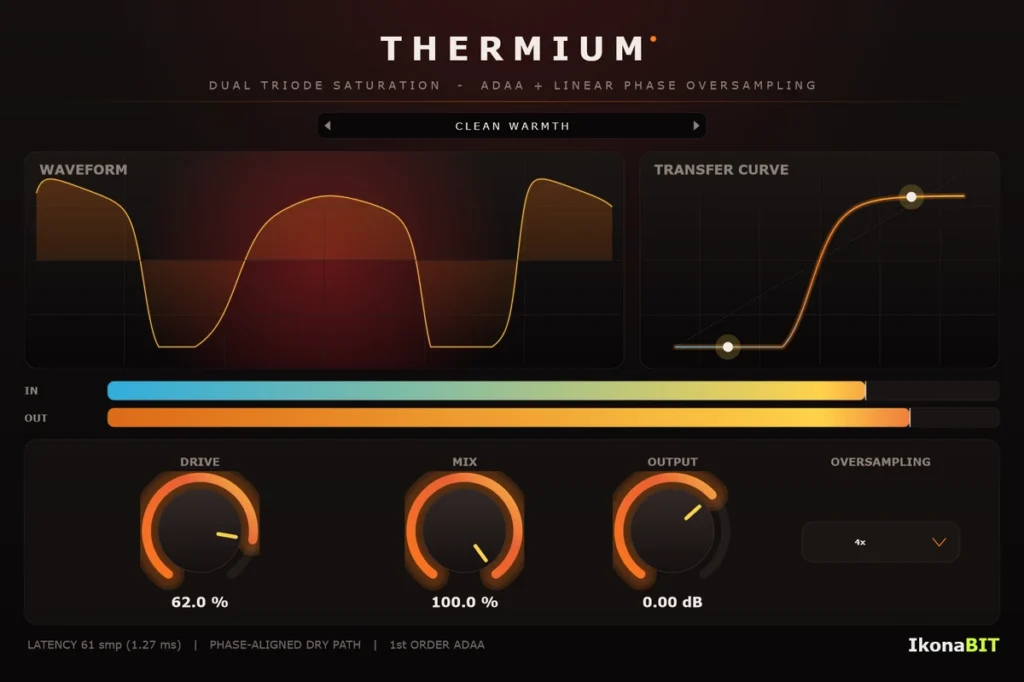
The curve you see is the function that is playing.
The right-hand display is not a drawing that resembles the curve: it calls the engine's own function. The two operating points run along it at the input peak, so you see WHERE the signal is working, not just what the curve looks like.
- Output oscilloscope on the left, transfer curve on the right
- The backdrop lights up on MEASURED heat: with a silent input it stays dark even at full drive
- Input and output meters with peak hold
The controls
4 controls, and the travel of one of them is a decision.
DRIVE is not linear: skew 0,35, meaning half the sweep reads 13.8 per cent. Most of the travel serves the low region, where the valve character is born and where a tenth of a point is audible - and it applies to host automation too, not just the mouse. Then phase-coherent MIX, OUTPUT from -24 to +12 dB and the oversampling choice, all smoothed per sample: no steps during automation.
Measured
Anti-aliased twice, with the dry path sample-aligned.
Oversampling up to 8x with linear-phase filters, plus antiderivative antialiasing (ADAA) on both stages: ADAA removes the alias born between one sample and the next, which oversampling alone does not see.
The nets run on the real processor, not on a copy of the curve: a test that repeats the code proves nothing. And the GUI snapshot measures itself - if the brand signature is not where it belongs, it turns red.
Specifications
In short
A preamplifier, measured.
4 controls, 30 presets, 61 samples of latency at 4x. At the centre of the panel the real transfer curve - the same function that is playing - and a backdrop that lights up on measured heat: with a silent input it stays dark even at full drive.
Downloads
Try Thermium
Each download is the Windows installer, a single .msi file. It installs for all users, so Windows asks for administrator rights; under each release there is also the .exe installer, inside a ZIP.
Thermium
Two triodes, not a curve
Between the two stages sit the coupling capacitor and the Miller capacitance, as in the circuit. They are not decoration: they are what decides how the distortion changes with level.
ikonabit-Thermium-1.0.0 beta
VST3Standalone
File names
- ikonabit-Thermium-1.0.0.msi