Multi-voice chorus
Plethos
Plethos
A linear multi-voice chorus: no saturation, no noise floor, and silence in is exact zeros out. Every voice reads one shared delay line with its own LFO, its own drift and its own place in the stereo field, and WIDTH acts only on the sides of the processed signal, so the mono sum does not change when you open the image.
v1.0.0

betadownload and try
Perpetual licence · 12 months of updates · full trial before you buy
In beta, and you try all of it
This is not a cut-down version: it is the complete instrument. We are asking you to use it and tell us what does not add up.
3 seconds at −18 dBFS · the clock restarts at every launch
v1.0.0
Every licence covers both formats. Until a licence file is activated the plugin runs in trial: the first 10 minutes of each session are clean, then a 3-second noise burst at -18 dBFS every 3 minutes, and offline renders are degraded.
Open it to 200 % and the mono sum does not move.
WIDTH multiplies only the sides of the wet signal, and the sides cancel in a mono sum by definition. Measured sample by sample, the mono sum at widths of 0, 100 and 200 % differs by at most 3 × 10⁻⁸.
How it is built
One delay line, several voices that never line up.
The sound comes from how the voices are fed and how they are moved, not from a coloured signal path.
One shared delay line
The input is reduced to a single source, the average of left and right, and written once. The voices read it at different delays, so no voice puts into one channel something that is missing from the other, and the dry signal stays stereo and untouched.
Voices that do not align
Each voice has its own sine LFO. The speeds are in ratios that are not multiples of each other, the phases are staggered, and a slow random drift is added per voice. Over 60 s with 8 voices, the correlation between the LFOs of any pair stays within 0.157.
Sinc readout
Delays are read with a 32-point sinc interpolator rather than a linear one, so moving the read point does not bring in the roll-off and distortion that linear interpolation adds. On a 110 Hz tone modulated to the maximum, content above 4 kHz stays below -88 dB in the worst case.
Who it is for
For widening, not for colour.
A chorus is usually asked to make something bigger. The measure of a good one is what is left when the listener folds it to mono.
Pads and strings
Slow, dark wet signal and wide fields. The factory bank of 20 presets is grouped by use, with a set for pads and strings.
Guitars, keys and voices
From 2 to 8 voices on a base delay of 6–30 ms, with a high-pass and a low-pass filter on the wet signal only, so the dry signal stays full.
Anything that has to survive mono
MONO CHECK plays the mono sum without changing the bus, and a correlation and width meter is always on screen.
Plethos and Plethos Lite
What the full edition has that the Lite does not.
Both share the chorus, the width law, the meters and the parameter identifiers, and both have zero latency. This is what only Plethos carries.
| Plethos | Plethos Lite | |
|---|---|---|
| Voices | 2 to 8 | 4, fixed |
| Controls | Rate, depth, drift, delay, voices, width, low cut, high cut, mix, output | Rate, depth, width, mix |
| Tempo sync | 15 divisions, from 8/1 to 1/32, dotted and triplets included | Not included |
| Mono check | Plays the mono sum without changing the bus | Not included; the correlation meter is |
| Filters on the wet signal | High-pass 20 Hz to 1 kHz, low-pass 1 to 20 kHz | Fixed at 80 Hz and 12 kHz |
| Voice modulation display | LFO curve of every voice, or correlation over time | Not included |
| Presets | 20 | 8 |
| Panel | 1500 × 860 | 1200 × 580 |
| Licence | In trial until a licence file is activated | FREE, licence from your account |
The voices
Up to 8 voices, drawn from the real chorus.
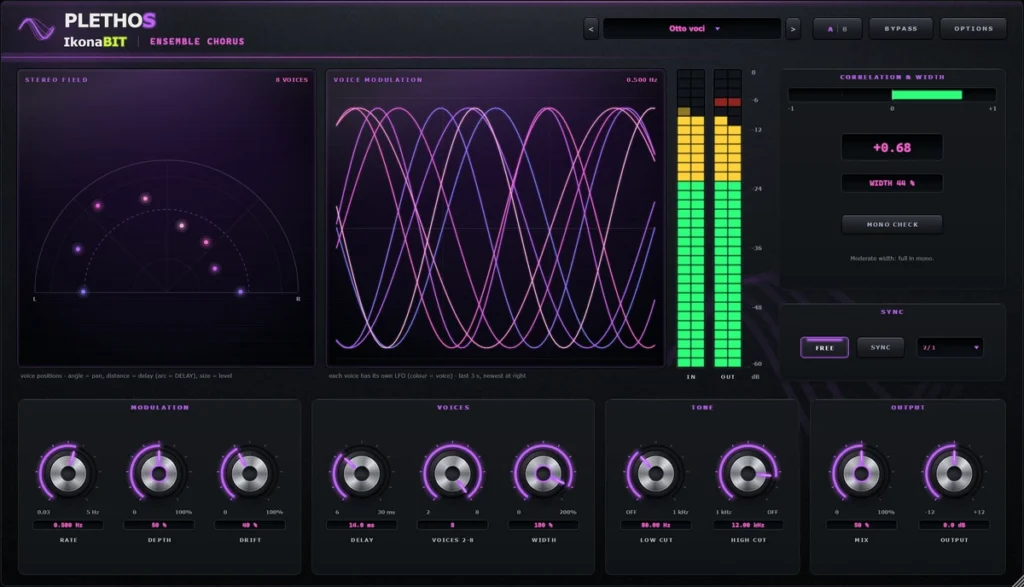
The stereo field shows one point for every active voice: the angle is its position, the distance is the delay it is reading right now relative to DELAY, and the size is its level. Beside it, the LFO curve of every voice over the last 3 s, one colour per voice. Both are drawn from the data of the running chorus, not from an animation.
- 2 to 8 voices, each at gain 1/sqrt(N): the wet level stays within 0.5 dB between 2 and 8 voices
- Positions alternate left and right; the first two always sit at the extremes
- Constant-power pan law for every voice

Width and the mono sum
WIDTH moves the sides. The mono sum is made of the middle.
The wet signal splits into a centre and sides. WIDTH multiplies only the sides: 0 % brings the voices to the centre, 100 % leaves them as they are, 200 % doubles the sides. In a mono sum the sides cancel, so what remains is the centre, which WIDTH does not touch. What does move in mono is the dry signal interfering with the voices, as in any chorus: at the defaults the mono sum sits 0.33 dB below stereo, and across the 20 factory presets the worst loss is -1.68 dB.

The panel
Ten knobs in four boxes, and a meter that is always there.
The top bar is the one shared by the whole line: presets with their arrows, A | B, BYPASS, OPTIONS. Under the displays, four titled boxes: MODULATION (rate, depth, drift), VOICES (delay, voice count, width), TONE (low cut, high cut) and OUTPUT (mix, output). RATE does double duty: hertz when SYNC is off, a note division when it is on. The picture shows the first two boxes.
- A | B: two complete copies of the sound, saved with the session
- Tempo sync on 15 divisions; the phase comes from the host position, so two offline renders are identical bit for bit
- Linear mix with no level compensation: at the default setting each channel leaves about 3.3 dB below the input, and OUTPUT (plus or minus 12 dB) brings it back
- Panel of 1500 × 860, scalable from 50 to 200 %

What is measured
Zero latency, linear, and measured under automation.
Latency is zero samples, declared once and unchanged in bypass and at every setting. Parameter moves leave no clicks: with voice count, width, rate and sync moved continuously, the worst content above 4 kHz in any 10 ms window is -69.6 dB.
The 14 parameters are the twelve of the sound plus MONO CHECK and bypass, and all of them can be automated. The output is identical bit for bit at every block size from 1 to 8192 samples, at 44.1, 48, 96 and 192 kHz, and nothing is allocated or locked in the audio path.
Specifications
In short
A chorus you can open all the way.
2 to 8 voices, 0–200 % of width, zero latency, and a mono sum that does not move with the width.
Downloads
Try Plethos
Each download is the Windows installer, a single .msi file. It installs for all users, so Windows asks for administrator rights; under each release there is also the .exe installer, inside a ZIP.
Plethos
Widen it without thinning it out
A linear multi-voice chorus: no saturation, no noise floor, and silence in is exact zeros out. Every voice reads one shared delay line with its own LFO, its own drift and its own place in the stereo field, and WIDTH acts only on the sides of the processed signal, so the mono sum does not change when you open the image.
ikonabit-Plethos-1.0.0 beta
VST3Standalone
File names
- ikonabit-Plethos-1.0.0.msi