Chorus
Plethos Lite
Plethos Lite
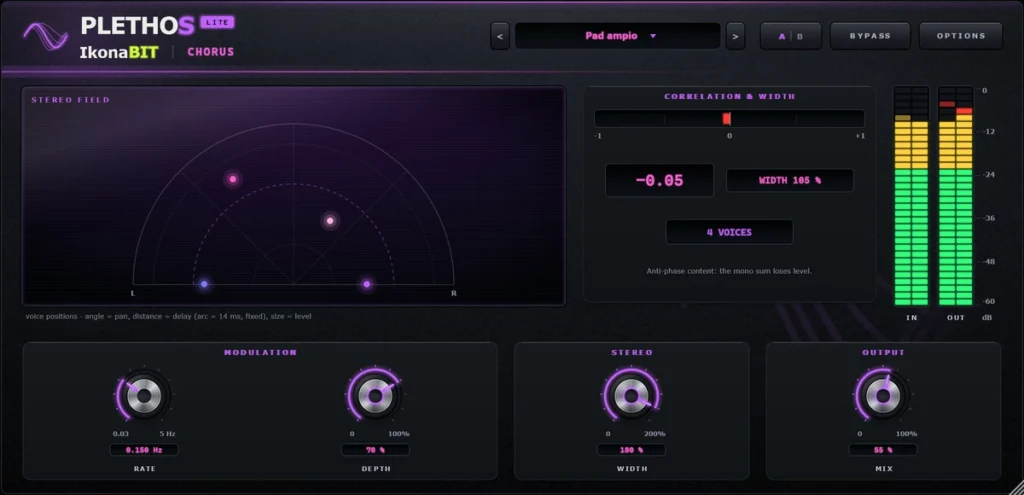
The chorus of Plethos with the decisions already made: four voices reading one shared delay line, each with its own LFO and drift, and RATE, DEPTH, WIDTH and MIX on the panel. It is linear, with no saturation and no noise floor, and WIDTH acts only on the sides of the processed signal, so opening the image does not thin the sound for whoever listens in mono.
v1.0.1

FREE
v1.0.1
FREE forever: no purchase, no time limit. To unlock it you need an account: get your FREE licence there, enter your computer's machine code and you receive the licence file for that computer. Until then the plugin runs in demo mode, like every ikonaDSP plugin. Both formats included.
Open it to 200 % and the mono sum does not move here either.
The widening law is the one of the full edition: WIDTH multiplies only the sides of the wet signal, and the sides cancel in a mono sum. Measured sample by sample, the mono sum at widths of 0, 1 and 2 differs by at most 3 × 10⁻⁸.
What it keeps
The same chorus, with less to decide.
The reduction is in capabilities, not in quality: what is left out are the controls that ask you to know what you are doing.
One shared delay line
The input is reduced to the average of left and right and written once. The voices read it at different delays, so the dry signal stays stereo and untouched and the mono sum does not depend on where the voices sit.
Sinc readout
Delays are read with a 32-point sinc interpolator rather than a linear one, as in the full edition.
Always in view
The stereo field, the IN and OUT meters and the correlation and width meter are on the panel at all times, in a compact form.
Who it is for
For widening in one move.
Four knobs are enough when the question is how wide and how much, not how many voices or how long a delay.
Quick widening
WIDTH from 0 to 200 % and MIX decide how much of the effect you hear; the voices, the delay and the filters are already set.
Mono-safe mixes
The correlation and width meter reads the output and tells you whether the sound would hold in mono. There is no MONO CHECK button in this edition.
A way up
The saved state uses the same identifiers as Plethos, so a session opens in both editions.
What Plethos adds
The same chorus, with the decisions left open.
Plethos shares this edition's chorus, its width law, its meters and its parameter identifiers, and adds the following. Both have zero latency.
2 to 8 voices
Instead of 4 fixed, with the count free to change while you play.
Tempo sync
15 divisions from 8/1 to 1/32, with the phase taken from the host position.
Drift, delay and filters
Drift, a base delay of 6–30 ms and the two filters on the wet signal, which this edition fixes at 30 %, 14 ms, 80 Hz and 12 kHz.
Output and MONO CHECK
A control of plus or minus 12 dB to bring back the level the linear mix takes away, and a button that plays the mono sum.
Voice modulation display
The LFO curve of every voice, or the correlation over time.
Sessions move across
A Lite session opens in Plethos with 6 voices until VOICES is set to 4.
The voices
Four voices, placed for you.
Four voices read one shared delay line at base delays of 14.0 / 11.6 / 16.4 / 10.4 ms, placed alternately left and right with a constant-power law, each at gain 1/sqrt(4) and with 30 % of drift. The stereo field shows them: the angle is the position, the distance is the delay being read right now against the fixed 14 ms (the dashed arc), the size is the level.
- RATE: voice 1 runs at exactly the set speed, the others at 0.89–1.26 times that speed, with the phases staggered by a quarter
- DEPTH moves the delay of each voice by at most plus or minus 4 ms
- Rate from 0.03–5 Hz, always in hertz

Correlation and width
WIDTH opens the field. It does not touch the mono sum.
WIDTH from 0–200 %: 0 brings the voices to the centre, 100 leaves them as they are, 200 doubles the sides. The sides cancel in a mono sum, so the mono sum does not change with the width. The meter reads the output after the bypass: the correlation from -1 to +1, the measured width from 0 to 300 %, and a status line that says what it is reading. It is the meter, not a button, that tells you whether a sound would hold in mono.

What is measured
Zero latency, and no control that does nothing.
The panel has exactly four knobs and nothing the Lite ignores, and the host is offered only the 5 parameters that act: rate, depth, width, mix and bypass. Latency is zero samples, also in bypass.
The 9 parameters this edition does not use stay in the saved state with the same identifiers, so a session opens in both editions; they are not offered to the host. With all of them at extreme values the output is identical bit for bit to the factory values. MIX is linear with no level compensation, as in Plethos, and this edition has no OUTPUT control to bring the level back.
Specifications
In short
The widening, without the studying.
4 voices, 4 controls, zero latency, and a mono sum that does not move with the width. That is the FREE edition.
Downloads
Try Plethos Lite
Windows downloads are installers (.msi, or the .exe inside a ZIP); macOS downloads are .pkg installers.
Plethos Lite
Four voices, four controls, the same mono sum
The chorus of Plethos with the decisions already made: four voices reading one shared delay line, each with its own LFO and drift, and RATE, DEPTH, WIDTH and MIX on the panel. It is linear, with no saturation and no noise floor, and WIDTH acts only on the sides of the processed signal, so opening the image does not thin the sound for whoever listens in mono.
ikonabit-PlethosLite-1.0.2 beta
VST3Standalone
ikonabit-PlethosLite-1.0.0
VST3Standalone
File names
- ikonabit-PlethosLite-1.0.2.msi