Hybrid acoustic grand piano
Orfeo88
Orfeo88
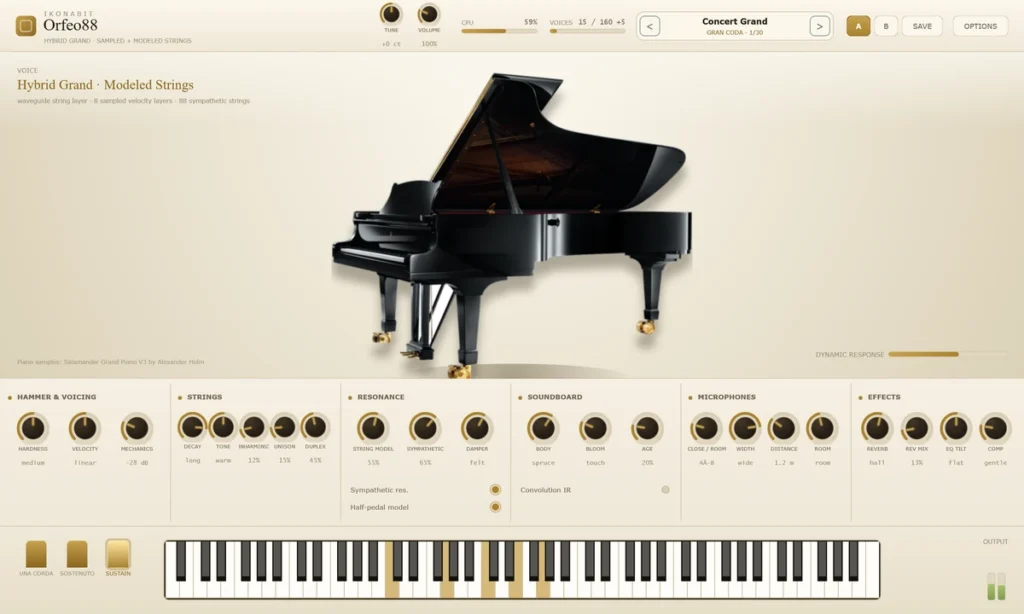
A multisample layer of 8 velocity strata in crossfade, and a physical layer of waveguides with dispersion, felt hammers and strings coupled to the bridge. String Model blends them, and it blends nothing when you leave it down.
VST3 + Standalone v1.0.0 Windows 64-bit

Coming soon
Not in the shop yet.
VST3 + Standalone v1.0.0 Windows 64-bit
One licence covers both formats. 12 months of updates from purchase; the instrument keeps working afterwards.
88 resonators, driven by the audio of the samples themselves.
Sympathetic resonance is not a reverb applied afterwards: it is a bank of resonators, one per key, excited by what is actually sounding. Hold the pedal and the strings you did not play answer the ones you did - which is the sound a real instrument makes and a sample library cannot.
The two layers
Samples for the attack, a model for what happens next.
The two layers are not alternatives with a crossfade between them. They are the two halves of the same note: recorded material where recording is best, and a model where a model is best.
Sample layer
8 velocity strata in crossfade over a pool of 160 voices. The attack of a piano is a mechanical event, and a recording of it is more honest than a simulation.
Physical layer
Waveguides with dispersion and inharmonicity, a non-linear felt hammer, strings coupled to the bridge - up to 24 voices. This is where sustain, coupling and duplex scaling come from.
One dial
String Model sets the balance. At zero the physical engine is not computed at all: you pay for it only when you use it.
Listen
Two demos, two factory presets.
Rendered offline by the plugin itself. Own transcriptions of public-domain works.
Who it is for
For playing, not for placing a piano in a track.
If a piano only needs to sit in a mix, a library will do. This is for when the instrument is what you are listening to.
Pianists
Sustain with continuous half-pedal, sostenuto and a continuous una corda - the three pedals of a grand, behaving as they do on the instrument.
Recording
Close and room microphones, a modal soundboard, tilt equaliser, compressor and reverb - the chain that turns an instrument into a recording of one.
Live playing
Zero latency, even with the body impulse response engaged. A piano that answers late is not a piano.
The strings
Dispersion, inharmonicity, and coupling to the bridge.
A real string is not an ideal one: its partials are slightly sharp of the harmonic series, and the amount depends on the string. The waveguide carries that dispersion, and the strings are coupled through the bridge, which is where the beating of a unison comes from.
- Decay, tone, inharmonicity, unison and duplex, all as controls
- A non-linear felt hammer: the harder the blow, the harder the felt
- Coupling through the bridge, so a unison beats rather than being detuned by hand

Resonance
88 resonators, one per key.
The sympathetic bank is excited by the audio actually being produced, and with the pedal down real recorded string resonances join it. Damper behaviour is continuous, so a half-pedal is genuinely half.
- 88 resonators driven by the sample audio
- Internal sympathy inside the physical model as well
- Continuous damper: the half-pedal is a position, not a switch

The recording chain
Soundboard, microphones, and the rest of the room.
A modal soundboard, then close and room microphones with distance and width, then a tilt equaliser, a compressor and a reverb. The instrument and the recording of it are separate stages, which is why changing the microphone position does not change how the piano plays.

What is measured
Zero samples of latency, with the body engaged.
Including the convolution of the body: the impulse response is applied without adding delay, because a piano that answers late is not an instrument you can play.
All 30 parameters are reachable from the panel - there is no page behind the page. On an instrument whose job is to be played rather than programmed, a control you have to go looking for is a control you will not use.


Specifications
Play it
Made to be played, not programmed.
30 factory presets and one panel with every control in reach.
Downloads
Try Orfeo88
Orfeo88
Samples and a model, on one control
A multisample layer of 8 velocity strata in crossfade, and a physical layer of waveguides with dispersion, felt hammers and strings coupled to the bridge. String Model blends them, and it blends nothing when you leave it down.
No release for this instrument yet.