Dynamic parametric equaliser
Fabula EQ
Fabula EQ
Stereo, mid-side or left-right per node. A node can be a static bell, a dynamic shelf that only moves when the band is loud, or a 96 dB/oct cut that exists only on the side channel - and the three choices are independent.
v1.0.0


betadownload and try
Perpetual licence · 12 months of updates · full trial before you buy
In beta, and you try all of it
This is not a cut-down version: it is the complete instrument. We are asking you to use it and tell us what does not add up.
3 seconds at −18 dBFS · the clock restarts at every launch
v1.0.0
One licence covers both formats. 12 months of updates from purchase; the plugin keeps working afterwards.
A node that is off costs zero.
It shuts down after the fade and passes through no loop at all. That is why all 24 nodes are declared from the start and there is no 'add band' button that allocates something: nothing is allocated, because nothing that is off is computed.
The structure
Trapezoidal state-variable filters, no delayed samples.
Two integrators per section, zero-delay topology. Not a biquad in direct form: the coefficients can move while the audio runs without the filter blowing up.
8 filter types
Bell, low shelf, high shelf, low pass, high pass, notch, band pass and tilt - each available at any of the 5 slopes.
5 slopes
6, 12, 24, 48 and 96 dB/oct, built from one, one, two, four and eight state-variable sections. The steepest ones are cascades of real filters, not a curve drawn to look steep.
Decrampled response
The response is analog-matched at the top of the spectrum instead of being squeezed towards Nyquist, and it is minimum-phase. The classic bilinear response is selectable when you want the comparison.
Who it is for
For the problems a static equaliser cannot solve.
A resonance that only appears when the singer pushes is not an equalisation problem. It is a dynamics problem that happens to live at one frequency.
Mixing
Per-node dynamics with 3 detectors and a window from 0.5 ms to 400 ms: the node moves when the band moves, and stays put otherwise.
Mastering
Zero latency in natural phase, linear phase when it is worth its delay, and mid-side per node so the centre and the sides can be treated differently.
Repair
A 96 dB/oct high-pass on one node, a notch on another, and a dynamic bell on a third - all in one instance, without stacking three plugins.
The dynamics
3 detectors, and three sources to listen to.
Peak, true RMS or a hybrid, with a window from 0.5 ms to 400 ms. The detector can listen to the band the node is working on, to the full band, or to an external sidechain - which is what turns a node into a de-esser, a ducker or a resonance tamer without changing plugin.
- Detector source: band focus, full band, or external sidechain
- Window from 0.5 ms to 400 ms
- Stereo, mid-side or left-right, chosen per node

Phase
Natural at zero latency, or linear when it earns its delay.
Natural mode is minimum-phase and adds no latency at all. Linear mode uses a finite-impulse-response filter of 1024, 4096 or 16384 taps, and the price is stated exactly: 21.3 / 85.3 / 341.3 ms at 48 kHz. The choice is a trade, and a trade is only honest when both sides are on the table.

What is measured
2346 checks over 46 presets - and a proof that the net can turn red.
The anti-regression net renders the factory presets and runs 2346 individual checks against a versioned reference. It also carries a deliberate-fault test: a net that has never failed has not been shown to work.
The parameter tree holds 453 entries but only 45 are automatable: 13 global controls plus 8 reassignable slots of 4. Exposing 453 parameters to a host would make the automation list unusable, and a list nobody can navigate is the same as no list at all.

Specifications
In short
An equaliser that moves only when it should.
24 nodes, 8 types, 5 slopes, dynamics on every one of them - and nothing computed for the nodes you are not using.
Downloads
Try Fabula EQ
Each download is the Windows installer, a single .msi file. It installs for all users, so Windows asks for administrator rights; under each release there is also the .exe installer, inside a ZIP.
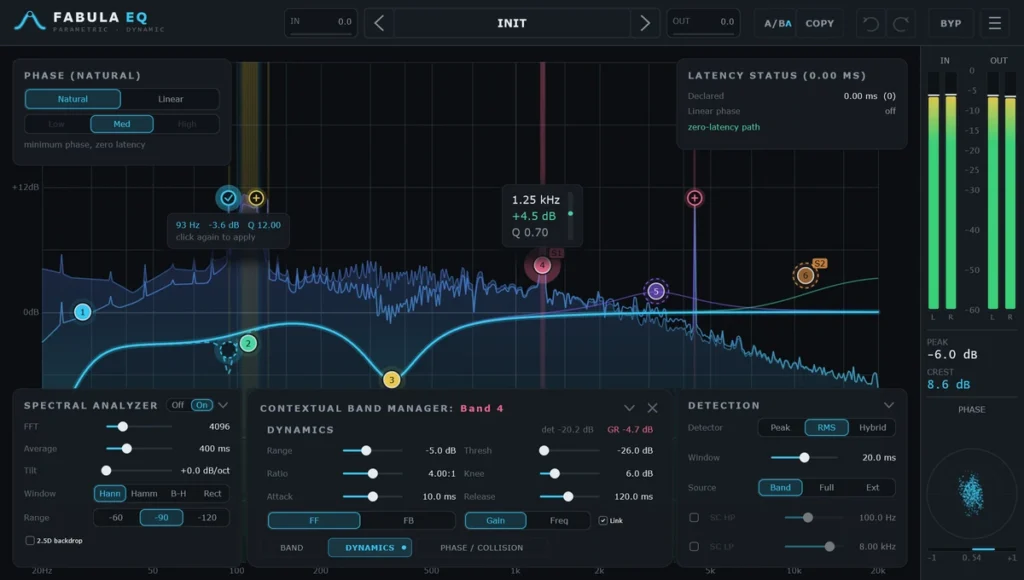
Fabula EQ
Every node has its own dynamics
Stereo, mid-side or left-right per node. A node can be a static bell, a dynamic shelf that only moves when the band is loud, or a 96 dB/oct cut that exists only on the side channel - and the three choices are independent.
ikonabit-FabulaEQ-1.0.0 beta
VST3Standalone
File names
- ikonabit-FabulaEQ-1.0.0.msi