Laddy79: the amplifier that opens late

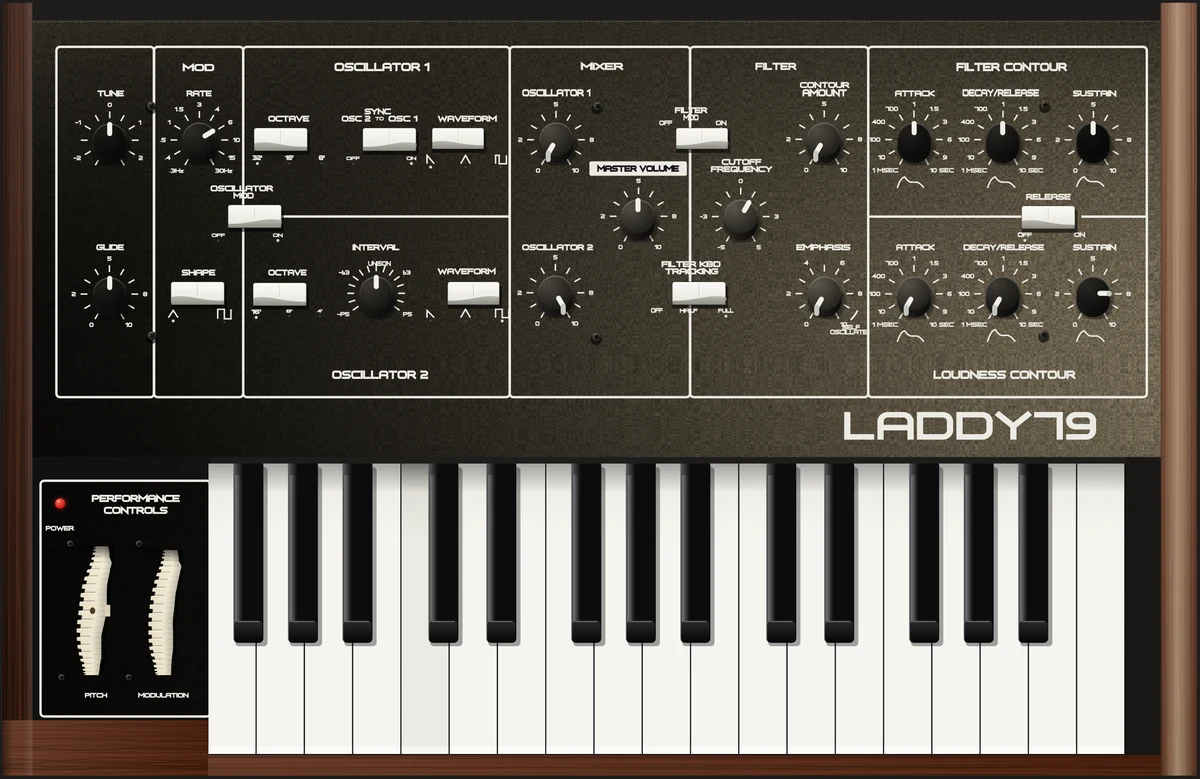
Laddy79 is a two-oscillator monosynth in the spirit of the late seventies, modelled piece by piece on the laws of its own circuit. One voice, and a handful of behaviours you notice within the first minute.
The amplifier opens late
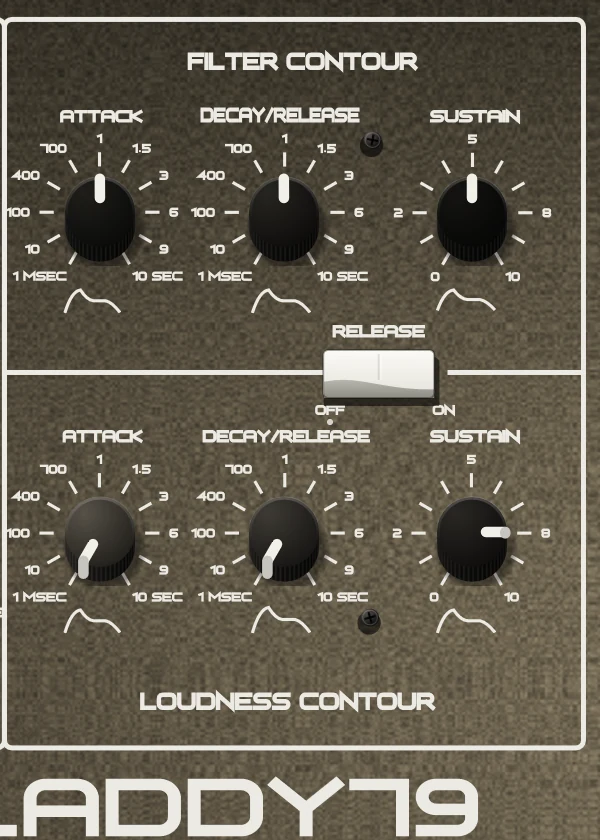
With a slow ATTACK the volume does not rise in a straight line: the amplifier stays almost shut until the control reaches the threshold of its transistor, then opens gradually. So the first little stretch of a slow attack is almost silent. Try a slow ATTACK on the loudness contour (the envelope) and listen to how the note starts.
Envelopes that pick up where they are
The two contours, one for the filter and one for the volume, are not lines drawn between points: each one fills and empties like the capacitor in a real circuit. The times, from 1 ms to 10 s, are printed on the panel. Strike a note before the last has finished and the new attack starts from wherever the contour is, not from zero, so the contour does not jump.
Two oscillators, one sync
Both oscillators offer saw, triangle and pulse, and the pulse width does not change: narrow, 10 %, on oscillator 1 and square, 50 %, on oscillator 2. OSCILLATOR 1 runs 32′, 16′ or 8′, OSCILLATOR 2 runs 16′, 8′ or 4′ (the bigger the number, the lower the sound), and INTERVAL tunes the second against the first, with UNISON at the centre. Switch SYNC on and the PITCH wheel goes only to the second oscillator: that is how you get the sync sound that sweeps under your hand.
A filter that sings
The filter is a four-pole transistor ladder, low-pass only: it lets the lows through and takes the highs away, and EMPHASIS, the resonance, makes it sing. EMPHASIS does most of its work in the upper half of the knob and, near the top, where the panel prints SELF OSCILLATE, the filter rings by itself. KBD TRACKING has three positions, OFF, HALF and FULL, and at FULL the cutoff follows the keyboard octave for octave.
Keyboard and glide
Hold several keys and the lowest one sounds. The contours restart only when you press a key on an empty keyboard, so play legato and the attack does not fire again. GLIDE, the slide from one note to the next, changes character along the keyboard: in the lower half the pitch climbs faster than it falls, in the upper half it is the other way round. The panel has 32 keys, F3 to C6; outside them the instrument carries on in exact octaves, so any MIDI keyboard can play it. The LFO runs from 0.26 to 30.1 Hz, triangle or square.
Around the sound
- 24 programs, picked from the top bar or from your host, each with its wheel positions.
- AUDIO IN sends an outside sound into the mixer, ahead of the filter, so anything can run through it. It is off at start-up.
- The computer keyboard plays the instrument, and the window resizes from 50 % to 200 %.
VST3 and Standalone on Windows. Try it now: load a program, set a slow ATTACK, hold one key and hear how the amplifier opens.