Polyphonic synthesizer - 8 voices
Obelyx8
Obelyx8
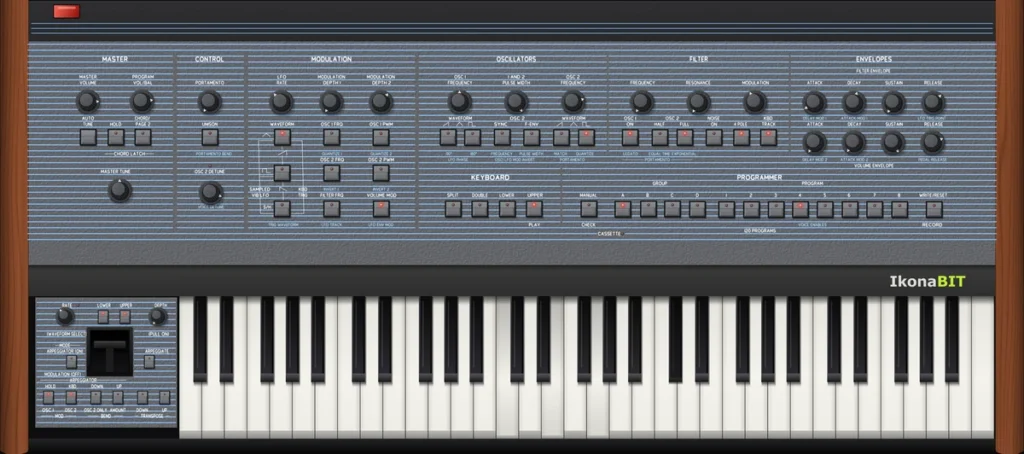
Each voice is a chain of two oscillators, a resistor-network mixer, a two- or four-pole filter and an amplifier. Above the voices - note assignment, LFO, arpeggiator, split, quantised controls - the model is just as careful, because in an instrument of this family half the character lives there. Controls do not reach a voice as a continuous signal: they are updated at 100 Hz and held in between, and pitch moves in 192 steps to the octave.
VST3 + Standalone v0.1.0 Windows 64-bit

Coming soon
Not in the shop yet.
VST3 + Standalone v0.1.0 Windows 64-bit
One licence covers both formats. 12 months of updates from purchase; the plugin keeps working afterwards.
Half the machine is what sits above the voices.
Note rotation, a single noise source, two independent modulation buses, controls that move in steps. None of it is simplified away.
How the sound is made
Quantised control, eight unequal voices, one shared noise.
Three things a generic subtractive synth smooths over, and this one keeps.
Control that moves in steps
Control numbers are held between updates. Pitch has 192 steps per octave: one step is 6.25 cent, and a movement below half a step moves nothing. It is the grain with which pitch moves, not an approximation to hide.
Eight voices that are not equal
Each voice has its own volume, its own detuning and its own random pitch wobble (about 13 cent rms in the model). Assignment is a pure rotation 1 to 8 that advances even when the voice it lands on is busy, so the ninth note steals one - and playing the same chord twice usually lands on other voices.
One noise source for everything
Noise enters every voice from the same source, so in a chord it adds in phase and grows with the number of notes instead of their square root: with two voices the bench measures +5.95 dB, where two independent noises would give 3.01 dB.
What it is for
Three things it does that a generic polysynth will not.
Not a list of features: three consequences of how the instrument is built.
Chords that do not come out quite the same twice
Voice tolerances, a random pitch wobble and a rotating assignment mean two plays of the same chord usually land on different voices and come out a little different.
Modulation you can aim
Two independent buses, each with its own depth, delay, attack, quantisation and inversion: pitch on one, volume on the other, and neither touches the other.
A keyboard that really splits
SPLIT and DOUBLE work with two real programs, not two zones with the same sound. The lower program is chosen with LOWER: in SPLIT it plays the lower half of the keyboard, in DOUBLE the two programs share the voices across the whole keyboard.
Filter and envelopes
Two or four poles, and a resonance the circuit limits.
A 4.5 octaves cutoff knob in 64 positions, optional keyboard tracking, and a filter envelope that adds up to 8 octaves when MOD is fully open. Four poles give 24 dB per octave, two poles a resonant 12 dB per octave.
- The resonance has 64 positions and at full RES the filter does not self-oscillate. Checked with one note and one cutoff setting, by releasing the note and looking at what is left four seconds later: -88 dB at two poles, -99 dB at four. The top of the range is a tuned value, not a measured figure of the chip.
- Envelope times are anchored, not chosen: the time constant runs from 1.128 ms to 11.28 s, exactly four decades, and every knob step multiplies the time by the same ratio.
- A sustain pedal (CC 64) takes the release to the value set on PAGE 2, and the note stays alive while the pedal is down.

Modulation
Two buses, not one depth with six destinations.
One LFO for the whole instrument, 0.067 - 50 Hz, with seven waveforms from the panel. It feeds two independent buses with their own depth:
- Bus 1: frequency of OSC 1, frequency of OSC 2, frequency of the filter. Bus 2: pulse width of OSC 1, pulse width of OSC 2, volume.
- Each bus has delay and attack from 0 to 3.5 s, a quantisation that turns the sweep into steps and an INVERT that reverses the envelope: the modulation starts at zero and rises, or starts full and falls.
- A second LFO, on the modulation panel, is a performance vibrato: it acts on pitch only, where the two destination keys send it, and adds to the lever and to the mod wheel.

Oscillators and mixer
A mixer that is a network, not a sum.
Two oscillators per voice, each with saw, pulse or - with neither on - triangle, plus sync and the filter envelope on OSC 2. The seven sources load one another: the saw of OSC 1 drops 0.30 dB when the pulse is switched on too, and lowering OSC 2 by 13.5 dB also lowers OSC 1 by 2.1 dB. A table of fixed gains does not reproduce that, which is why switching everything on does not sound like the sum of the single sounds.

The second face
PAGE 2: every control has a second function.
Knobs and keys carry their function in white and, with PAGE 2 on, many of them the one printed underneath in blue: modulation delay and attack, quantisation, LFO phase, the six portamento modes, voice enables, the bank file. It is an instrument you can program deeply without a single menu.
- Portamento is linear in time, 0 to 10 s, with six combinable variants: MATCH, QUANTIZE, BEND, LEGATO, EQUAL TIME, EXPONENTIAL.
- WRITE stores the panel into the current program; the written version wins over the factory one, travels with the plug-in state and is marked with an asterisk in the list.

What is measured
Every stage against the value it should have.
The bench checks each stage against an expectation recomputed from the topology: LFO, envelopes, mixer, voice, assignment, control grid, resonance, PAGE 2. Where a value does not follow from a calculation on the circuit it is tuned and declared as such in the code.
Version 0.1.0 is an honest early release: the bank has 120 positions but 104 distinct programs, because 16 positions are still placeholders to be filled, and there are no factory programs dedicated to SPLIT and DOUBLE yet - both modes work with any pair of the existing programs.
Specifications
In one line
Eight voices, and the part above them.
8 voices, 16 oscillators, 104 distinct programs in 120 positions, 80 parameters for the host, zero samples of latency. The arpeggiator, split, hold and the lever are played, not automated: they belong to the instrument, not to the project.
Downloads
Try Obelyx8
Obelyx8
The eight-voice polysynth, modelled at circuit level
Each voice is a chain of two oscillators, a resistor-network mixer, a two- or four-pole filter and an amplifier. Above the voices - note assignment, LFO, arpeggiator, split, quantised controls - the model is just as careful, because in an instrument of this family half the character lives there. Controls do not reach a voice as a continuous signal: they are updated at 100 Hz and held in between, and pitch moves in 192 steps to the octave.
No release for this instrument yet.