Line101 has a knob for analog quirks

Turn AGE up in Line101’s drawer and the amplifier stops being polite. The thump at the start of every note gets fatter, and a second harmonic grows with it: an extra voice an octave above the note. The oscillator drifts a little further, up to 6 cents. One knob for the thump and the harmonic, because in the model they come from the same number.
The chip is the BA662. Rohm reportedly built it to order for one maker’s instruments and never put it in a catalogue. We know of no public datasheet for it, and the amplifier is not a recording of a real machine: it is rebuilt from how this kind of part works, the figures declared by two modern clones, and the circuit it sits in.
Two amplifiers, two families of harmonics
At its default setting and a normal working level, the strongest harmonic this amplifier adds is the third. Odd harmonics, like the third, are traditionally described as tightening a sound; even ones, like the second, as fattening it. The other amplifier we model, built on the CEM3360, has a touch of even harmonics instead. Both behaviours come from how the models are built, not from measurements on the chips, and how audible the difference is, your ears decide.
It is not a fuzz: in the model it stays almost clean (about 0.1 % distortion at one signal level, and 1 % only at more than three times that level). At the other end it shuts completely: with the control at zero nothing passes, so a staccato note ends in silence.
AGE: one value, two effects
Real analog parts stray a little from the ideal; here the stray is an input offset, a tiny extra voltage. Two modern clones of the part declare two values for it: 250 microvolts for the better version and at most 3 millivolts for the loose-tolerance one. In the model AGE slides the offset from one to the other and moves two things together. The thump at the attack grows by more than 20 dB, from about 29 to about 7 dB below full scale. And the second harmonic: with no offset the model has none at all, and it is the offset that brings it in.
What we leave out
Three things are missing: the chip’s bandwidth (how high it reaches), its slew rate (how fast it changes voltage) and its own noise. We know of no public source for them, so they stay out of the model.
Try it: load Glide Bass in Line101, hold a note and sweep AGE from end to end. The thump at the attack comes forward, and a second harmonic grows behind it.
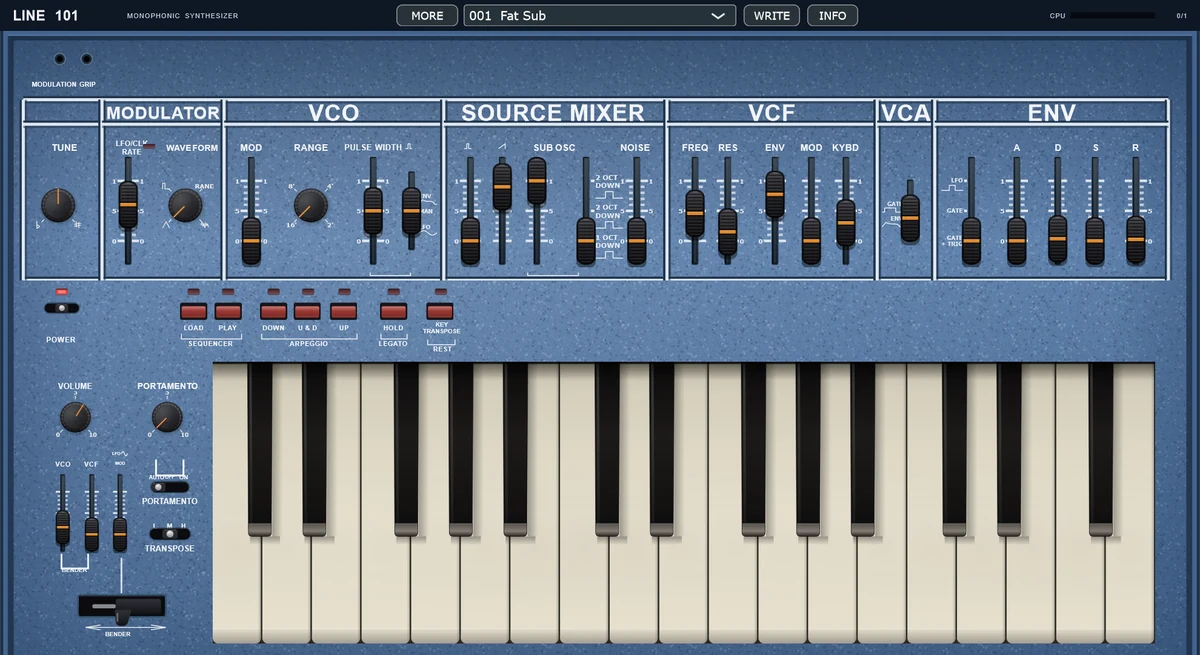
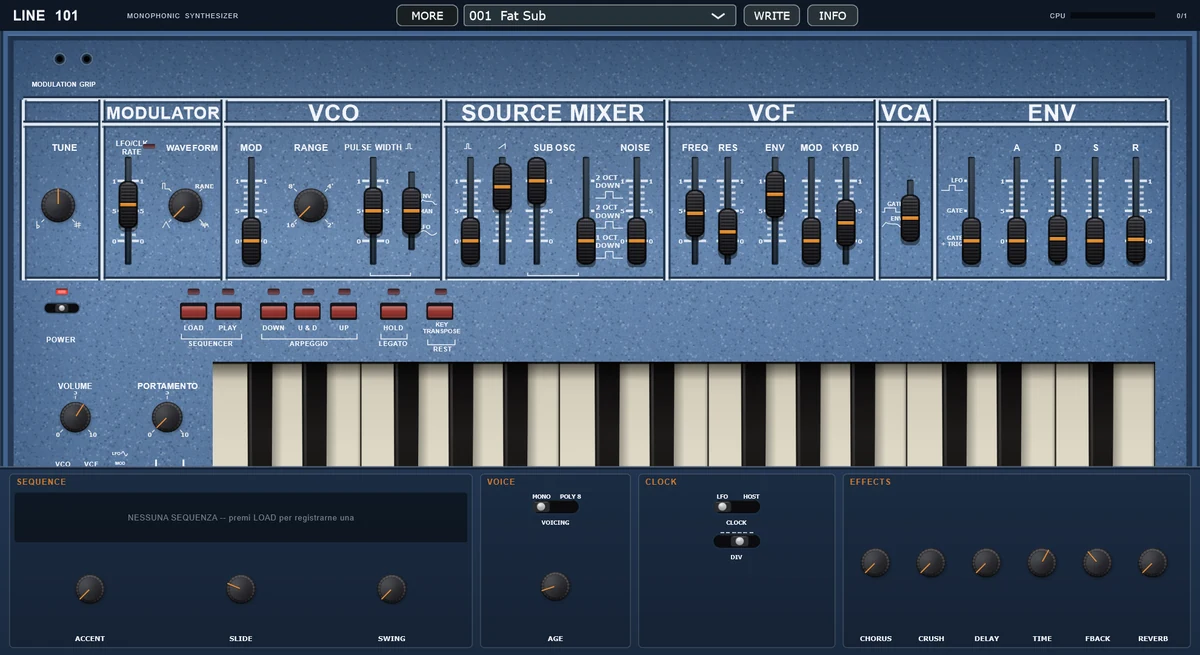
The instrument
