One knob, and the drum itself changes

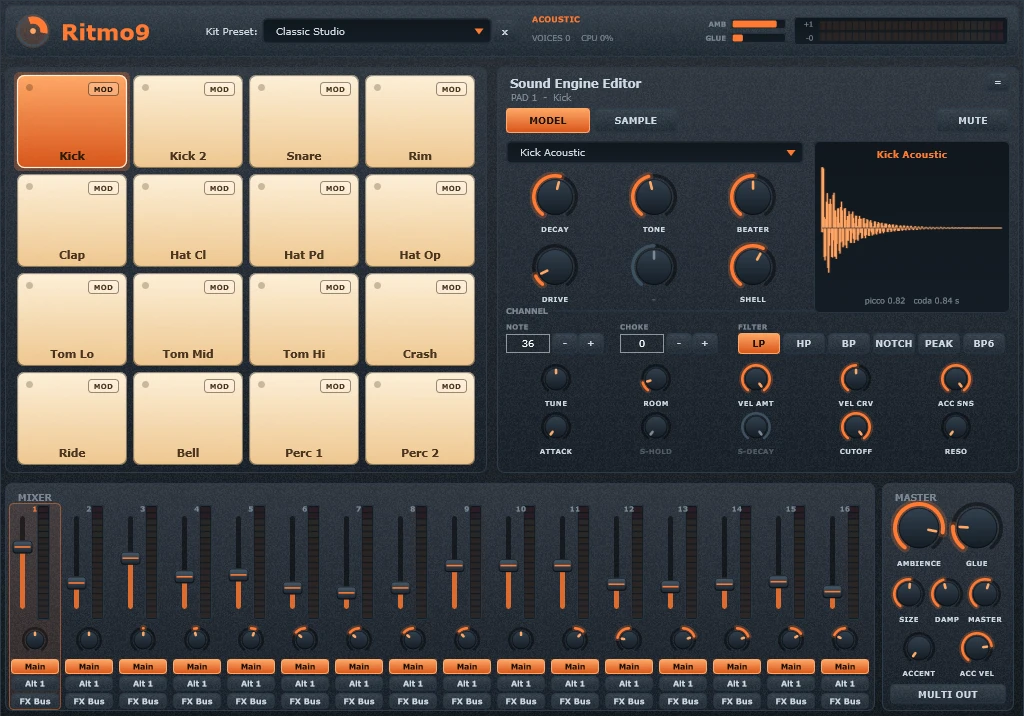
Load Classic Studio in Ritmo9. Hit the Kick pad. Now turn DECAY to the right and hit it again.
The drum got longer. Not a longer sample with a fade on the end of it: a longer drum. Turn SHELL up and you hear more of the wood around the hit, with your pattern still running in the DAW. In the factory kits every pad is modelled rather than recorded, twenty models in all, ten electronic and ten acoustic, and every knob you turn is there on the very next hit.
Sixteen pads, sixteen channels
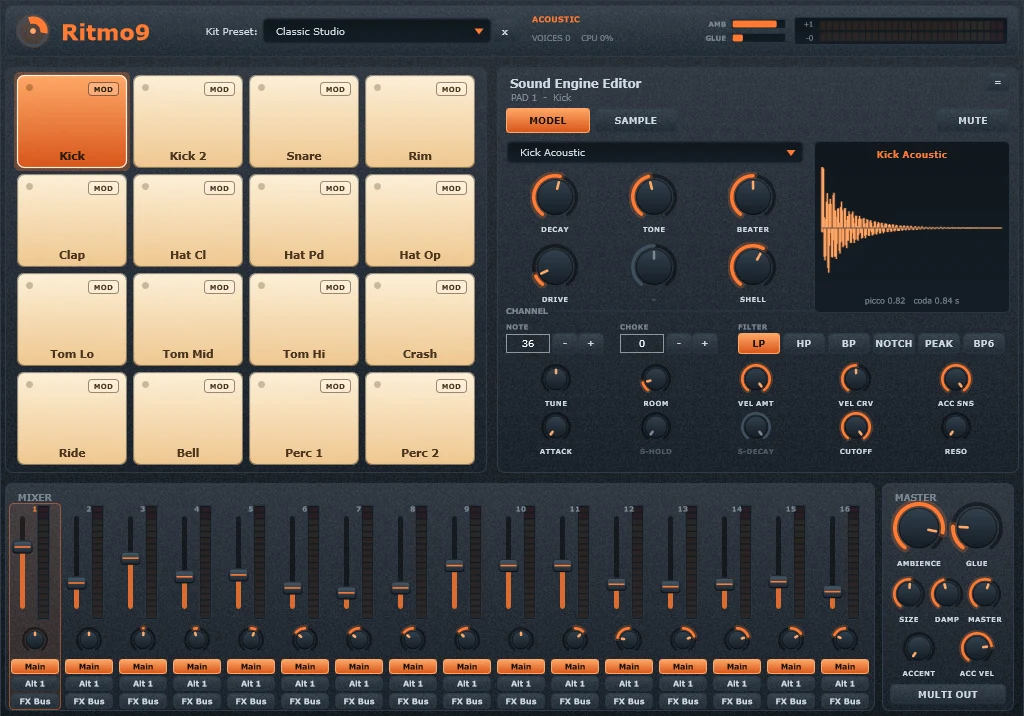
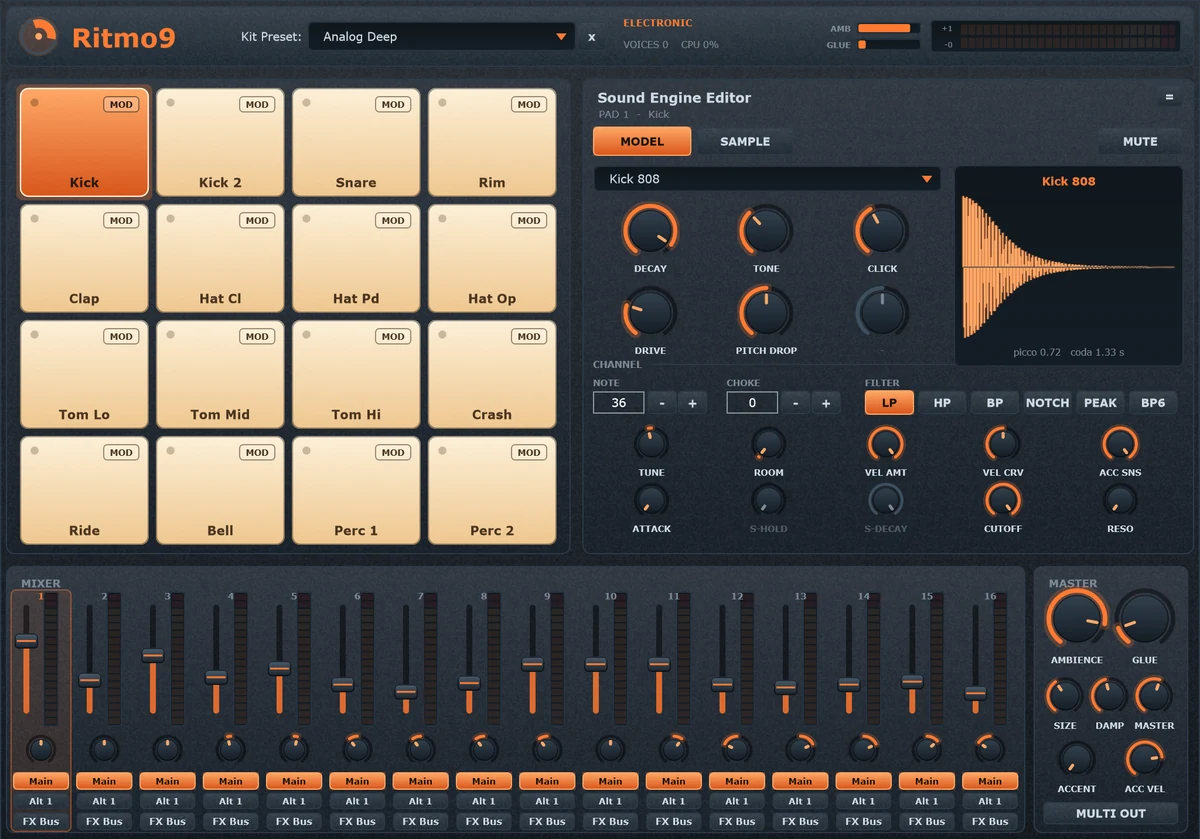
Kick, snare, hats, toms, crash, ride, percussion: every pad keeps its seat and its MIDI note in all twenty factory kits, so a pattern written on one kit plays on all the others. What changes is the drum sitting in the seat. Behind each pad sits a full channel: fader, pan, a filter with six modes, room send and output.
Next to the pads sit six knobs, and they rename themselves. On an electronic kick the fifth one reads PITCH DROP: how far the pitch falls, and for how long. That fall is what turns a tone into a thump. On an acoustic tom the same slot reads TENSION, and the pitch sags a little while the drum rings. On a hi-hat that slot is dark, because there is nothing to bend there.
- RATTLE, on the acoustic snare, is the wire underneath. Keep it low and soft hits barely wake the wires; they answer mostly when you lean on the pad.
- SPREAD, on the clap, sets the gap between the little bursts of noise that make up one clap. Turn it and the clap tightens or loosens.
- SIZE, on the acoustic hats, ride and crash, lets the low part of the metal ring for longer. Same crash, longer wash.
- DRIVE, on every drum, adds grit: the hit gets denser and edgier.
And one thing that isn’t a knob: on the acoustic drums and cymbals a quiet hit is darker, a hard hit is brighter. Play a tom fill with a light hand and it stays at the back of the track by itself.
Twenty kits, from Jazz Brush to Industrial
Rock Big and Rock Tight start from the same drums: one long and roomy, the other short, dry and squeezed harder. Swap between them while the pattern plays and hear how much of a drum sound is tails and room. Metal Punch is short and mean, Jazz Brush plays small and soft, Funk Snap is dry and snappy. Then the machines: Analog Deep, House Analog, Techno Hard, Trap Sub with its very long, very low kick, Electro Retro, Lo-Fi Tape, Industrial. Hybrid Rock/Electro puts an electronic kick under acoustic snare, toms and cymbals, because an acoustic snare over an electronic kick is one menu click and not a project decision. And four more for style: Latin Percussion, where the toms become congas; Cinematic Epic, deep and roomy; Boom Bap, dark and gritty; Brush Kit, all soft touch.
Your own sounds, in the same strip
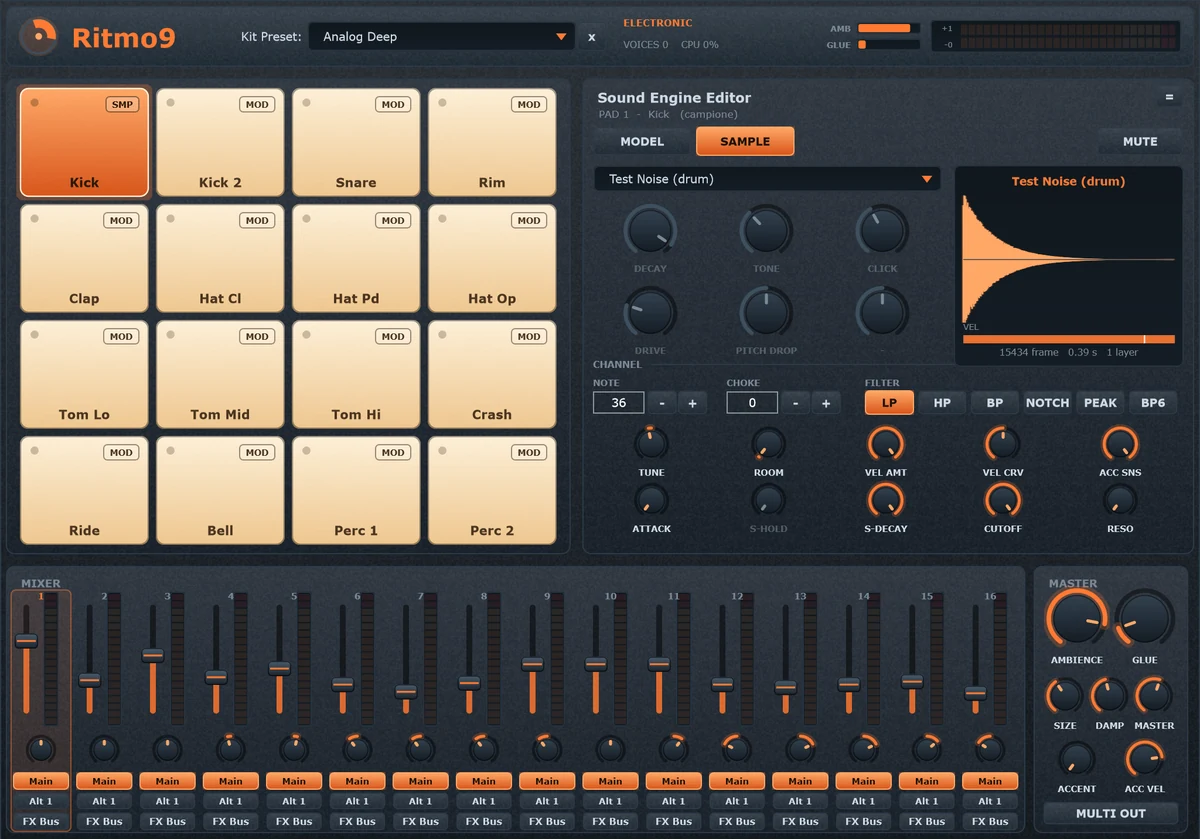
Any pad flips from MODEL to SAMPLE and takes your WAV, with the same filter, pan, room send and output after it. TUNE on a sample pad behaves like a drum box and not like a tuner: pitch it down and it gets longer too.
Three things to do in the first ten minutes
- Write the pattern with only two velocities, one hard (above ACC VEL, 100 by default) and one soft, then ride the ACCENT knob until the groove starts breathing. One knob, sixteen pads.
- Hover a pad: everything in its choke group lights up, so you see the closed hat shutting the open one before you hear it. There are 8 choke groups, the factory kits use two, the rest are yours.
- Switch on MULTI OUT and send the snare to an output of its own (enable that output in your DAW). There are 4 stereo outputs, and a snare with its own compressor downstairs is a different record.
96 voices, VST3 and Standalone. Load Classic Studio, put a hand on DECAY and hit the kick twice: Ritmo9 says everything it has to say in two hits.
The instrument