The release nobody programmed

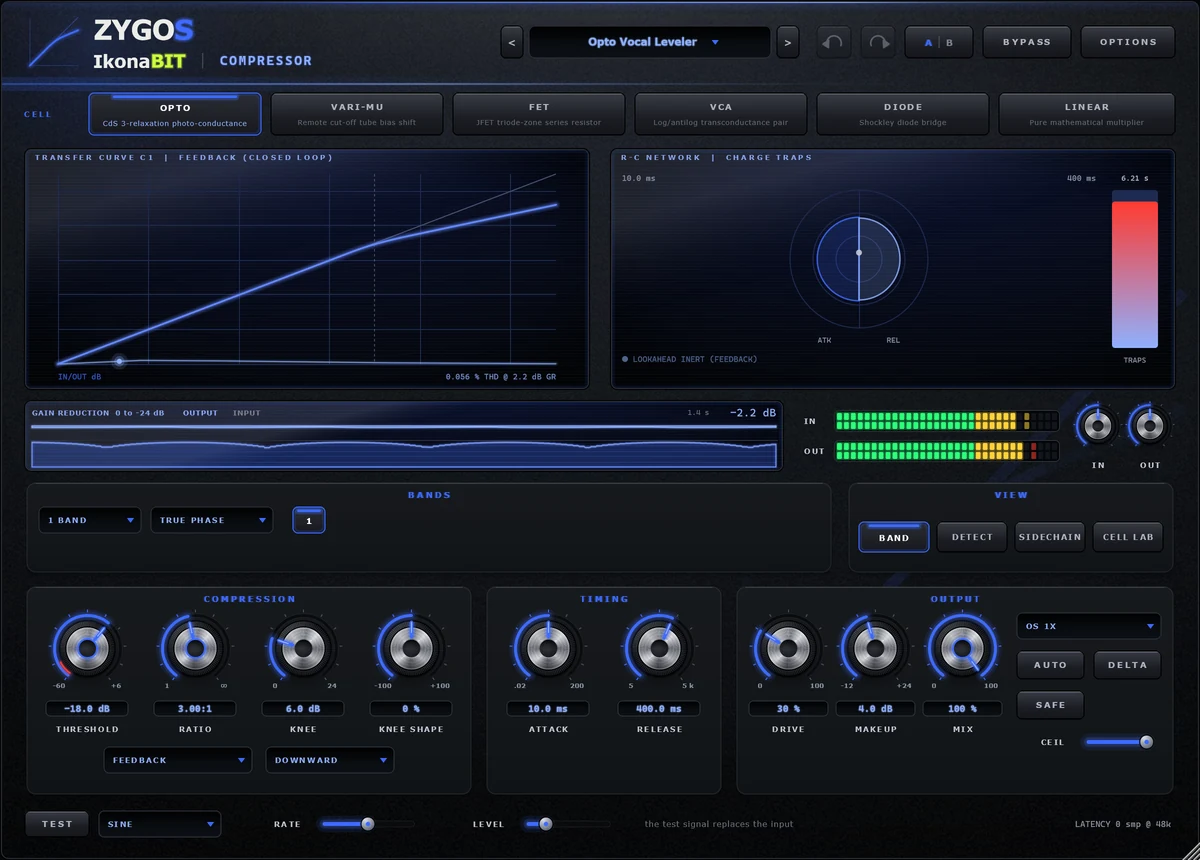
Pick the opto cell and set Release to 50 ms. Squeeze hard for twenty seconds, then let go: the level climbs back slowly. Squeeze for a fraction of a second instead and it comes back much sooner. Same knob, same 50 ms. Nobody changed anything.
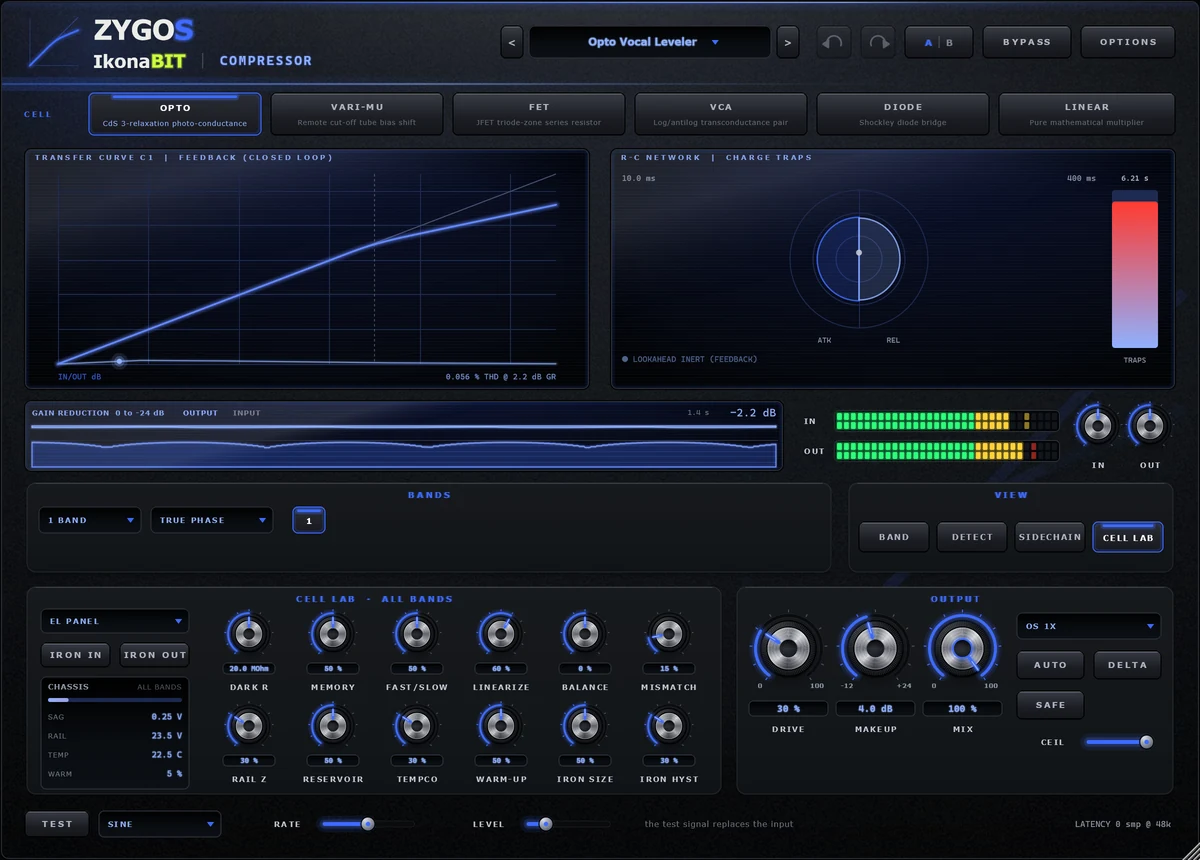
Zygos has no auto-release switch, and that behaviour is stored nowhere. The opto cell is modelled as a lamp and a photoresistor that slowly remember the light they have had, and that memory sets how fast the cell lets go. A long squeeze fills it; a short one barely does.
Measured in our model, after a squeeze of 60 milliseconds the reduction takes roughly 0.4 seconds to fall to a third of its size. After twenty seconds of squeezing it takes roughly six seconds. More than fifteen times longer, from one setting nobody touched.
Five cells, five ways to hold a sound
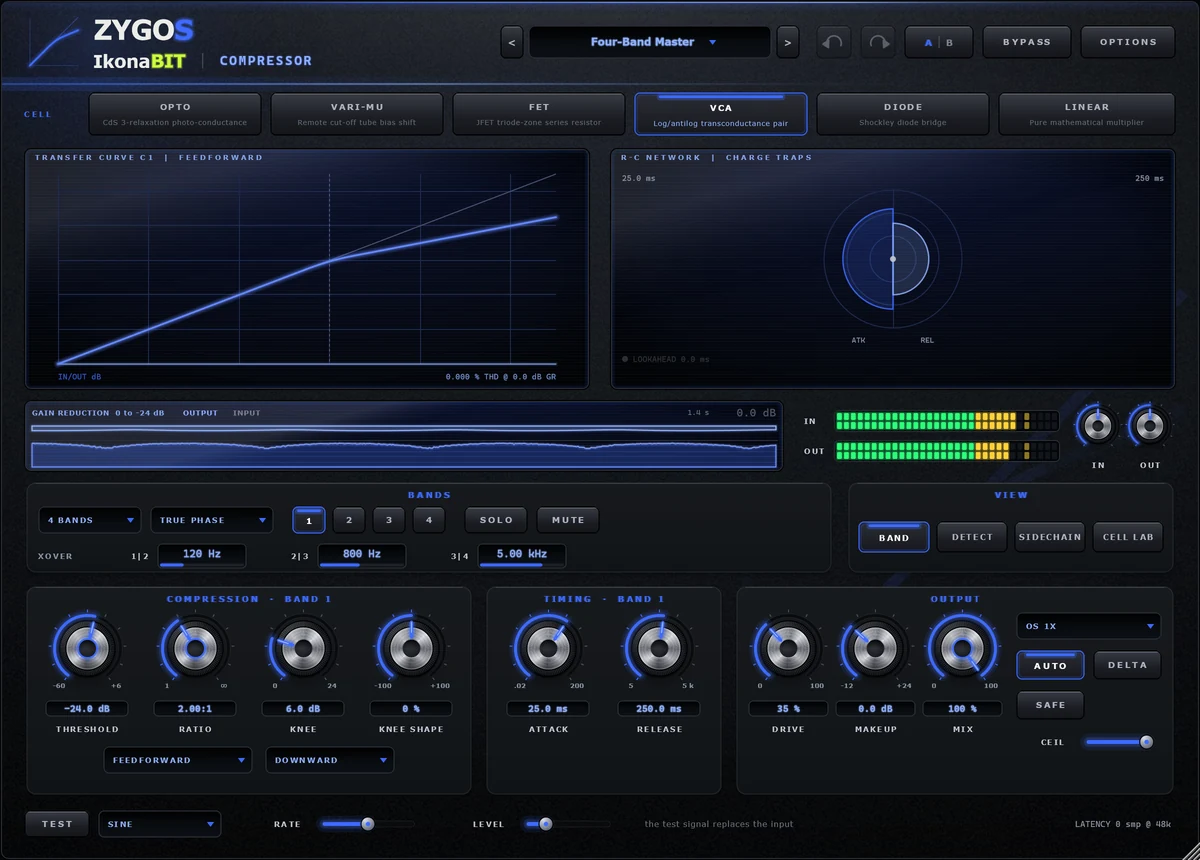
Choosing a cell in Zygos is choosing a sound, and it is a first-level choice on the front panel. The vari-mu, the FET and the diode bridge get richer the harder they work, and the louder the signal and the higher the Drive, the more you hear it: a snare arrives with harmonics the compression brought along. The opto goes the other way: past the first few dB it gets cleaner as it clamps, which makes it one to try under a lead vocal. The VCA keeps out of the way almost entirely.
That pattern is not a stored table: it comes out of each part’s own equations. Only the opto has a memory of its own; the other cells follow the Attack and Release you set. In the valve the gain reduction is a shift of the grid bias, so the distortion grows along with it. The VCA’s small trace of distortion sits at low levels, the opposite of the FET’s.
One power supply, shared by every band
Zygos has one power supply per instance, with an output impedance and a reservoir capacitor. When the compressor works it pulls current and the supply sags, which raises the effective threshold a little. Ask for 10 dB of reduction at 2:1 on a stereo track and you get about 9.3 dB with the factory supply, about 8.2 dB with a weak one. Every band shares that supply, so four bands compressing together pull it down further than one: a multiband setting behaves like one machine rather than four plug-ins in a row.
On top of that there is an optional transformer stage, Iron In and Iron Out, off at the factory. It works on the low end and mostly leaves the highs alone: at the same level, a 50 Hz tone pushes the core about twenty times harder than a 1 kHz tone. The bass thickens, the treble stays where it is.
Clean when you want it clean
At the factory settings Zygos hands the signal back exactly as it came in, sample for sample, for as long as nothing is being reduced, and there is no filter of its own in the audio path. With Drive at zero and no reduction, every cell does the same.
Ask for reduction and the cells do what you asked: with the supply at zero impedance and Drive at zero, 10 dB asked is 10 dB delivered, to within a few hundredths of a dB. The VCA reads 10.04 on purpose, the small mismatch of its transistor pair.
Load Zygos, run a vocal through it and try the cells one after another: the same take, held in different ways.
The instrument
