Listen to the second second

Hold a chord in Orfeo88 with the pedal down and count to two. The attack belongs to the recorded grand. The second second is where the computed strings come in: listen for the note to settle and for its strings to beat gently against each other.
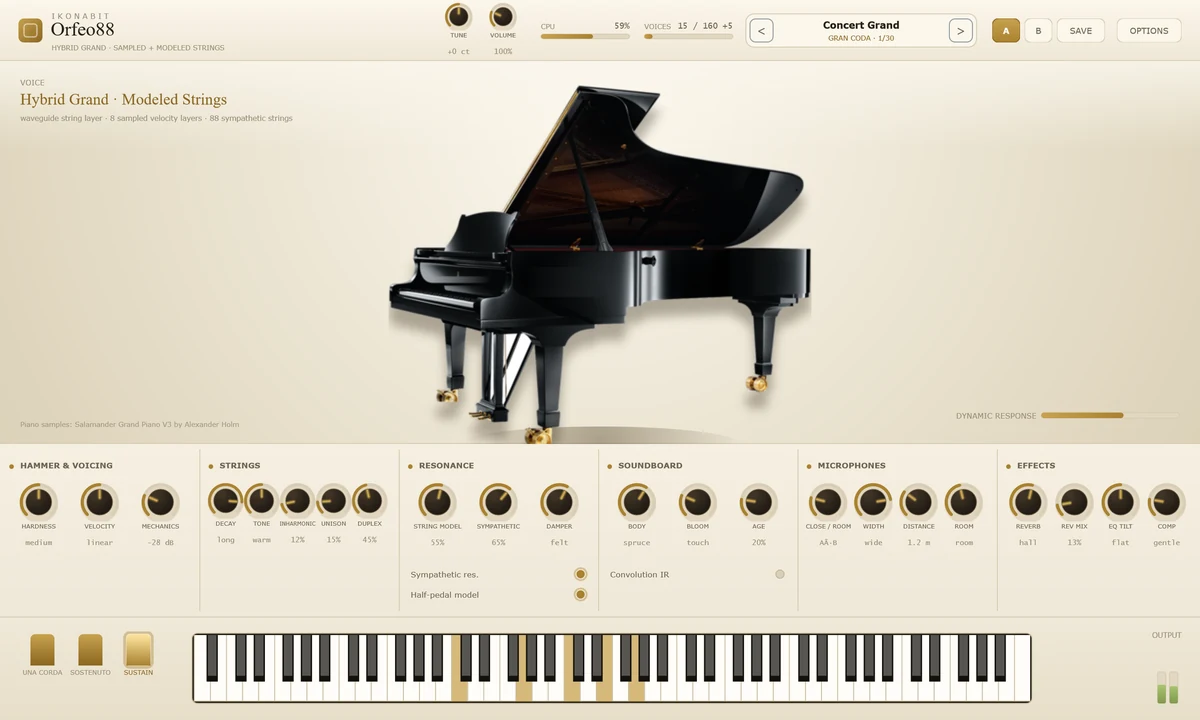
Orfeo88 is two pianos playing together. One is a recording of a grand piano. The other is computed while you play: strings, a felt hammer, the way the strings of one note share a bridge, the pedals and a little mechanical noise. Both go through the same soundboard, microphones and room. The sympathetic resonance, the other strings answering when the pedal is down, comes from the recorded side: real recorded resonances plus a bank of 88 resonators fed by the recorded sound.
String Model: 18% on the honky tonk, 55% on the concert grand
String Model sets how much of the computed strings you hear under the recording. At 0% they are switched off completely and Orfeo88 plays the recording alone; above 0% they run and weigh on the processor. The factory presets set it by family: 18% on the honky tonk, which is out of tune on purpose, up to 55% on the concert grand, a big instrument with a long ring, where there is room for them. They fade in over about a tenth of a second, so the attack stays with the recording and the computed strings work on the part you actually sit and listen to.
A piano is never perfectly in tune with itself
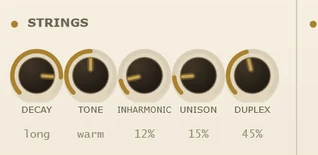
Real piano strings are stiff, so their upper partials sit a little sharp of a perfect harmonic series. A piano is never perfectly in tune with itself, and a lot of its character lives in that. The computed strings have this stiffness built in, and the Inharmonic knob sets how much of it there is; it also stretches the tuning of the recording a little towards the ends of the keyboard.
In the computed piano each note has up to three strings, tuned a hair apart. That tiny gap is what makes a held note breathe.
The recording underneath is Alexander Holm’s freely licensed Salamander Grand Piano V3: eight velocity layers in crossfade, key-off noises and real recorded string resonances. Velocity chooses which layer speaks, so playing harder changes the colour and not only the level, and the computed strings play along with whichever layer is speaking.
Load the concert grand in Orfeo88, put the pedal down, play one chord and let go of nothing. Listen past the attack: the second second is the part worth judging.
The instrument
