Chora keeps the tail moving

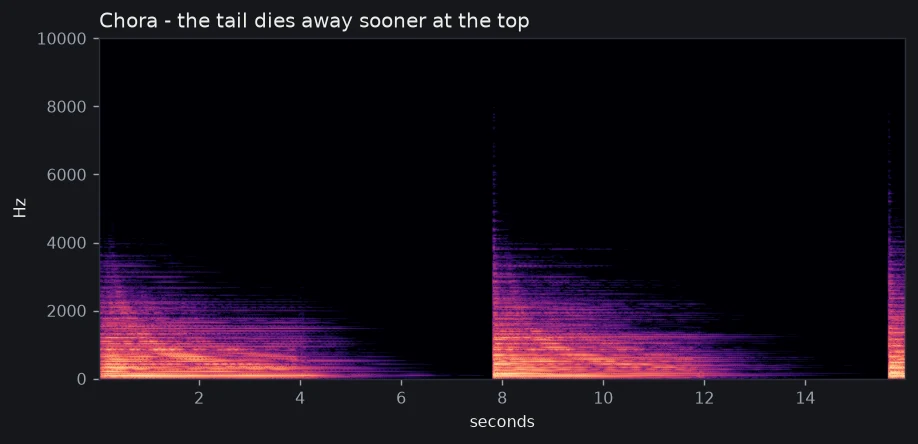
Hold a chord on Chora, lift your hands and listen to what stays behind. The top of the chord fades first, the low end stays a little longer, and the tail keeps shifting as it goes instead of hanging on one note. That is how a real room behaves, and Chora does it the moment you load it, before you touch a single control.
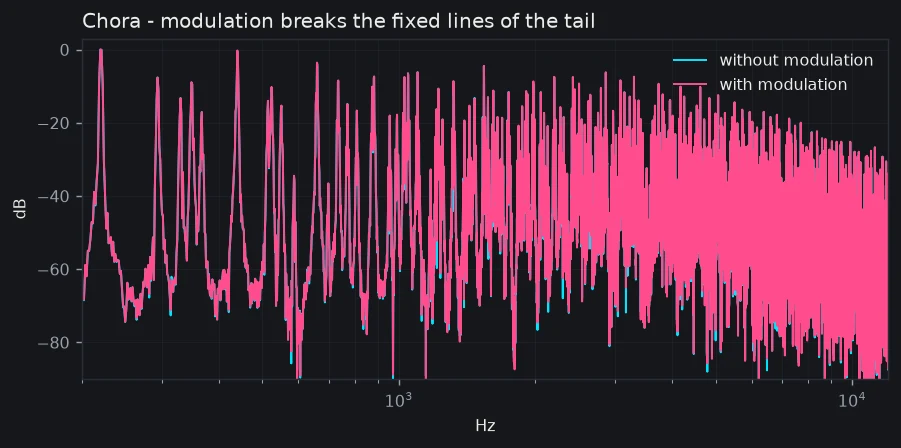
That starting tilt is on purpose. At the default settings the highs (around 8 kHz) fade about three times faster than the mids (around 1 kHz), and the lows (around 125 Hz) last about twice as long. Underneath, by default, sixteen delay lines each drift on their own, and the way they feed into one another shifts slowly while it runs, so the tail keeps changing as it fades.
Change the room, keep the decay time
Move Size, switch the matrix, go from sixteen lines to eight, open the diffusion: the character of the room changes, and the decay time stays close to what you set. You can reshape the room around a mix without going back to fix the Decay every time. The shuffling only moves the sound around; it doesn’t add any, so it doesn’t make the tail swell.
How long it takes to fill, how long it takes to fade
A small space smooths out almost at once; a big hall takes longer. In the factory presets, Close Ambience blends into one smooth wash in about 30 ms, Rich Plate in about 70 ms, and Grand Random Hall in about 140 ms. Decay runs from 0.2 to 20 seconds on the knob; past about ten seconds the tail gets longer by less and less, and the screen tells you so. For a tail that doesn’t fade, there is Freeze: it holds the tail where it is while it is on, and the movement stops with it. Press it under a held chord and you have a bed to write over.
The curve in the middle is not a drawing
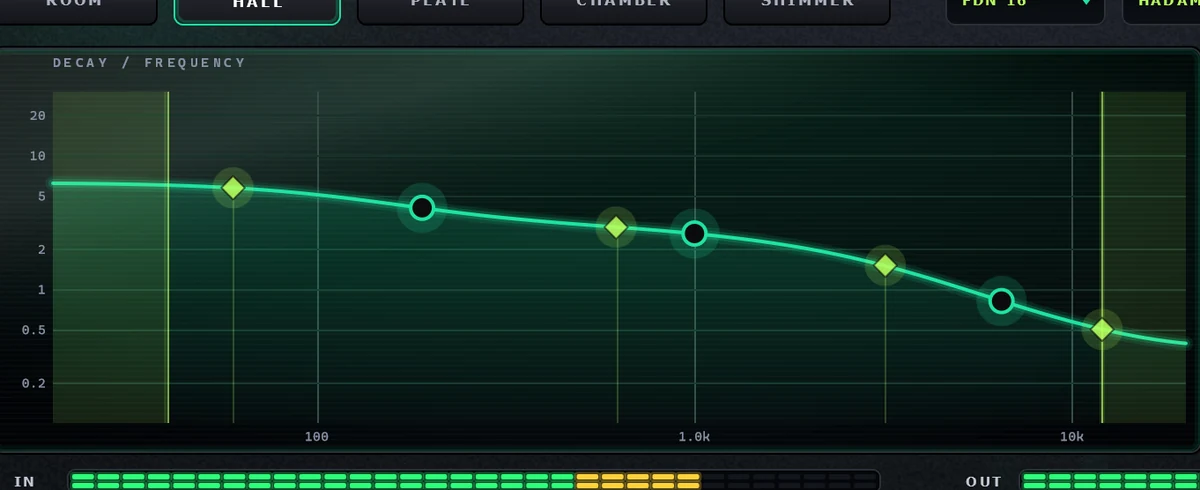
The decay curve on the panel isn’t a sketch. Chora works it out with the same filter that shapes the tail, from your current settings, so when you drag a point you see the decay you are setting. Latency is zero, and Chora asks the host for twenty seconds of tail so a bounce doesn’t cut it short.
Put Chora on the send you reach for most, hold one chord and take your hands off the keys. What happens after that is the reason to have it.
The instrument
