Monophonic analogue synthesizer
Line101
Line101
Not a row of blocks with the right names on them. The oscillator has its dead time, the filter keeps its bass under resonance, the amplifier compresses and thumps: behaviours that are inconvenient on paper, and the reason the instrument is recognised in two notes.
v1.0.0

betadownload and try
Perpetual licence · 12 months of updates · full trial before you buy
In beta, and you try all of it
This is not a cut-down version: it is the complete instrument. We are asking you to use it and tell us what does not add up.
3 seconds at −18 dBFS · the clock restarts at every launch
v1.0.0
One licence covers both formats. 12 months of updates from purchase; the instrument keeps working afterwards.
The amplifier compresses oddly - and that is the whole point.
Its distortion is odd-order and its control law is linear, and it has an offset that produces the thump at note-on. Both are part of the behaviour of the stage. Removing them would make a cleaner instrument and a less recognisable one.
The voice
One oscillator, 3 sub-oscillator modes, and noise with a corner.
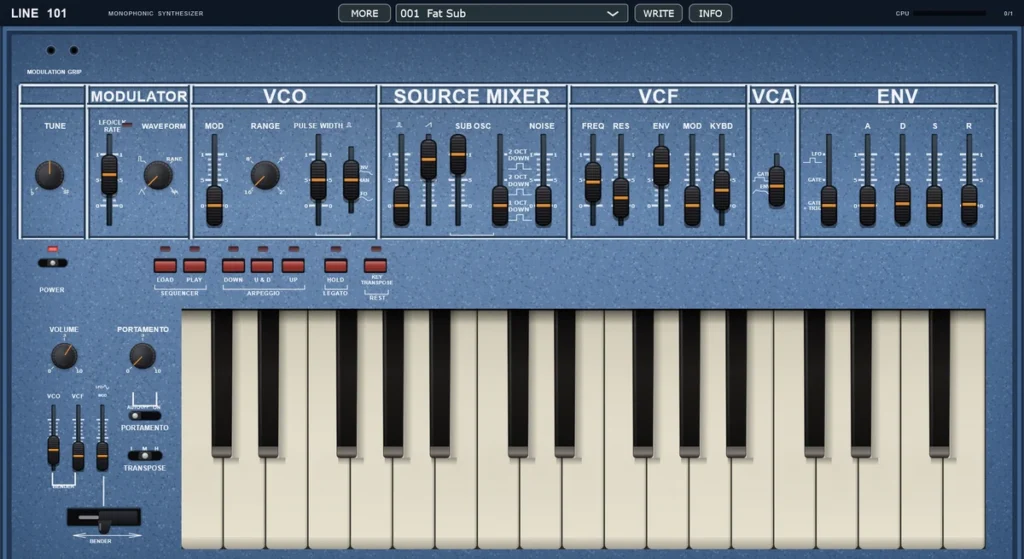
Saw, variable-width pulse, sub and noise, all summed together in a mixer with a fader each - the source section of a monophonic synth, where you build the raw material before shaping it.
The oscillator
A single voltage-controlled oscillator with saw and pulse from the same core, with the dead time and scale error of an analogue oscillator rather than the perfect response of a band-limited generator.
The divider
The sub comes from a divider: one octave down as a square, two octaves down as a square, or two octaves down as a pulse at a quarter width. Three characters, not one level.
Noise with a pole
The noise is not white: the stage that amplifies it has a corner at 3 kHz, and that corner is in the model. It is why the noise sits where it sits.
Who it is for
For basses, leads, and sequences that run on their own.
A monophonic synth with a sequencer built in is not a smaller polysynth. It is an instrument for one line at a time, played hard.
Bass and lead
The four-pole filter reaches self-oscillation, and the amplifier adds its own compression on the way out - the sound is loud before you make it loud.
Sequenced music
100 steps across 2 banks, with rests and ties, transposed live from the keyboard. The sequence is part of the patch.
Anyone who wants it polyphonic
A poly mode of 8 voices lives in the drawer - the same voice, 8 times, when the part needs chords.
The filter
4 poles, 24 dB/oct, up to self-oscillation.
A four-pole low-pass with resonance up to self-oscillation, and bass that does not thin out as the resonance rises. What matters most is at the extremes: what it does at full resonance, how it behaves when driven, and how the resonance interacts with the source level.
- Frequency, resonance, envelope amount, modulation and key-follow
- Self-oscillation, so the filter is also a sine source
- One envelope, shared by filter and amplifier, that behaves like a capacitor: the decay aims at the sustain, the release starts from the instantaneous level

Sequencer and arpeggiator
100 steps, 2 banks, and the clock is the LFO.
The sequencer and the arpeggiator both run from the low-frequency oscillator, which is why changing the modulation rate changes the tempo of the pattern. Rests and ties are steps like any other.
- 100 steps over 2 banks, with rests and ties
- Live transposition from the keyboard
- Arpeggiator: up, up and down, down, with hold

The source mixer
Four sources, four faders, summed before the filter.
Saw, pulse, sub and noise each have their own level, and they are summed before the filter rather than switched. That is what lets a bass carry a sub underneath a bright pulse, and what makes the noise part of the timbre rather than an effect on top of it.

In numbers
101 parameters, and a patch that carries its own sequence.
The stages are specified by their behaviour - the noise corner at 3 kHz, the 24 dB/oct slope, the odd-order compression of the amplifier, the envelope that decays towards the sustain - and each can be heard and measured on the instrument itself.
The sequence travels inside the patch rather than beside it: recalling a sound recalls the line that goes with it. On an instrument built around a sequencer, separating the two would mean the patch is only half the idea.


Specifications
In short
A small instrument, modelled seriously.
One oscillator, 3 sub modes, a 4-pole filter to self-oscillation, an amplifier with its own compression, and 100 steps that belong to the patch.
Downloads
Try Line101
Each download is the Windows installer, a single .msi file. It installs for all users, so Windows asks for administrator rights; under each release there is also the .exe installer, inside a ZIP.
Line101
Modelled at the level of the circuit
Not a row of blocks with the right names on them. The oscillator has its dead time, the filter keeps its bass under resonance, the amplifier compresses and thumps: behaviours that are inconvenient on paper, and the reason the instrument is recognised in two notes.
ikonabit-Line101-1.0.0 beta
VST3Standalone
File names
- ikonabit-Line101-1.0.0.msi