Drum machine and sampler - 16 pads
Ritmo9
Ritmo9
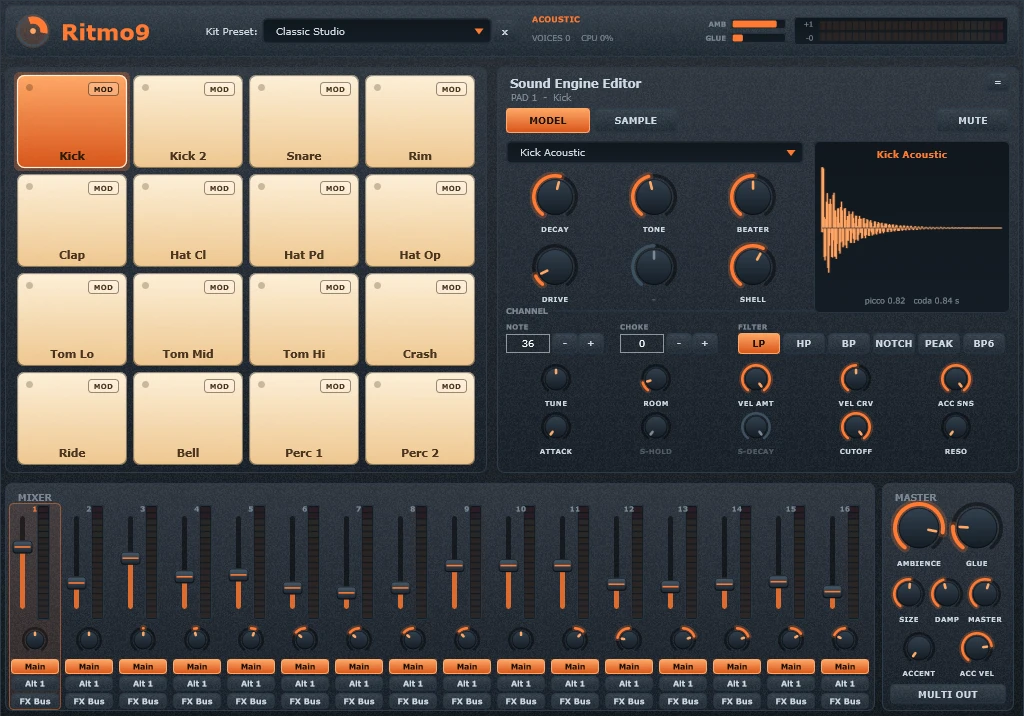
Not a polyphonic synth and not a general sampler. 16 independent channels firing one-shots, each with a source you can switch between a synthesis model and a multisample - and the same chain downstream either way.
v1.0.0

betadownload and try
Perpetual licence · 12 months of updates · full trial before you buy
In beta, and you try all of it
This is not a cut-down version: it is the complete instrument. We are asking you to use it and tell us what does not add up.
3 seconds at −18 dBFS · the clock restarts at every launch
v1.0.0
One licence covers both formats. 12 months of updates from purchase; the instrument keeps working afterwards.
The choice of source does not change the rest of the channel.
Tune, filter, pan, room send and bus: a modelled kick and a sampled kick go through the same channel strip (a sampled pad also gets hold and decay). That is why swapping one for the other is a decision about sound and not a decision about workflow.
The sources
20 models: 10 analogue, 10 acoustic.
The analogue side is the drum-machine idiom - a tuned body, a noise transient, a decay you set. The acoustic side is modal: membranes solved as Bessel modes, so the drum has a size and a tension rather than a sample rate.
Analogue models
10 models in the drum-machine tradition: the kick whose decay you dial in, the snare that is body plus noise, the metal that is a bank of partials.
Acoustic models
10 modal models. A membrane is solved as its modes, so tuning the drum changes the relationship of the partials the way tightening a head does.
Multisample
The same pad can load samples instead, reusing the sample engine of our sampler - and then run through the identical channel chain.
Who it is for
For programming drums, not auditioning kits.
The instrument assumes you will want to change the sound of a drum, not just choose a different one.
Producers
20 factory kits by genre, exposed to the host as programs, and user kits without limit - on file and inside the project.
Mixing
4 switchable stereo pairs plus an ambience bus and glue on the main output: the kit arrives in the DAW already split.
Live playing
8 exclusion groups, a global accent with a velocity threshold, and per-pad sensitivity - the hi-hat behaves like a hi-hat.
The channel
One chain, 26 controls, 16 times.
Tune, an AHD envelope, a state-variable filter with 6 modes, pan and bus assignment. Every pad has its own copy, and every control is automatable: 424 in total, 16 channels of 26 plus 8 kit-level parameters.
- 6 voices per pad, from a pool partitioned per pad - 96 in total
- A partitioned pool means a busy hi-hat cannot steal the kick's voices
- 6 filter modes on every channel, whatever the source

Sources and switching
Model or sample, on the same pad.
The source selector is per pad, and it changes what generates the one-shot - not what happens to it afterwards. A kit can therefore mix modelled and sampled drums without any of them sitting in a different signal path.
- Per-pad source: synthesis model or multisample
- The same tune, envelope, filter, pan and bus either way
- 8 choke groups, assignable per pad

Outputs
4 stereo pairs, plus ambience and glue.
Each pad goes to the pair you assign it to, so the kick, the snare, the hats and the rest arrive in the mixer already separated. The ambience bus and the glue on the main output are there for the case where you want the kit to sound like one instrument rather than 16 of them.
What is measured
424 parameters, all automatable.
The count is not a round number because it is counted, not estimated: 16 channels of 26 controls each, plus the kit-level parameters. Every one of them reaches the host.
The voice pool is partitioned rather than shared: each pad owns 6. A shared pool is cheaper and sounds fine until a fast hi-hat pattern eats the voices the kick needed, at which point the kit thins out exactly when the music is busiest.

Specifications
Keep looking
Looking for something else?
The other instruments and effects are one click away.
Downloads
Try Ritmo9
Each download is the Windows installer, a single .msi file. It installs for all users, so Windows asks for administrator rights; under each release there is also the .exe installer, inside a ZIP.
Ritmo9
Sixteen pads, two ways to make a drum
Not a polyphonic synth and not a general sampler. 16 independent channels firing one-shots, each with a source you can switch between a synthesis model and a multisample - and the same chain downstream either way.
ikonabit-Ritmo9-1.0.0 beta
VST3Standalone
File names
- ikonabit-Ritmo9-1.0.0.msi