Wavetable synthesizer - 8 voices
Edge8
Edge8
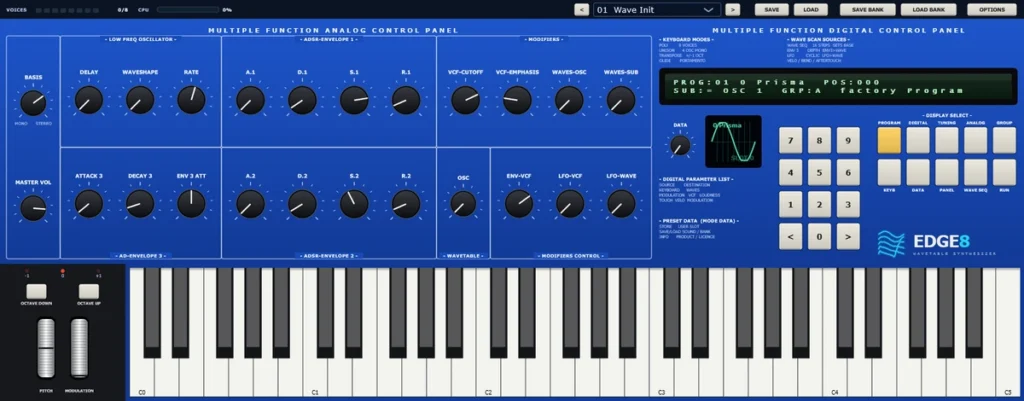
Two oscillators travel a path of 64 slots, a dedicated envelope sweeps it, a 16-step sequencer can move where the sweep starts, and downstream there is a four-pole low-pass that reaches self-oscillation.
VST3 + Standalone v1.0.0 Windows 64-bit


Coming soon
Not in the shop yet.
VST3 + Standalone v1.0.0 Windows 64-bit
One licence covers both formats. Twelve months of updates included; the instrument keeps working afterwards.
The wavetables are ours, and they come from no archive.
Every waveform is defined by its spectrum - amplitude and phase of each harmonic - and generated by formula at first use. There is not one imported sample in the whole bank. Defining the spectrum instead of drawing the shape has an audible consequence: the waves are band-limited by construction, so there is no raw material from which aliasing could appear as you play higher.
The bank
256 waves: 16 families of 16 frames.
Inside a family the frame is a continuous morph from one extreme to the other. The 16 families cover the characters a wavetable instrument has to be able to make.
The paths
32 paths of 64 slots each, drawn through the pool. Two oscillators can travel different paths, with the second detuned.
The wave-scan envelope
The third envelope does not touch the filter or the amplitude: it sweeps the read position through the table. It is the signature of the instrument.
Band-limited by construction
Synthesis stops at 128 harmonics and the reduction levels use fewer still, so the table cannot alias regardless of how high you play.
Who it is for
For sounds that change while they hold.
A held note here is not a static sound with a filter over it. The timbre moves because the oscillator is reading somewhere else.
Evolving pads and textures
The wave-scan envelope and the step sequencer give a note a shape in time that no filter can imitate.
Digital character
Formant, bell, comb, resonance and grain families - the digital timbres, made from spectra rather than sampled.
Hardware habits
A physical panel with a 40x2 character display and a menu: parameters live where a panel would put them, not in a page of sliders.
The filter
Four poles, all the way to self-oscillation.
An OTA-style four-pole low-pass, 24 dB/oct, that reaches self-oscillation - so it is also a sine source when you want one. Cutoff and emphasis sit on the analogue panel, next to the two controls that decide how much the oscillators and the sub move through the table.
- Envelope 1 to the cutoff, envelope 2 to loudness, envelope 1 to the wave position
- Velocity, bend, aftertouch and LFO can all reach wave, filter and loudness
- Poly, or a monophonic unison of 4 stacked oscillators

The wave sequencer
16 steps, on the scan position - not on the notes.
This sequencer does not play a melody. It moves where the oscillator reads inside the table, step by step, so one held note becomes a rhythmic figure of timbre. Gate, trigger and rate are set from the menu.
- 16 steps on the read position, synced to the host
- Rate, gate and trigger mode from the digital panel
- It combines with the wave-scan envelope rather than replacing it

The digital panel
A display, a keypad, and a menu that reaches everything.
68 parameters are reachable from the panel or the menu, out of 161 exposed to automation. The character display shows program, bank, wave, split, tuning and location, and the numeric keypad drives the same navigation the hardware idiom implies: choose the page, choose the parameter, turn the data knob.

What is measured
All 210 presets, rendered and compared.
Every factory preset is rendered by the real processor at 48 kHz - held note and release - and compared against a versioned fingerprint on peak, RMS, spectral centroid, attack time and 8 logarithmic bands.
Alongside the comparison, an audit measures resolution and aliasing on the isolated oscillator and verifies the data round-trip, and a parameter sweep drives every control to both ends of its travel - failing if an inert one appears undeclared. The wave tables are built once and shared by every instance, so changing path or sweeping it costs nothing extra.


Specifications
Keep looking
Looking for something else?
The other instruments and effects are one click away.
Downloads
Try Edge8
Edge8
Walk inside the table
Two oscillators travel a path of 64 slots, a dedicated envelope sweeps it, a 16-step sequencer can move where the sweep starts, and downstream there is a four-pole low-pass that reaches self-oscillation.
No release for this instrument yet.