Multisample sampler - 16 multitimbral parts
Slyce7
Slyce7
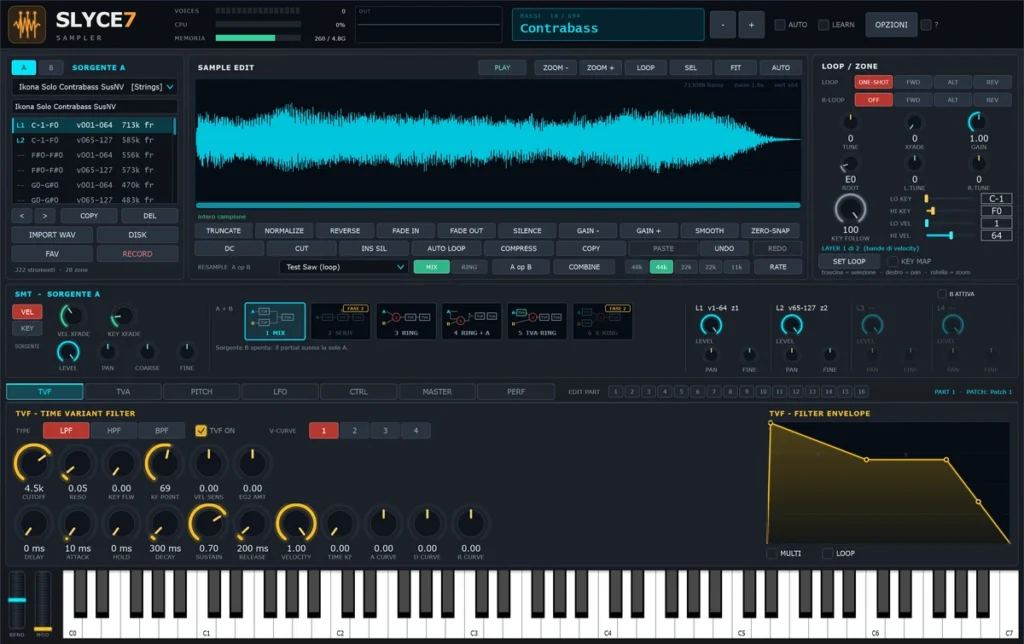
A bank of zones mapped across keys and velocity, an editor that works on the real PCM, a layer mix table with crossfades, a partial with two sources inside one voice, and a multitimbral side of 16 parts with 8 independent stereo outputs.
VST3 + Standalone v1.1.0 Windows 64-bit

Coming soon
Not in the shop yet.
VST3 + Standalone v1.1.0 Windows 64-bit
One licence covers both formats. The library installs separately. 12 months of updates from purchase; the instrument keeps working afterwards.
You cut the sample, normalise it, find its loop, give it keys and a velocity band - and from there it becomes an instrument.
That is the working model of the large rack samplers of the late Eighties - source, editing, mapping, performance - with the addition of being able to open the discs of some of them.
The bank
The zone, the layer, the partial.
The base unit is the zone: a sample with its key range, its velocity range, its root key, fine tuning, gain and loop points. Above it, the layers; above them, the partial.
4 layers with crossfade
Velocity or keyboard position decides which layer speaks, and the crossfade softens the change of layer: at 0 it is a hard switch. Mix, or 4 ring structures.
Two sources per partial
Sources A and B, each with its own 4-layer table, multiplied or summed inside the same voice. Two multisamples that behave as one instrument, not two instruments stacked.
Cubic reading
Catmull-Rom interpolation with corrected loop edges: the loop join does not click because the interpolator is given the right neighbours, not because a fade hides it.
Who it is for
For people who build their own instruments.
If you only want to play a library, most players will do. This is for the part before that.
Sound libraries
20 commands on the PCM and the loop with undo and redo, plus recording straight from the input, up to 12 s.
Studio rigs
16 parts and 8 stereo buses, assignable per part - one instance can be the whole rack, with each part on its own channel in the DAW.
Archive owners
It reads WAV, AIFF and FLAC, and also the discs of Akai and Roland samplers and, for E-mu, the samples of single banks, so material that has been sitting unreadable can be played again.
Filter and envelopes
One filter model, 6 types - and envelopes that can be drawn.
A digital multimode filter at 12 dB with 6 types. Above it, 3 envelopes - amplitude, filter and pitch - each of which can be a full DAHDSR or a four-point rate/level shape, which is the idiom the rack samplers used.
- 3 envelopes: amplitude, filter, pitch
- 2 LFOs, free or synced, reaching 37 destinations
- 280 parameters, with MIDI Learn on any control

Performance
16 parts, 8 stereo outputs.
Each part has its own patch, its own effects and its own output bus. The voice ceiling adapts to the measured load: a polyphonic sampler is expensive per voice, and without that a fast passage would saturate.
- Up to 64 voices per part, with an adaptive ceiling on measured load
- 8 stereo buses, assignable per part
- Parameters and effects published double-buffered with an atomic index - no locks on the audio path

The library
84 instruments, 694 factory patches.
The instrument installs separately from its library, so the plugin stays small and the material can grow without a new release. With the library installed there are 694 patches, all exposed to the host as programs.

What is measured
280 parameters, and a bank that proves each one moves the output.
The registered tests cover the engine and the bank, the real processor path with the editor instantiated, an audio anti-regression net, a parameter completeness bank that drives every control to full scale and measures whether the output changes, and the activation outcomes.
Voice allocation is conditional: the sampler builds the sample reader and leaves out the FM core, the oscillator pair and the synthetic oscillators it does not use, and of the six filter models it builds one. That is memory not spent, on an instrument where each voice already costs a lot. On top, validation at severity 10.

Specifications
Keep looking
Looking for something else?
The other instruments and effects are one click away.
Downloads
Try Slyce7
Slyce7
The machine that builds libraries
A bank of zones mapped across keys and velocity, an editor that works on the real PCM, a layer mix table with crossfades, a partial with two sources inside one voice, and a multitimbral side of 16 parts with 8 independent stereo outputs.
No release for this instrument yet.