Six-operator FM synthesis
Tine7
Tine7
All level and time mathematics is integer, in a fixed-point format, with the tables of the original: a thousand-point log-sine lookup, an exponential table, a frequency table. The operators are pure sines, the envelopes are logarithmic and integer, the feedback is the average of two consecutive samples.
VST3 + Standalone v1.0.0 Windows 64-bit


Coming soon
Not in the shop yet.
VST3 + Standalone v1.0.0 Windows 64-bit
One licence covers both formats. Twelve months of updates included; the instrument keeps working afterwards.
The choices that make this timbre recognisable are consequences of the model, not corrections applied afterwards.
A floating-point implementation of the same algorithm sounds cleaner and less like the thing. The rounding, the table resolution and the envelope quantisation are not defects to be smoothed away: they are where the character lives.
The core
6 operators, 32 algorithms, 24 active parameters each.
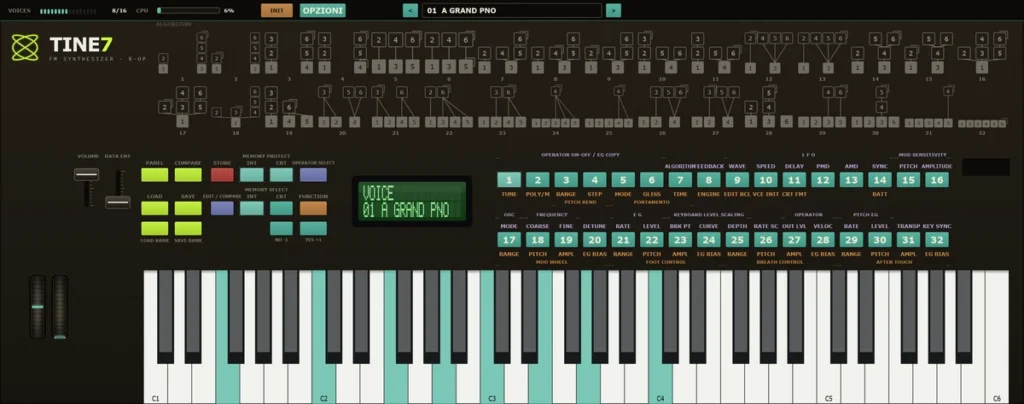
The 32 classic six-operator algorithms - the ones the factory bank and the panel actually use - drawn on the panel as they were drawn on the original.
Two engines
Faithful runs the core at 49096 Hz, with the aliasing of the period included rather than removed. Clean runs at double rate with anti-aliasing, for when you want the algorithm without the artefacts.
Frequency
A coarse grid of 0-31 by a fine grid of 0-99, giving ratios from 0.5 to 61.7 - or a fixed frequency, which is how bells and noises are made.
Envelopes
4 rates and 4 levels per operator, plus a global pitch envelope. Logarithmic and integer, like the rest of the core.
Who it is for
For the sounds that only this arithmetic makes.
Electric pianos, bells, and basses with an attack that no filter can produce, because the attack is a change of spectrum rather than a change of brightness.
Classic FM sounds
128 original factory voices in 4 pages of 32, plus writable user slots.
Existing libraries
System-exclusive import and export: single voice of 163 bytes and a bank of 32 voices of 4104 bytes. What you have keeps working.
Modern playing
MPE, micro-tuning from standard scale files, FM unison up to 8 voices, and a 4-row modulation matrix on top of the period core.
No filter, and that is the point
The amplitude is governed entirely by the carrier envelopes.
The shared engine has filters; this instrument keeps them switched off. This family of synthesis does not have a filter, and adding one would let you round off exactly the edges the arithmetic exists to produce. Brightness here is an amount of modulation, not an open cutoff.
- 6 pure sine operators - no other waveform, by design
- Feedback as the average of two consecutive samples
- 32 algorithms, chosen on the panel as a picture rather than as a number

The panel
A membrane panel and a character display, or 4 tabs when you are in a hurry.
The instrument edits like the hardware: one parameter at a time, chosen with a numbered key and set with the data control. When that is too slow, the advanced editor shows all 6 operators at once on 4 tabs. Both write to the same voice - the panel is a way of working, not a limitation.

The advanced editor
4 pages the original never had, over a core that has not changed.
Press PANEL and the membrane header folds away: in its place are the 4 pages that show at once what the character display shows a slice at a time. It is not a second engine. It writes the same parameters of the same voice, and the fixed-point core underneath never learns the difference.
- ALGO / MIX / GLOBAL - the 32 algorithms as a grid you pick by looking, the pitch envelope drawn, LFO and master on the same page
- OPERATORS - the 6 operators one per row, each envelope drawn beside its 24 parameters: no menu to walk through
- MOD / RANDOM - spectrum analyser, the algorithm diagram lighting up the operators that are actually sounding, a 4-row modulation matrix, and morphing between the current voice and another one from the bank
- VOICE / MPE / TUNE - FM unison up to 8 voices, per-note MPE, and micro-tuning from standard scale files

What is measured
Bit-for-bit determinism, and a hash over every factory voice.
The core has unit tests with zero tolerance on the tables, an end-to-end test that proves two identical renders are bit-for-bit identical, and a headless tool that renders all 128 factory voices and hashes them - so any unintended drift shows up as a changed number rather than as a feeling.
The output stage passes the signal unchanged sample by sample below 0.9 dBFS; only above that does a continuous soft knee compress the peaks of dense polyphony. There is no global waveshaping at normal levels - a period core deserves an output stage that does not colour it.


Specifications
Keep looking
Looking for something else?
The other instruments and effects are one click away.
Downloads
Try Tine7
Tine7
Integer arithmetic, on purpose
All level and time mathematics is integer, in a fixed-point format, with the tables of the original: a thousand-point log-sine lookup, an exponential table, a frequency table. The operators are pure sines, the envelopes are logarithmic and integer, the feedback is the average of two consecutive samples.
No release for this instrument yet.