Channel strip
StripL
StripL
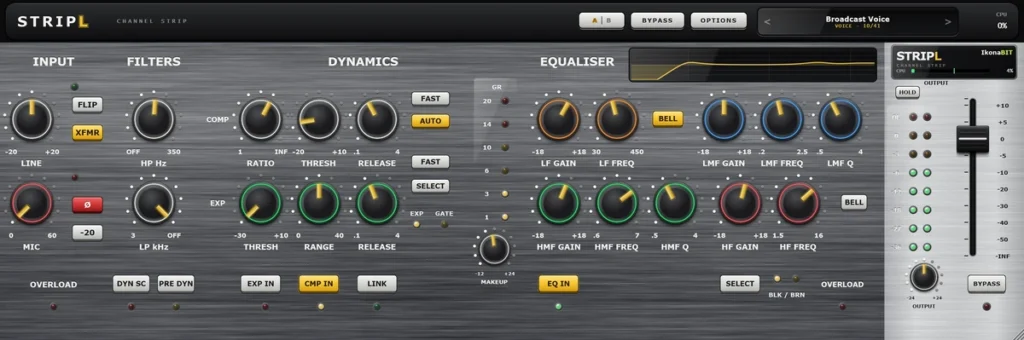
A channel strip laid out like a classic console channel: line and mic input with a transformer stage, high-pass and low-pass filters, a VCA compressor and an expander or gate, and a four-band equaliser with two characters. The only stages that saturate are the transformer and the compressor path; filters and EQ stay linear. 41 factory presets are one click away, and your own can be saved as files.
v0.2.1

betadownload and try
Perpetual licence · 12 months of updates · full trial before you buy
In beta, and you try all of it
This is not a cut-down version: it is the complete instrument. We are asking you to use it and tell us what does not add up.
3 seconds at −18 dBFS · the clock restarts at every launch
v0.2.1
Every licence covers both formats. Until a licence file is activated the plugin runs in trial: the first 10 minutes of each session are clean, then a 3-second noise burst at -18 dBFS every 3 minutes, and offline renders are degraded. Factory presets always work; saving and loading your own needs the licence.
Only two stages colour the sound. The rest stays exact.
The input transformer and the VCA path of the compressor are the nonlinear parts, and both are protected against aliasing: the transformer runs at twice the sample rate, and the worst alias measured on it is -114 dB. Filters and EQ are linear, so the equaliser does to the signal what its curve says.
How it is built
One signal path, and the order is yours to change.
The modules follow the console. What changes is where the dynamics and the filters sit.
Console signal path
Input with line gain, mic gain, polarity inversion, a 20 dB pad and a transformer stage; then filters, dynamics and EQ; then fader and output. FLIP puts the dynamics after the EQ, PRE DYN puts the filters before the dynamics, and DYN SC feeds the compressor's detector from the filters while the audio goes through unfiltered.
One gain element, two jobs
The compressor and the expander or gate act on the same VCA, with their reductions summed in dB, as on a console. The compressor runs from 1:1 to infinity, with a 6 dB soft knee and an attack of 3 ms, or 300 µs with FAST.
Linear where it matters
The high-pass is third-order, 18 dB per octave; the low-pass is second-order, 12 dB per octave; the EQ is minimum phase. Only the transformer and the compressor path add anything to the signal.
Who it is for
For the channel you would build a mix on.
One plugin from the preamp to the fader, with the order of the modules in your hands.
Voices and instruments
Mic gain up to 60 dB, the pad and the transformer on the way in, then the filters, a compressor and the EQ. The factory bank has 41 presets in 9 categories, from Voice and Drums to Master.
Drums and buses
An expander or gate with threshold, range and release, a stereo LINK, and a compressor that reaches an infinite ratio. DYN SC takes the detector signal from the filters, so the low end does not pump the compressor.
Anything that has to stay put in the session
Latency is fixed at 31 samples with every module on or off, so the host compensates once. In bypass the output is the input delayed by that amount, bit for bit.
StripL and StripL Lite
What the full edition has that the Lite does not.
Both share the filters, the four EQ bands, the compressor, the preset bank and the parameter identifiers, and both have the same fixed latency. This is what only StripL carries.
| StripL | StripL Lite | |
|---|---|---|
| Input | Line gain, mic gain, polarity, 20 dB pad, transformer | Not included |
| Compressor | Threshold, ratio, release, FAST, AUTO, makeup | Threshold, ratio, release, makeup |
| Expander and gate | Threshold, range, release, gate or expander | Not included |
| Module order | FLIP, PRE DYN, DYN SC and stereo LINK | Not included |
| EQ character | BLK and BRN | BRN only |
| Presets | 41 | 25 |
| Panel | 1540 × 482 | 1150 × 482 |
| Licence | In trial until a licence file is activated | FREE, licence from your account |
Input and filters
From the preamp to the cut.
Line gain of plus or minus 20 dB and mic gain from 0 to 60 dB are summed into one smoothed gain, followed by the polarity switch, the 20 dB pad and the transformer. The transformer adds even harmonics through a biased core: the second harmonic is 0.16 % at -18 dBFS and 0.88 % at -3 dBFS. Then the high-pass, from 16 to 350 Hz, and the low-pass, from 3 to 22 kHz, both out of circuit at the end of their travel.
- XFMR is a switch, and the amount of even harmonics is fixed: it is the character of the iron, not a parameter
- With XFMR off the stage passes the signal bit for bit, delayed by 31 samples
- The filters can sit before or after the dynamics (PRE DYN) or only feed its detector (DYN SC)

The equaliser
Four bands, two characters.
LF (30–450 Hz) and HF (1.5–16 kHz) are shelves that switch to bells; LMF (200–2500 Hz) and HMF (600–7000 Hz) are bells with a Q from 0.5 to 5. The curve of the whole EQ is drawn above the knobs. The two characters change bandwidth and ceiling, not the structure: BLK keeps the full Q and sharper shelves, to carve, with up to 18 dB per band; BRN opens the bells to about 1.6 times the bandwidth, with gentler shelves and up to 15 dB, for broad strokes.

Dynamics
A compressor and a gate that share one VCA.
The compressor has a threshold from -20 to +10 dB, a ratio from 1:1 to infinity and a release of 100 ms–4 s; the attack is 3 ms, or 300 µs with FAST. AUTO runs two release networks in parallel and the larger reduction wins, so short transients recover quickly and sustained material does not pump. The expander or gate has a threshold from -30 to 0 dB, a range of 0 to 40 dB and 2 dB of hysteresis. MAKEUP, from -12 to +24 dB, comes after the dynamics.
- Gain-reduction meter in six LED steps, from 1 to 20 dB
- LINK couples the two channels of a stereo signal
- With the compressor and the gate off and makeup at 0 dB, the dynamics leave the signal path

What is measured
Fixed latency, and a preset bar that does not click.
Latency is 31 samples, declared once to the host and the same with every module on or off, bypass included. Loading a preset crossfades over 6 ms, so changing preset on running audio leaves no step.
All 40 parameters can be automated. The factory presets are technical starting points, not tuned by ear: thresholds are in dBFS and the EQ is moderate, ready to be adjusted on your own sources. A preset rewrites every sound parameter, so nothing is left over from the previous one. User presets are saved as files, one folder per user, and saving or loading them is part of the licensed version.
Specifications
In short
A channel strip you can reorder.
Input, filters, a VCA compressor, an expander or gate and a four-band EQ in one plugin, 41 presets, and 31 samples of fixed latency.
Downloads
Try StripL
Each download is the Windows installer, a single .msi file. It installs for all users, so Windows asks for administrator rights; under each release there is also the .exe installer, inside a ZIP.
StripL
The whole console channel, in one plugin
A channel strip laid out like a classic console channel: line and mic input with a transformer stage, high-pass and low-pass filters, a VCA compressor and an expander or gate, and a four-band equaliser with two characters. The only stages that saturate are the transformer and the compressor path; filters and EQ stay linear. 41 factory presets are one click away, and your own can be saved as files.
ikonabit-StripL-0.2.2 beta
VST3Standalone
File names
- ikonabit-StripL-0.2.2.msi
ikonabit-StripL-0.2.1 beta
VST3Standalone
File names and previous versions (1)
- ikonabit-StripL-0.2.1.msi
ikonabit-StripL-0.2.0 beta
VST3Standalone