MIDI generator
Kinetik
Kinetik
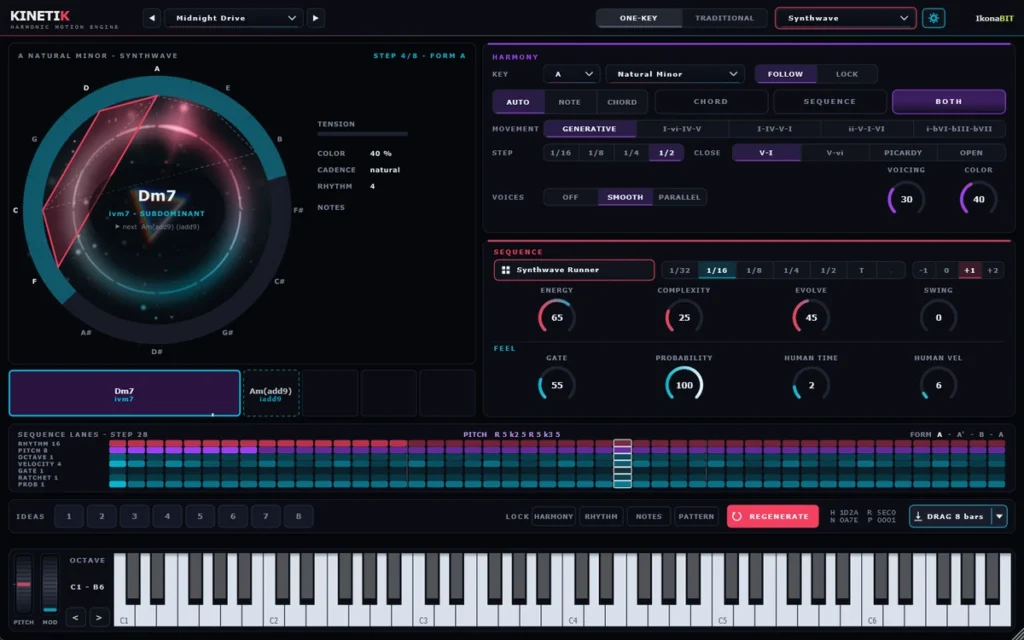
Kinetik is a MIDI effect: notes in, notes out, no audio. Put it on an instrument track and a key, or a held chord, becomes harmony that moves, written in one of 11 genre languages and driven by 4 visible seeds you can lock, regenerate and take into your DAW as a .mid clip.
v1.0.0

betadownload and try
Perpetual licence · 12 months of updates · full trial before you buy
In beta, and you try all of it
This is not a cut-down version: it is the complete instrument. We are asking you to use it and tell us what does not add up.
3 seconds at −18 dBFS · the clock restarts at every launch
v1.0.0
VST3, Windows 64-bit. The licence is assigned from your account on ikonabit.com and tied to your computer. Without a licence the plug-in runs as a demo: the first 10 minutes of a session are clean, then the MIDI output is interrupted in cycles, and .mid export and your own programmes are disabled.
It makes no sound. It decides what is played.
Kinetik sits in front of an instrument and answers the keys you hold with chords, a riff and a progression that knows where the phrase ends. Every choice comes from 4 numbers shown on the panel and saved with the project: the same project, looped, moved or reopened, plays the same notes.
Two engines
One key that plays a phrase, or every key a chord.
You choose how the keys you play are read. Both engines share voicing, riff, feel and output.
One-Key
One key is the tonic and the progression moves by itself, in phrases of eight steps. FOLLOW transposes it with the key; LOCK keeps the key and lets the note you play choose the degree it restarts from.
Traditional
Every key is a chord, stacked in thirds along the scale and voiced by VOICING and VOICES. The engine to use with a keyboard under your hands, and the default.
A language per genre
11 genres, each with its own vocabulary of chords, functions, tensions and cadences: 299 chords in all, with 121 substitutions. COLOR sets how far from the key the progression travels.
The idea
Chance you can keep.
What Kinetik chooses at random comes from 4 16-bit numbers, shown in the idea bar as H R N P and saved with the project.
Four seeds
Harmony picks the chords and the harmonic rhythm. Rhythm decides which optional hits of the riff stay. Notes slides the line against the rhythm and places the ornaments. Pattern picks which of three patterns Auto proposes for the genre.
Four locks
HARMONY, RHYTHM, NOTES and PATTERN hold what you like. REGENERATE draws new values for the rest and never the same twice; with a pattern chosen by hand it moves to another pattern of the same family.
Eight slots
Each slot stores every parameter except HUMANIZE and the MIDI out channel, plus the four seeds. Click to recall, Shift-click to store. They can also be recalled from a MIDI keyboard: eight notes from C-1 to G-1, or C0 to G0, chosen in the settings menu and removed from the input.
A clip for your DAW
DRAG takes 4, 8 or 16 bars of what you hear onto a track as a .mid file, or Export from the menu. The clip is rendered from a copy of the processor with the same state, so it is the live music, note for note.
Who it is for
For people who start from a chord, not from a blank grid.
Kinetik does not replace the part you would write. It proposes one, keeps it if you like it, and brings it back identical.
Writing
Hold a key and the next chord is already drawn on the panel. Lock what works, regenerate the rest, and keep 8 ideas ready to recall.
Playing
In Traditional every key you press becomes a voiced chord with a riff on top. Voice leading keeps the inner voices moving as little as possible: 38 semitones against 57 over twelve chords in C major, in the test.
Producing
Take the idea into the project: drag a 8-bar clip onto a track, or print it in NextTake. Same idea, same notes, every time the project is reopened.
Harmony
Chords that follow function, not a table.
In One-Key the next chord depends on the function of the one playing (from a dominant it goes almost always home, from a tonic it rarely stays), on a flow matrix per genre, on the push to resolve and on COLOR. The next chord is decided in advance and drawn on the panel: what is announced is what arrives.
- COLOR from 0 %, where every chord is diatonic to the scale, upwards: borrowed and altered chords enter in proportion to their tension, measured against the scale you chose
- 10 scales: Major, Natural, Harmonic and Melodic Minor, Dorian, Lydian, Mixolydian, Locrian, Pentatonic, Blues
- A phrase opens at home, prepares the close with a subdominant and ends on a formula: V-I, deceptive V-vi, Picardy third, or Open
- VOICING from triads to thirteenths and from close to open; VOICES Off, Smooth or Parallel
- Avoid notes respected: an extension that would clash is removed, never replaced by a note outside the key

The riff
34 patterns, three macros, a form that develops.
The riff is written as data, one lane per parameter: rhythm, pitch, octave, velocity, gate, ratchet and probability. 7 lanes of up to 32 steps each, so a seven-note line over a five-hit rhythm does not repeat until the two realign. Notes outside the chord are not written into the patterns: COMPLEXITY adds them, and at 0 every pattern plays chord tones only.
- Form A A′ B A: the theme, a variation, a development with the line inverted, the return. Above 70 % EVOLVE the theme itself changes every four phrases
- ENERGY thins or thickens the riff around its essential hits; above 60 % ratchets of up to four hits per step enter
- COMPLEXITY adds neighbour and passing notes on weak steps; above 40 % chromatic approach notes join, the only notes of the riff that can leave the scale. Ornaments never cross a chord change
- SWING from 0 to 75 %; RATE in 9 values, from 1/32 to whole notes, with triplets and dotted eighths

The library
34 patterns in 8 families.
Plus Auto, which picks the pattern for the genre. The six of the last family are the modes of a classic arpeggiator, written as patterns: every step is essential, so ENERGY does not thin them.
| Family | Patterns |
|---|---|
| Pulses | Pop Pulse · Octave Drive · Eighth Pump · Dyad Stabs |
| Melodic | Synth Run · Rising Spiral · Cascade · Broken Chord |
| Electronic | Trance Gate · Berlin Ostinato · Acid Line · Polymeter 5/16 · Pluck Echo |
| Classical / Cinema | Alberti · Cinematic Ostinato · Chorale Arp |
| Black music | Gospel Comp · Neo-Soul Slide · Funk Chop · Stride Hint |
| Urban | Trap Roll · Drill Slide · Lo-fi Lazy · Boom Bap Keys |
| Atmosphere | Ambient Drift · Bell Sparkle · Synthwave Runner |
| Arpeggiator | Up · Down · Up-Down · Converge · Random · Brownian |
The scope
The circle of fifths, with the chord drawn in it.
The scope shows the key as a band on the circle of fifths and the chord as a polygon, with the sounding notes lit on its vertices and the next chord dashed. At the centre sit the name, the numeral and the function; beside it, tension, COLOR, cadence, harmonic rhythm and notes. Under it, the eight steps of the phrase as blocks, with the current chord lit.

Reading your hands
It reads a held chord as a chord.
INPUT decides how the keys you hold are read.
AUTO, NOTE, CHORD
AUTO: a key is a key and a held chord is recognised. NOTE: every key on its own, never a chord. CHORD: as AUTO, and any two keys become the triad of the key that contains them.
Recognition
The keys of the first 30 ms of the gesture (or up to the next grid line when the transport runs) are read as the chord with the fewest extensions: 7 qualities, 10 extensions, inversions and slash bass. The bass you play stays at the bottom.
Time
With the transport playing, every step falls on the host grid, so a loop or a jump of the playhead plays the same sound. Stopped, the engine runs free at the host tempo, only while a key is held.
An output you can trust
Two chords asking for the same note retrigger it, and the note-off leaves only when the last owner releases it. If the event queue fills, new notes are dropped and note-offs never are. Bypass, stop, reset and CC 123 and 120 release everything Kinetik holds. Controllers, pitch bend, aftertouch, pedal and SysEx pass through untouched.
Traditional
Every key a chord, with your hands on a keyboard.
The engine for playing. Each key is brought to the scale (to the nearest note, downwards on a tie), stacked in thirds, opened by VOICING and tied to the previous chord by VOICES. The key is always KEY; in Traditional, GENRE only chooses the pattern when PATTERN is on Auto. Controls that mean something only in One-Key (STEP, MOVEMENT, CLOSE, COLOR, FOLLOW and LOCK) are dimmed on the panel, and the code agrees.
- VOICES Smooth moves the inner voices 38 semitones over twelve chords in C major; with Off it is 57, a third more
- A leap of an octave or more between two keys is read as a change of register, and the voice leading starts again
- PROBABILITY never removes the root

Factory programmes
48 programmes, a bank for every genre.
Init plus 47, exposed to the host as programs. Choosing one returns the seeds to their starting values, so it plays the same whatever you regenerated before.
| Group | Programmes |
|---|---|
| Init | Init |
| Pop | Golden Hour · Radio Pulse · Sunset Stabs |
| Rock / Anthem | Stadium Drive · Power Pump · Highway Anthem |
| Classical | Alberti Garden · Chorale Light · Nocturne Spiral |
| Cinematic | Ostinato Rising · Falling Stars |
| Jazz | Stride Avenue · Blue Arpeggio · Midnight Changes |
| Neo-Soul | Velvet Slide · Butter Keys · Chop Shop |
| Gospel | Sunday Comp · Praise Stabs · Choir Rise |
| Trap / Drill | Night Roll · Drill Glide · Ice Bells |
| Lo-fi | Dusty Morning · Boom Bap Study · Rain on Glass |
| EDM / Trance | Festival Gate · Supersaw Run · Pluck Horizon |
| Synthwave | Neon Runner · Berlin Night · Acid Boulevard |
| Keys (Traditional) | Keys Pulse · Keys Chords + Run |
| EDM, more keys | Euphoria Gate · Uplift Spiral · Big Room Stabs · Progressive Pluck · Sunrise Cascade · Polymeter Rave |
| Synthwave, more keys | Midnight Drive · Chrome Horizon · Retro Arcade · Outrun Sunset · Neon Acid · Night City Bells |
What is measured
Notes that open are notes that close.
A hanging note is the one defect a MIDI effect cannot afford, and no host scan listens to the musical content of the output. So the test drives the real processor block by block and checks that every note that lights is closed.
Also measured: 11 of 11 genres, with COLOR at 0, give only diatonic chords; all 34 patterns play in the scale and well formed in both engines; 44 runs of the genres through the engine, every note in the scale of its chord; HUMANIZE TIME set to 50 ms peaks at 50.0 ms, mean 16.4 ms.
In the DAW
Verified in NextTake. Not claimed anywhere else.
Kinetik is declared as a MIDI effect: MIDI in, MIDI out, no audio bus. A host that can route a plug-in's MIDI output can place it in front of an instrument. Only NextTake, the ikonaDSP DAW, has been tried with the real VST3, by automated tests that all passed. Other hosts have not been tested yet, so none is listed.
Seen as MIDI FX
The host sees no audio bus and classifies it as a MIDI effect, not among the effects.
Stops when told
With a held chord the arpeggio plays (9 attacks in four quarters), and stop silences everything without Kinetik starting again on its own.
On the grid
On a chord region it generates 26 attacks, all on the 1/16 grid.
The same, twice
State saves and reopens, and two exports of the same project are identical event by event. In NextTake the .mid is not dragged: Kinetik stays on the track and printing MIDI FX onto the region gives the same 22 attacks as the arpeggio, within one tick.
Bypass and removal
No note left on within two blocks and no new attacks after bypass or removal.
Odd block sizes
Blocks of 1, 7, 32, 64, 100, 511 and 4096 samples, a buffer with no channels, the on-screen keyboard added to the host keys: covered by the engine test.
Demo and licence
Ten clean minutes, then in bursts.
Without a licence Kinetik runs as a demo. There is no sound to spoil, so the demo acts on the MIDI stream and on your files. The licence is assigned from your account on ikonabit.com and tied to your computer.
The first 10 minutes
Nothing is taken away: all the controls, all the factory programmes, the project state of the DAW and the host programs work as always.
Then a cycle
The output MIDI plays for 15 seconds and stops for 5, over and over. The engine keeps running and phrases advance as usual, but what falls in the 5 seconds does not go out. When the block starts Kinetik sends a note-off for every note it holds, so nothing hangs downstream. A status line at the bottom of the panel counts it. Time is counted in processed samples, and restarts at every new session.
Files
In the demo you cannot export or drag the .mid file, nor save or load your own programmes. Factory programmes always work. With a licence nothing is counted or blocked, and a licence that arrives while the panel is open unlocks it without reopening.

Specifications
In one line
A chord in, a phrase out.
2 engines, 11 genres, 34 patterns, 48 programmes, and an idea that comes back exactly as you left it.
Downloads
Try Kinetik
Each download is the Windows installer, a single .msi file. It installs for all users, so Windows asks for administrator rights; under each release there is also the .exe installer, inside a ZIP.
Kinetik
Chords and riffs from one held key
Kinetik is a MIDI effect: notes in, notes out, no audio. Put it on an instrument track and a key, or a held chord, becomes harmony that moves, written in one of 11 genre languages and driven by 4 visible seeds you can lock, regenerate and take into your DAW as a .mid clip.
ikonabit-Kinetik-1.0.0 beta
VST3
File names
- ikonabit-Kinetik-1.0.0.msi