Flanger
Rheos
Rheos
Two modes, 5 LFO shapes, feedback from -95 to +95 % and an optional filter in the loop. Latency, the dry signal and the LFO phase stay fixed while you play: they are measured, not promised.
v1.0.0

betadownload and try
Perpetual licence · 12 months of updates · full trial before you buy
In beta, and you try all of it
This is not a cut-down version: it is the complete instrument. We are asking you to use it and tell us what does not add up.
3 seconds at −18 dBFS · the clock restarts at every launch
v1.0.0
Every licence covers both formats. Until a licence file is activated the plugin runs in trial: the first 10 minutes of each session are clean, then a 3-second noise burst at -18 dBFS every 3 minutes, and offline renders are degraded.
The latency, the dry signal and the LFO phase do not move.
Here the latency is the same in both modes and at every setting, the dry signal is always delayed by the same amount, and the LFO is a pure function of position - so two renders of the same session are identical, bit for bit.
The engine
Two paths, one delay line.
Classic and through-zero always run together and are cross-faded when you change mode, so the switch makes no click.
Classic
The wet signal trails the dry one. The delay starts at MANUAL (0.4-5 ms) and rises exponentially with DEPTH, capped at 20 ms: each octave of delay takes the same travel, which is how the ear follows the comb.
Through-zero
The dry signal is delayed too, so the wet one can pass in front of it. The offset crosses zero when DEPTH is above 50 %, and the comb closes and reopens. With POLARITY at minus the sound cancels at the crossing.
Sinc interpolation
Fractional delay is read with a 32-point windowed sinc, not a linear or Lagrange interpolator, which lose treble on every pass of the loop. Flat within 0.0004 dB up to 18 kHz at 48 kHz.
Who it is for
For sweeps you can repeat.
A flanger is judged by what it does when the session is bounced, automated and reopened.
Mixing and bounces
Two offline renders of the same session are identical, bit for bit, wherever the render starts: the LFO phase comes from the position, not from a counter.
Movement in time
RATE locks to the host tempo on 15 divisions, from 8/1 to 1/32, dotted and triplet included. If the host gives no tempo, 120 bpm is assumed.
Mono sources
Stereo phase from 0 to 180 degrees offsets the right-hand LFO from the left. A mono track into a stereo output starts with the right channel as a copy of the left, so the phase still opens the field.
What Rheos adds
What the full edition has that the Lite does not.
Both share the delay line, the latency, the bypass, A | B and the parameter identifiers, so a session moves between them. This is what only Rheos carries.
| Rheos | Rheos Lite | |
|---|---|---|
| Modes | Classic and through-zero | Classic only |
| Base delay (MANUAL) | 0.4-5 ms | Fixed at 1 ms |
| LFO shapes | 5: sine, triangle, saw, square, sample and hold | Sine |
| Filter in the loop | 500 Hz to 20 kHz, or off | Off |
| Stereo phase | 0 to 180 degrees | Fixed at 90 degrees |
| Polarity | Plus or minus | Plus |
| Output level | -12 to +12 dB | Fixed at 0 dB |
| Factory presets | 20 | 8 |
| Latency | 256 samples (5.33 ms at 48 kHz) | The same |
| Licence | Trial until a licence is activated | FREE, licence from your account |
The comb
A display computed from the real state of the flanger.
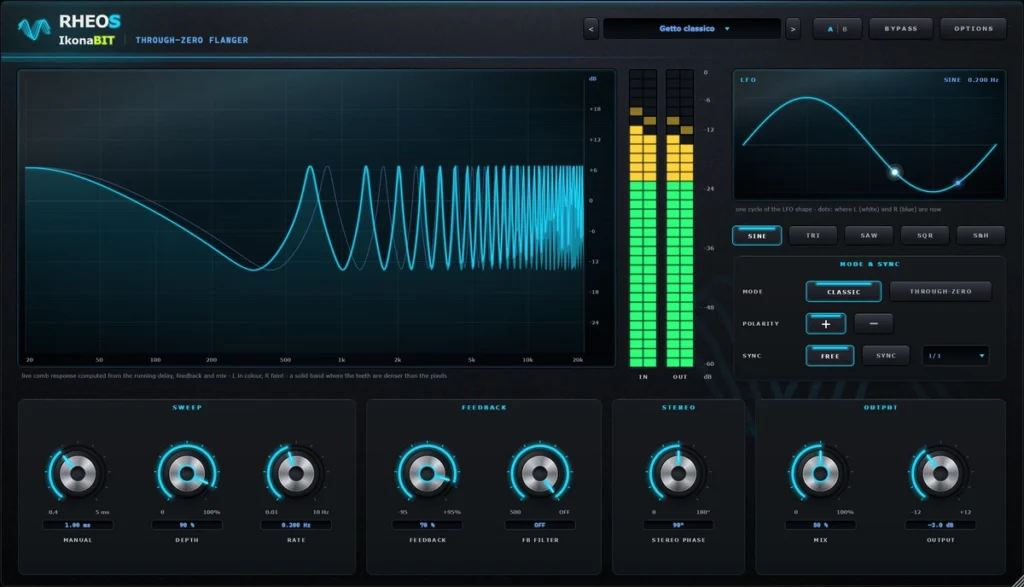
The curve is not a drawing: it is computed from the running delay, feedback and mix at every block, left channel in colour and right channel faint. With a delay of 1 ms the first notch sits at 500 Hz. Each column shows the true minimum and maximum of the comb over the band it covers, so narrow notches are not lost. The measured comb matches the computed one to 0.0000 dB away from the notches, and the first notch falls below -200 dB. The null of through-zero is brief by nature: the delay crosses zero rather than stopping there, and with feedback on the recirculation fills it in.
- Classic: the delay runs from MANUAL upwards, capped at 20 ms
- Through-zero: the wet signal oscillates around the dry one and can pass in front of it
- POLARITY at minus turns the teeth of the comb into notches

LFO and sync
5 shapes, each a pure function of position.
Sine, triangle, saw, square, and sample and hold. Because each shape depends only on where it is in the cycle, a render that starts anywhere gets the same phase. With SYNC on, one cycle lasts one division and RATE chooses the division instead of the frequency; the speed is capped at 10 Hz, the top of RATE, even in sync. A change of shape is a cross-fade of 50 ms.
- 15 divisions, from 8/1 to 1/32, dotted and triplet included
- Free: 0.01-10 Hz
- Sample and hold draws one random level per cycle from a fixed seed: the same preset always sounds the same
- The right-hand LFO is offset by the stereo phase

Feedback
Up to 95 %, in a loop that cannot run away.
Positive feedback gives peaks, negative feedback a hollow comb with the resonances on the dry notches. The loop has a DC blocker, a limited write value and an input cleaned of non-finite values, and its second-order low-pass filter runs from 500 Hz to 20 kHz and is excluded at the end of travel. Because the delay moves inside the loop, every pass shifts the pitch again, so the slope of the sweep is limited to 0.15 samples per sample, about 15 % of pitch deviation. With MANUAL at 1 ms, full depth holds up to 5.43 Hz on a sine in classic mode; beyond that DEPTH counts for less than the knob says. It is the price of a loop that stays clean.

The panel
One window, every sound control in view.
The top bar is the one shared by the whole effects line: presets with their arrows, A | B, BYPASS, OPTIONS. Under it the comb display, the IN and OUT meters (32 segments, 0 to -60 dB, 2 s peak hold) and the LFO display, with two dots for where the left and right LFOs are now. Five titled boxes carry the controls: SWEEP, FEEDBACK, STEREO, OUTPUT, and MODE & SYNC. All 13 sound parameters have a control on the panel.
- Bypass delays the dry signal by the declared latency, with a 10 ms fade, while the flanger keeps running
- A | B: two complete copies of the sound, saved with the session
- Panel of 1500 x 860, scalable from 50 to 200 %
- 20 factory presets, also exposed as host programs

What is measured
A constant 5.33 ms of latency, in both modes.
The latency is 5 ms plus half the interpolation window, declared once when playback is prepared. It does not depend on the mode, on the parameters or on the block size, and it is the same in bypass. Through-zero needs the dry signal delayed, so that the wet one can sit in front of it; Rheos pays the same in classic mode, so that changing mode never moves the dry signal or the host's compensation.
The bypass is measured too: with a sine at -12 dBFS and the bypass switched every 50 ms, the difference from the delayed dry signal is exactly 0 at steady state. The output is identical, bit for bit, with one block or with blocks of 1, 37, 512 or 8192 samples, in both modes. The audio path allocates nothing and takes no locks. One limit is worth knowing: near Nyquist the interpolator stops being transparent. At 0.45 of the sampling rate the response falls by up to 0.77 dB, and with high feedback on material rich above 18 kHz at 48 kHz the images recirculate.
Specifications
In short
A flanger that stays where you put it.
Classic and through-zero, 5 LFO shapes, feedback to 95 % and a constant 5.33 ms of latency.
Downloads
Try Rheos
Each download is the Windows installer, a single .msi file. It installs for all users, so Windows asks for administrator rights; under each release there is also the .exe installer, inside a ZIP.
Rheos
A through-zero flanger that holds still where it matters
Two modes, 5 LFO shapes, feedback from -95 to +95 % and an optional filter in the loop. Latency, the dry signal and the LFO phase stay fixed while you play: they are measured, not promised.
ikonabit-Rheos-1.0.0 beta
VST3Standalone
File names
- ikonabit-Rheos-1.0.0.msi