Limiter and mastering
Telos
Telos
A lookahead limiter for the last stage of the mix and of mastering. The peak is measured on the oversampled signal, so the ceiling holds where a converter or a codec reconstructs it. Around that guarantee: 4 styles, a two-stage release, dither with noise shaping and a loudness meter.
v1.0.0

betadownload and try
Perpetual licence · 12 months of updates · full trial before you buy
In beta, and you try all of it
This is not a cut-down version: it is the complete instrument. We are asking you to use it and tell us what does not add up.
3 seconds at −18 dBFS · the clock restarts at every launch
v1.0.0
Every licence covers both formats. Until a licence file is activated the plugin runs in trial: the first 10 minutes of each session are clean, then a 3-second noise burst at -18 dBFS every 3 minutes, and offline renders are degraded.
The ceiling is a property, not a setting.
The gain a sample receives is never higher than the gain the highest peak in its lookahead asks for, and the peak is measured on the oversampled signal. It survives any style and any release setting. The one switch that changes what it covers is TRUE PEAK, and the panel says so: with it off, the ceiling is written in dBFS.
The limiter
The gain moves before the peak arrives.
The signal waits in a delay line as long as the lookahead while the detector looks at what is coming, so the reduction is in place exactly when the peak reaches its sample.
Lookahead, declared
0.5 … 5 ms. Short is sharper and catches peaks on the fly; long descends more gently and distorts less on the lows. Every millisecond is latency, and Telos reports it to the host.
True-peak detector
The peak is estimated on a signal oversampled 2x, 4x or 8x, plus an estimate of the maximum between grid points. Only the detector oversamples: the audio passes through no oversampling filter and inherits no phase from one.
Two-stage release
A fast stage and a slow one, mixed. RELEASE is the time to 90 % of the recovery. In AUTO the weight of the slow stage follows how deep and how long the recent reduction has been, so a kick drum and a pad do not need the same setting.
Who it is for
For the last stage, where a number has to be true.
A limiter makes one promise. Everything else on the panel is there to serve it.
Mastering
True-peak detection up to 8x, dither to 16 or 24 bit with optional noise shaping, and a loudness meter on the output.
Delivery targets
20 factory presets, with ceilings and gains set for streaming, podcast and broadcast delivery. A ceiling of -1 dBTP leaves room for lossy codecs, which overshoot when they decode.
Stems and busses
Stereo link from 0 to 100 %, four styles, and presets for hard drums, safe vocals and soft busses.
What Telos adds
What the full edition has that the Lite does not.
Both share the same limiter and the same guarantee on the ceiling, and a session saved in one opens in the other. Telos Lite is the FREE edition. Telos runs in trial until a licence file is activated: the first 10 minutes of each session are clean, then a 3-second noise burst at -18 dBFS every 3 minutes, and offline renders are degraded.
| Telos | Telos Lite | |
|---|---|---|
| Controls on the panel | 13, one control for each | GAIN, CEILING, RELEASE, TRUE PEAK, and the bypass in the bar |
| Lookahead | 0.5 … 5 ms | 2 ms, fixed |
| Detection | 2x / 4x / 8x | 4x, fixed |
| Style | Transp, Balanced, Punchy, Loud | Balanced, fixed |
| Release | AUTO or manual | AUTO, always on |
| Stereo link | 0 … 100 % | 100 %, fixed |
| Output trim | -12 … 0 dB | 0 dB, fixed |
| Dither and noise shaping | Yes | Not included |
| Loudness meter | Yes | Not included |
| Parameters | 13, all automatable | Same identifiers, so sessions move between editions; five act: GAIN, CEILING, RELEASE, TRUE PEAK and bypass |
| Factory presets | 20 | 8, a bank of their own |
| Panel | 1500 x 860 | 1200 x 580 |
True peak
Measured where the converter would measure it.
A peak between two samples can exceed the samples themselves, and the converter or codec downstream reconstructs it. Telos estimates it with a polyphase interpolator at 2, 4 or 8 points per sample; the factor is reduced at high sampling rates (8x at 44.1 / 48 kHz, 4x at 88.2 / 96 kHz, 2x at 176.4 / 192 kHz). Against an independent 16x reference on pink noise, the overshoot beyond the ceiling measured +0.042 dB at 4x and 8x and +0.065 dB at 2x: a measurement, not a guarantee.
- Oversampling 2x, 4x or 8x, in the detector only
- Ceiling written in dBTP, or in dBFS when TRUE PEAK is off
- With TRUE PEAK off the detector runs at 1x: cheaper, 32 samples less latency, and the ceiling holds on samples only

Style and finish
Four styles, and dither for the last step.
The styles change the shape of the smoothing, the ratio between the two release stages and the speed of the fast one. Transp and Balanced use two cascaded averages for a rounder descent; Punchy and Loud use a single average, a ramp that is faster and harder. They can be changed while playing without breaking the ceiling. Dither requantises to 16 or 24 bit with TPDF dither after the output trim, with optional noise shaping that lowers the noise where the ear is most sensitive. Off, the signal passes bit for bit. Switch it on only if the final file has that bit depth.
- Transp · Balanced · Punchy · Loud
- Dither OFF / 16 / 24 bit, TPDF, optional noise shaping
- Output trim -12 … 0 dB, after the limiter

Loudness
Momentary, short-term, integrated, and the true peak held.
The meter follows ITU-R BS.1770-4 / EBU R128 on the output: momentary over 400 ms, short-term over 3 s and integrated, refreshed every 100 ms, plus the true peak held since the last reset. The weighting is designed from analogue parameters, so it is valid at any sampling rate. Test signals at -23 LUFS read -23 LUFS within 0.1 LU on all three. RESET clears the measurement, never the audio. Telos measures loudness; it does not correct it.

The panel
Thirteen parameters, thirteen controls.
The top bar is the one shared by the whole line: presets with their arrows, A | B, BYPASS, OPTIONS. Under it the level display scrolls right to left: the output envelope in colour over the input, which shows only where it exceeds the output - where the limiter is taking away - gain reduction in red from the top, and the ceiling as a dashed line. Then the IN, GR and OUT meters, the loudness readout, and seven boxes. All 13 parameters have a control on the panel, and every knob carries its reading with the unit.
- A | B: two complete copies of the sound parameters, saved with the session
- Declared latency equals spent latency, bypass included: the dry signal is delayed by the same amount, so switching neither shifts time nor clicks
- Panel of 1500 x 860, scalable from 50 % to 200 %

What is measured
Declared latency is spent latency.
At the factory values latency is 128 samples (2.67 ms at 48 kHz): the lookahead plus 32 samples of detector delay when TRUE PEAK is on. It does not depend on the oversampling factor or on the block size, and the test measures it with an impulse at 44.1, 48, 96 and 192 kHz.
Each preset writes all 12 sound parameters, so loading one leaves nothing of the previous. The test net runs every preset on the real processor with pink noise: values inside their limits, finite output, true peak no more than 0.1 dB above the ceiling.
Declared limits: there is no sidechain input, and Telos handles mono and stereo only, not multiband. It is not a normaliser. There is no hold stage, so with a fast release the gain follows the individual half-cycles of a bass and distorts it: for bass and sub use releases of 300 ms or more. With TRUE PEAK off the ceiling holds on samples only. Changing the lookahead changes the declared latency, and many hosts re-read it only when playback is stopped, so do not automate it during playback.
Specifications
In short
A ceiling that holds.
4 styles, a true-peak detector up to 8x, dither and a loudness meter, in 20 factory presets. The FREE Lite edition keeps the same limiter with four controls.
Downloads
Try Telos
Each download is the Windows installer, a single .msi file. It installs for all users, so Windows asks for administrator rights; under each release there is also the .exe installer, inside a ZIP.
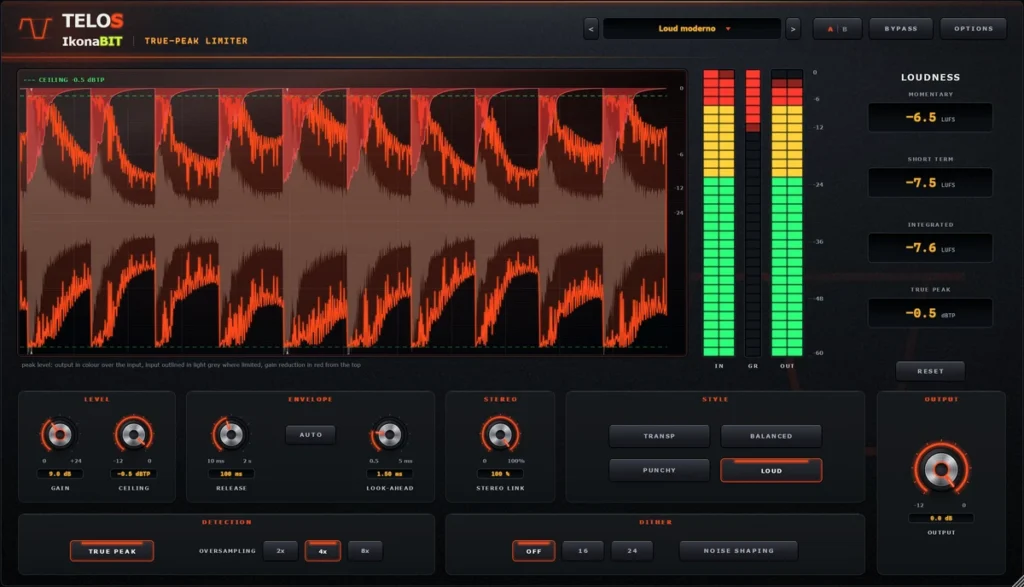
Telos
True-peak limiter with lookahead
A lookahead limiter for the last stage of the mix and of mastering. The peak is measured on the oversampled signal, so the ceiling holds where a converter or a codec reconstructs it. Around that guarantee: 4 styles, a two-stage release, dither with noise shaping and a loudness meter.
ikonabit-Telos-1.0.0 beta
VST3Standalone
File names
- ikonabit-Telos-1.0.0.msi