Two-oscillator monosynth - 32 keys
Laddy79
Laddy79
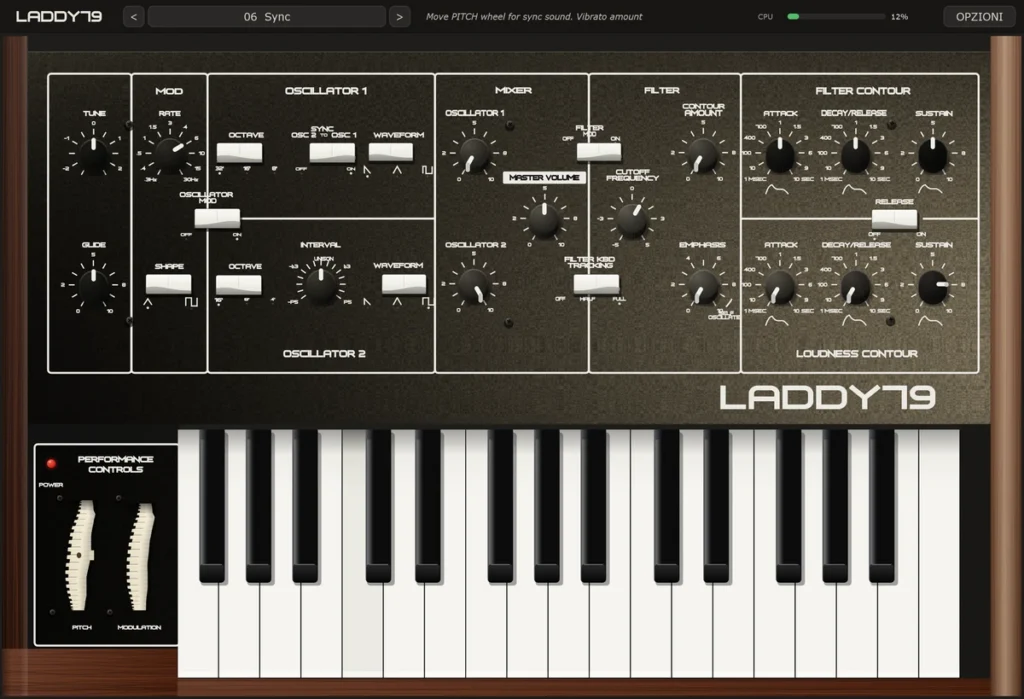
Not a chain of generic blocks with the right names: two ramp oscillators, a 4-pole transistor-ladder filter whose resonance reaches self-oscillation, a transconductance VCA that opens only past its transistor's junction, two contours built on RC time constants, a relaxation LFO and a low-note-priority keyboard with glide. The panel is the instrument's own, and every knob reads the value printed on its silkscreen.
v0.1.0

betadownload and try
Perpetual licence · 12 months of updates · full trial before you buy
In beta, and you try all of it
This is not a cut-down version: it is the complete instrument. We are asking you to use it and tell us what does not add up.
3 seconds at −18 dBFS · the clock restarts at every launch
v0.1.0
VST3 and standalone, Windows 64-bit. The full edition can be tried in full: 10 clean minutes each session, then short bursts of noise. There is no Lite edition.
One voice, no shortcuts.
26 panel controls, 28 automatable parameters. No noise generator and no ring modulator: the instrument does not have them, and the model does not add them.
How the sound is made
Ramp oscillators, a ladder, an OTA.
Each stage follows the law of the circuit it is built from, rather than an approximation of how it sounds.
Oscillators from a ramp
An exponential current discharges a capacitor from +6 V and a monostable restarts it in 1.5 µs. Sawtooth, triangle and pulse are all derived from that ramp, as in the circuit. The pulse is 10 % wide on oscillator 1 and 50 % on oscillator 2, and the width is fixed. Edges are corrected with a two-point polyBLEP.
A ladder that closes inside the step
Four transistor stages with one capacitor each, integrated with a linearly implicit trapezoid with prewarp: the feedback closes inside the step, not one sample late. The input pair saturates, and each stage is a transconductance integrator - not a linear filter with a tanh bolted on after it.
A VCA with a threshold
The OTA is driven through a common-base transistor, so it barely opens until the control passes the junction threshold: the first part of a slow attack stays almost silent, and gain is not linear with the contour voltage. The gain law is a 2049-point table, solved once with Newton's method on the transistor equation.
Who it is for
Three things a generic monosynth will not do.
Not a feature list: three consequences of the circuit that you can hear from the first notes.
Sync you can sweep
With sync on, the PITCH wheel goes to oscillator 2 only. That is the circuit's rule, not a convenience, and it is how the sweeping sync timbre is made.
Resonance to the limit
EMPHASIS grows mostly in the upper half of its travel and reaches self-oscillation near the top, where the panel prints SELF OSCILLATE. Below a few tens of hertz the loop opens, so the low end does not choke.
Contours that restart where they are
A new attack starts from the present voltage rather than from zero, so a note played before the last one has ended has no click. Played legato, the attack does not repeat at all.
The filter
Four poles, and a resonance that rings.
CUTOFF FREQUENCY runs from -5 to +5. With CUTOFF at 0, keyboard tracking off and no contour or modulation on the filter, the filter is tuned to ring at 666 Hz at full EMPHASIS. The frequency control is exponential, 18 mV per octave, with a soft ceiling at the top that stands for the tail current of the circuit.
- FILTER KBD TRACKING has three positions: OFF, HALF, FULL. At FULL the cutoff follows the keyboard octave for octave, which is the factory calibration.
- EMPHASIS feeds the fourth stage back to the input through a high-pass. The loop gain is calibrated the way the factory did it, and the resulting constants are rechecked by a test.
- Low-pass only, like the circuit: there is no HP or BP mode.

The oscillators
Two ramps, a sync, an interval.
OSCILLATOR 1 spans 32', 16' and 8'; OSCILLATOR 2 spans 16', 8' and 4'. TUNE is common to both. INTERVAL tunes the second against the first: UNISON at the centre, 8.33 semitones at full travel - the fifth is reached before the end, and the silkscreen says so.
- SYNC OSC 2 to OSC 1 resets the phase of oscillator 2 on the reset of oscillator 1, to a fraction of a sample.
- OSCILLATOR MOD sends the LFO, through the MOD wheel, to the oscillators as vibrato.
- The mixer takes the two oscillators and the external audio input. The only noise is the thermal noise of the mixer node, one microvolt, and it does nothing but seed the resonance loop.

Contours and amplifier
A capacitor, not a segment.
The two contours - FILTER and LOUDNESS - are not segment ADSRs: each one is the voltage of a capacitor. The attack charges towards +12 V through the knob, up to an 8 V threshold where the contour turns to decay; the decay falls towards the SUSTAIN level with the same constant. Times are printed from 1 ms to 10 s. With RELEASE off the release takes about 9.5 ms; with it on, as long as the decay. One detail the circuit imposes: the real time does not go below about 5 ms, so on the four time knobs the first sixth of the travel does not change the sound.

What is measured
The plug-in plays the machine that was measured.
The processor and the measurement tools use the same translation from panel to engine, and a test compares them to the bit on all 24 programmes. Block sizes of 512, 4096, 1 and 777 samples against 512 give the same bits, and so does a patch applied before or after prepare. 42 checks out of 42, rerun on a binary built the same day.
Levels differ between programmes the way the programme sheets they come from do: the output convention is one, for all of them. The median RMS across the 24 programmes is -22.8 dBFS. With MASTER VOLUME and the filter open you can pass 0 dBFS, as the real machine pushed hard into an audio interface does.
Specifications
In one line
A circuit, not a preset library.
32 keys, 26 panel controls, 28 automatable parameters and 24 factory programmes. No display and no scope, as on the instrument: you read the sound from the position of the controls.
Downloads
Try Laddy79
Each download is a ZIP file containing the Windows installer.
Laddy79
A 1979 two-oscillator monosynth, modelled at circuit level
Not a chain of generic blocks with the right names: two ramp oscillators, a 4-pole transistor-ladder filter whose resonance reaches self-oscillation, a transconductance VCA that opens only past its transistor's junction, two contours built on RC time constants, a relaxation LFO and a low-note-priority keyboard with glide. The panel is the instrument's own, and every knob reads the value printed on its silkscreen.
ikonabit-Laddy79-0.1.0 beta
VST3Standalone
File names
- ikonabit-Laddy79-0.1.0-setup.zip