Polyphonic synthesizer - 6 voices, 18 oscillators
Memo18
Memo18
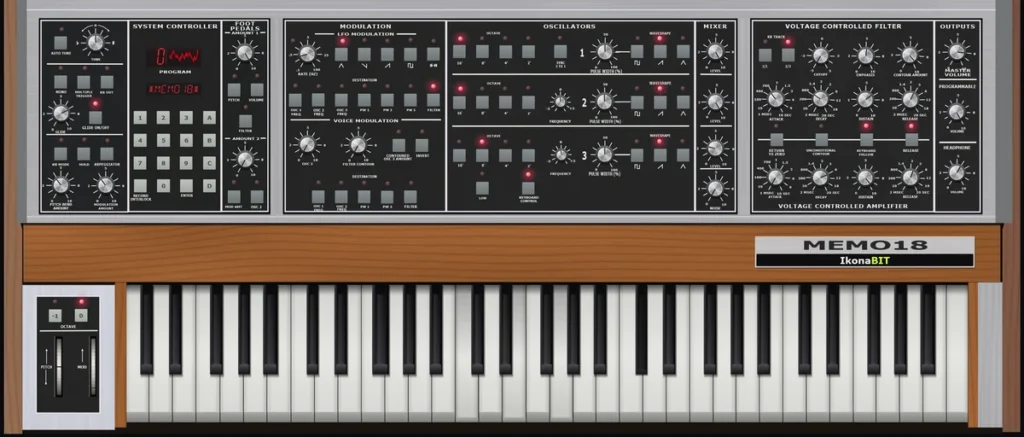
Every voice is a board of its own: three oscillators, a 4-pole transistor-ladder filter, two envelopes and an amplifier. The sound does not come from a wavetable or a generic filter model - it comes from what those circuits do when you push them: a summing stage that clips, a ladder that sings, eighteen oscillators that are never perfectly in tune.
v1.0.0

betadownload and try
Perpetual licence · 12 months of updates · full trial before you buy
In beta, and you try all of it
This is not a cut-down version: it is the complete instrument. We are asking you to use it and tell us what does not add up.
3 seconds at −18 dBFS · the clock restarts at every launch
v1.0.0
One licence covers both formats. 12 months of updates from purchase; the plugin keeps working afterwards.
Nothing here is a polite filter model.
At normal level the ladder works almost straight. The dirt comes from the summing stage before it and the amplifier after it - and both are in the model.
How the sound is made
Three oscillators per voice, and the shapes add up.
Saw, triangle and pulse are not alternatives: they sum. Nine sources reach one summing node per voice, and the node has a ceiling.
Sync is a window, not a reset
OSC 2 syncs to OSC 1 through a 100 µs window in which the output sits at the bottom, not through an instantaneous reset. That is why sync is heard as a waveform and not only as a pitch.
18 oscillators that drift
Each oscillator gets a fixed offset drawn from a Gaussian with a 3 cent standard deviation, depending only on voice and oscillator. Two renders of the same program are identical to the bit, but no two of the eighteen sit exactly where their neighbour sits: a chord never stands completely still.
One noise source, six voices
The noise is pink and a single source feeds all six voices, so it adds in phase: six voices against one measure 6.0 times in amplitude. Six independent generators would be a different machine.
What it is for
Three things it does that a generic polysynth will not.
Not a list of features: three consequences of how the circuit is built, audible on the first chord.
Chords that breathe
The drift is per oscillator and fixed per voice, so a held chord has the slow, uneven beating of real hardware rather than a flat, locked stack.
Leads and bass with an edge
Sync with a real window, a clipping summing stage and a ladder you can push into self-oscillation: the harsh end of the instrument is where it is most itself.
Played, arpeggiated, sequenced
9 arpeggiator modes clocked from the LFO or from the DAW transport, hold as a chord memory, MONO from one to 6 voices, and sequences of programs.
The filter
A 4-pole ladder, tracked from the keyboard.
24 dB per octave, with the cutoff input summed from the CUTOFF knob, the LFO, voice modulation, the filter contour, the pedal and a four-position keyboard tracking: none, one third, two thirds, full. Measured in octaves of cutoff per octave of keyboard, one third reads 0.327.
- EMPHASIS reaches self-oscillation: silent at 0.70 and 0.90, singing at 0.95, and a sine of 6.9 V peak to peak at full travel, with the third harmonic at -44 dB.
- The ladder runs 8x oversampled with a sixth-order decimator at 20 kHz (-85 dB at 45 kHz), so the harmonics of the singing loop do not fold back into the band.
- Declared limit: the pitch of the singing filter sits about 3 % under the nominal cutoff, a ratio of 3.875 where 4.00 would be exact.

Oscillators and mixer
Three oscillators, three shapes, one noise source.
Each oscillator has the 16', 8', 4' and 2' registers, its own pulse width (2 % to 98 %, never at the edges) and its own level in the mixer. OSC 3 can be cut loose from the keyboard to act as a modulator, or dropped by a factor of 34 (5.09 octaves, measured). The triangle comes out almost sinusoidal: its third harmonic measures -31.0 dB against -19.1 dB for a pure triangle, because the voice amplifier compresses.

What is measured
Every part against the formula of the circuit it comes from.
The bench does not compare the model with itself. Each block is checked against the closed-form response of its own network, and where the formula is not enough the value is tuned by ear and declared as such in the code.
The 120 self-validating golden checks are there to prove that the comparison can turn red. A net that cannot fail proves nothing.


Specifications
In one line
Six voices, eighteen oscillators, no shortcuts.
100 factory programs, all rewritable; 95 automatable parameters; 12 envelopes; zero samples of latency. A bank file saves and reloads the whole memory, and two expression pedals plus five switch pedals work from MIDI controls.
Downloads
Try Memo18
Each download is the Windows installer, a single .msi file. It installs for all users, so Windows asks for administrator rights; under each release there is also the .exe installer, inside a ZIP.
Memo18
Eighteen oscillators that never quite agree
Every voice is a board of its own: three oscillators, a 4-pole transistor-ladder filter, two envelopes and an amplifier. The sound does not come from a wavetable or a generic filter model - it comes from what those circuits do when you push them: a summing stage that clips, a ladder that sings, eighteen oscillators that are never perfectly in tune.
ikonabit-Memo18-1.0.0 beta
VST3Standalone
File names
- ikonabit-Memo18-1.0.0.msi