Bitcrusher / decimator
Shatter
Shatter
Two non-linearities, and you can measure them one at a time: the quantisation step and the hold period. Everything else about this plugin is the decision of HOW you set them - and the first decision is that RATE is a frequency, from 200 Hz up to off, not a division of whatever the session happens to run at.
v1.0.0

betadownload and try
Perpetual licence · 12 months of updates · full trial before you buy
In beta, and you try all of it
This is not a cut-down version: it is the complete instrument. We are asking you to use it and tell us what does not add up.
3 seconds at −18 dBFS · the clock restarts at every launch
v1.0.0
One licence covers both formats. 12 months of updates from purchase; the plugin keeps working afterwards.
The alias is not a defect here. It is the product.
Which is why there is no oversampling, and why the one control that governs the alias had to be measured until it actually did.
The engine
The order of a real converter
First you SAMPLE, then you quantise the value that was held. Invert them and you quantise a number that is thrown away a moment later, so the audible step is the wrong one.
A frequency, not a ratio
"fs/12" is 4000 Hz at 48 kHz and 3675 at 44,1: the same saved value would be two different sounds. RATE spans 7,9 octaves from 200 Hz to 48 kHz, and the decimation factor is the consequence.
16 bits down to 1, continuously
Mid-riser quantisation: N bits give exactly 2^N codes, so at 1 bit you hear 2 levels and not three. The steps the panel draws are the ones the engine produces, not a second copy of the rule.
Jitter is time, not level
Each hold draws the next period at random: it is the flaw of a cheap clock, and it cannot be faked by adding noise. One generator per channel, so the two sides err independently and the stereo image opens instead of dirtying the centre.
What it is for
Three ways in
The 30 factory programs are grouped in 5 families, and the families are the answer to "what do I do with it".
Period converters
A rate and a bit depth that were once a machine, from the studio sampler to the intercom. Here the value on the knob is the figure that class of gear actually ran at.
Dirt in parallel
MIX below half: the grain is added underneath the programme instead of replacing it, and the dry keeps the transient. This is the use that survives a mix.
Destruction, and a way back
When the crush IS the sound, OUTPUT pays the bill in level - and TONE decides how much of the top survives, with real authority: 26,0 dB across its travel.
The panel
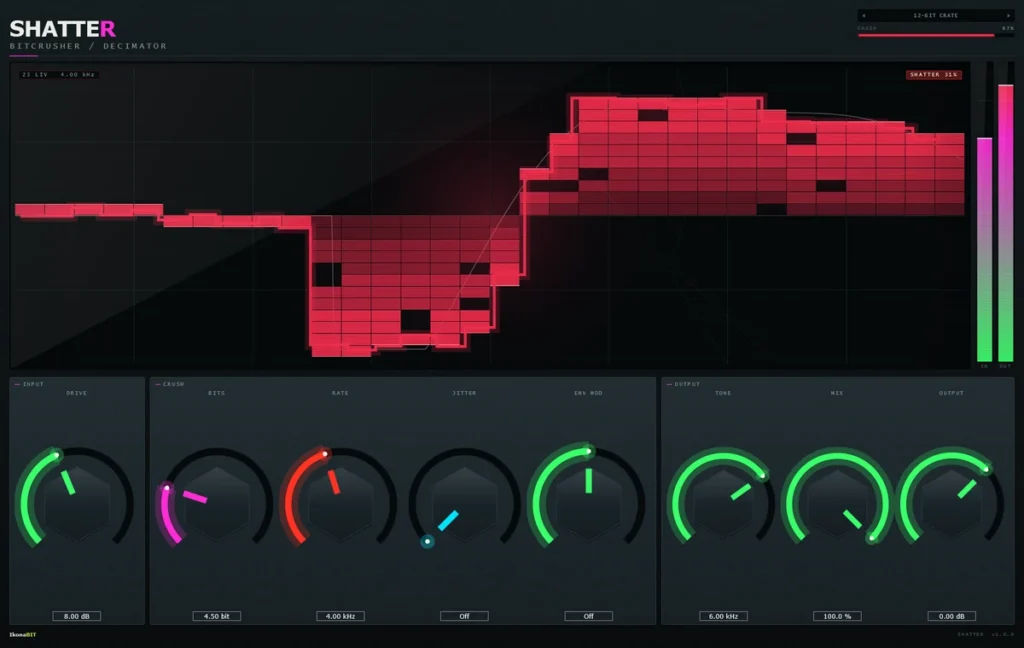
Before and after, in the same frame.
The display does not draw the parameters, it draws the SIGNAL that went through - and it draws the one that went in as well, from two separate queues that start on the same block. The difference between two signals drawn at different instants is not the difference between the two signals.
- Level grid taken from the engine, not a copy of the rule
- The badge states the levels and the rate that are actually playing
- With ENV MOD on, the display follows the effective values, not the knobs

The controls
8 controls, and both ends of each one are exact.
RATE is smoothed in octaves, not in hertz: a linear run would spend nine octaves in a tenth of the travel. ENV MOD moves bits by subtraction and the rate by octaves, downwards - sampling slower is breaking more - so the two work in the same unit and the same direction.

Measured
How do you measure a plugin whose defect is the point?
You cannot measure "how much alias there is" and call it an error. So the bench does the only honest thing: it computes from the TOPOLOGY how much there must be - the Dirichlet kernel of the hold - and compares. Across 10 images the deviation is 0,01 dB. The decimator is exact, and that is what let us find the real defect: the tone control did not govern what the product said it governed.
At rest everything that is not the tone sits at -92,0 dB, and on silence the output residue is 0,160 microvolts: the DC blocker at 12 Hz is there for that, and it is measured.
Specifications
In short
A destroyer you can steer
Everything here is continuous and smoothed per sample, so automation never steps. Both ends of every control are exact: TONE off is y = x with no residue, RATE off is a factor of exactly one. A plugin whose neutral positions are only *nearly* neutral is a plugin you cannot trust for the other ones.
Downloads
Try Shatter
Windows downloads are installers (.msi, or the .exe inside a ZIP); macOS downloads are .pkg installers.
Shatter
Sampling in hertz, not in ratios
Two non-linearities, and you can measure them one at a time: the quantisation step and the hold period. Everything else about this plugin is the decision of HOW you set them - and the first decision is that RATE is a frequency, from 200 Hz up to off, not a division of whatever the session happens to run at.
ikonabit-Shatter-1.0.0 beta
VST3AUStandalone
File names
- ikonabit-Shatter-1.0.0.pkg
- ikonabit-Shatter-1.0.0.msi