Circuit-modelled polysynth - 6 voices, 61 keys
Aura60
Aura60
A master runs at 1.9 MHz and two 16-bit dividers hand each voice its note. That single fact decides how the instrument behaves: chords cannot drift apart, because every voice comes from the same crystal - and the voices are coherent, so what you hear when they sum is the machine, not six independent synths playing together.
v1.0.0


betadownload and try
Perpetual licence · 12 months of updates · full trial before you buy
In beta, and you try all of it
This is not a cut-down version: it is the complete instrument. We are asking you to use it and tell us what does not add up.
3 seconds at −18 dBFS · the clock restarts at every launch
v1.0.0
VST3, CLAP and standalone application on Windows 64-bit; VST3, Audio Unit and standalone on macOS; LV2 and CLAP on Linux. Perpetual licence, 12 months of updates from purchase.
The filter does not hear a knob. It hears a sample of one.
One control-voltage bus, multiplexed across the voices, held for 750 us per voice. The cutoff of a note sits still between two passes - and on a fast arpeggio you hear that step.
How the sound is made
One master, 6 voices, and every stage is the part on the schematic.
Not a block diagram with analogue-sounding names: each stage is modelled as the component it is, and each constant carries the page it was read from.
The DCO divides, it does not oscillate
Sawtooth, pulse with modulated width, sub an octave down and noise, all summed at the node with the resistors of the schematic. Tuning cannot drift between voices because there is nothing to drift: they share a master.
Four poles, and a sampled control
The filter is a four-pole ladder at 0.30 V/oct, open to 30 kHz. Its control bus is multiplexed: each voice is refreshed every 750 us, and in between the cutoff is frozen. That is the circuit, and it is audible.
One noise source for the whole machine
There is a single generator, as on the board. Hold six notes and the hiss adds six times in phase while the signal does not: the floor rises by 15.6 dB. It is not a flaw in the model, it is the consequence of sharing one part.
Who it is for
Three things you hear on the first chord.
Not a feature list: three consequences of the architecture.
Chords that do not drift
Every voice divides the same master, so no interval can go out of tune against another. The movement you hear on a held chord is the chorus, and nothing else.
A bank that was read, not invented
The 56 factory patches come from the original data cassettes: the sixteen pots are the bytes of the instrument, decoded with a self-check, and the switches are transcribed from the owner's chart. Two sources, the same series of patches.
Six voices, or twelve
6 as the machine has them, or 12 when you need more: the second set behaves as a second voice board - same master, same LFO, same noise, its own multiplexer. At six the engine produces the same samples it always did.
The filter
Four poles, a 4-position high-pass, and no resonance compensation.
The low-pass is the four-pole chip of the original, and its self-oscillation is not a special case: 8 of the factory patches have no waveform switched on at all and sound only because the filter sings on the thermal noise of one 2 uV resistor. Remove that noise and those eight patches go silent - which is how the noise was found missing in the first place.
- High-pass at 250 / 547 / 1080 Hz, plus a flat position - the corners are measured, not computed from the parts
- Cutoff to 30 kHz, the ceiling of the circuit and not of the sample rate
- Envelope, LFO and keyboard tracking all reach the filter through the same sampled bus

The chorus
2 bucket-brigade lines, 256 stages, LFOs in counterphase.
The effect this instrument is remembered for is not a stereo widener: it is 2 analogue delay lines of 256 stages, each driven by its own low-frequency oscillator, and the two run in opposite phase. That is why the image moves the way it does. 3 modes, and the third is both together - which on the panel means pressing two buttons at once, because the machine has three keys and four states.

What is measured
The panel against a photograph, the sound against itself.
Two nets, and they defend different things. The audio net renders the 56 factory patches plus isolating scenarios and compares the metrics; the panel is checked against the rectified photograph, position by position and colour by colour, by a tool that reads the geometry from the source instead of keeping a copy of it.
The cost is stated rather than hidden: every voice runs at every sample, even a silent one, because the voices are coherent and because 8 patches sound only by self-oscillation. That is 18 % of real time at 6 voices and 36 % at 12. Skipping the idle voices was tried; the audio net rejected it.


Specifications
In one line
A panel of 38 controls, and every one of them is on the original.
56 factory patches in 7 banks of eight plus a writable user bank, arpeggiator, hold, key transpose, bender. 2x internal oversampling, 0 samples of latency.
Downloads
Try Aura60
Windows downloads are installers (.msi, or the .exe inside a ZIP); macOS downloads are .pkg installers. Linux downloads are a .tar.gz archive with an install script (system-wide or per user), or a .deb package.
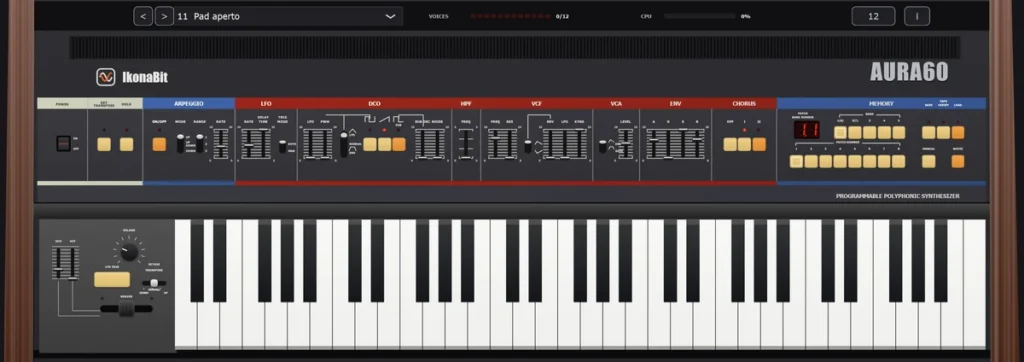
Aura60
Six voices from one oscillator, and a filter whose control voltage is sampled
A master runs at 1.9 MHz and two 16-bit dividers hand each voice its note. That single fact decides how the instrument behaves: chords cannot drift apart, because every voice comes from the same crystal - and the voices are coherent, so what you hear when they sum is the machine, not six independent synths playing together.
ikonabit-Aura60-1.0.0 beta
VST3AUCLAPLV2Standalone
File names
- ikonabit-Aura60-1.0.0-linux-x86_64.tar.gz
- ikonabit-Aura60-1.0.0.pkg
- ikonabit-Aura60-1.0.0.msi