Divide-down string ensemble - 49 keys
Arco49
Arco49
There is no voice allocation here, and nothing to run out of: 61 tones are generated at once, all the time, from a single master oscillator. That is why held chords never beat against each other, why the vibrato moves every note together and in phase, and why this instrument cannot be imitated by a polysynth with a chorus on it.
VST3 + Standalone v1.0.0 Windows 64-bit


Coming soon
Coming soon
VST3 + Standalone v1.0.0 Windows 64-bit
VST3 and standalone, Windows 64-bit. Perpetual licence, 12 months of updates from purchase.
The character is in what it does not do.
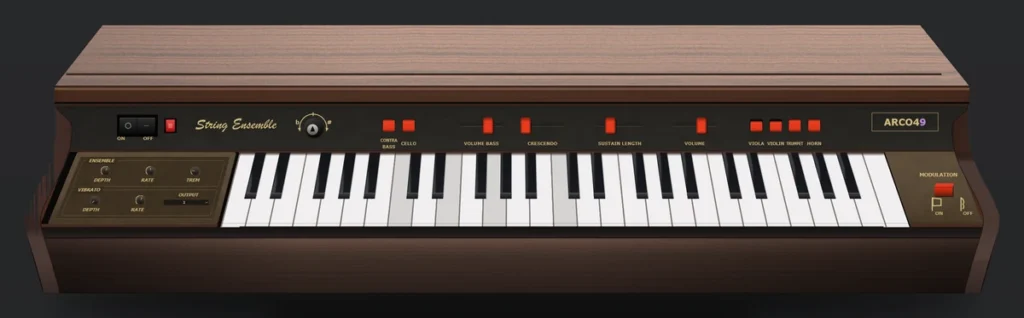
No filter. No ADSR. No per-note envelope. Twelve controls, and each one is on the original panel.
How the sound is made
A master, an octave generator, 9 divider chains.
Frequency division is an old idea with a modern consequence: tuning cannot drift, because every octave is an exact division by two of the one above it.
Division is exact
Error on the divide-by-two: zero. Drift in cents between octaves: 0 cent. Against the octave generator datasheet, all twelve pitch classes land within 0.01 cent.
The wave is not a sawtooth
The schematic puts the capacitor in series, so the network differentiates: what comes out is an exponentially decaying pulse, half-wave blocked by a diode. The tail follows the analytic curve to within 2.3 %.
One capacitor per note
19 distinct values across 61 tones (5.6 - 180 nF), so the ratio between the time constant and the note period stays near 0.233 - a spread of 1.35x instead of the 32x a single capacitor would give.
Who it is for
Three things it does that a polysynth will not.
Not a list of features: three consequences of the architecture that you can hear on the first chord.
Chords that never beat
All notes come from one master, so no interval can be out of tune with another. Hold ten notes: the pitch relationship is rigid.
Vibrato in phase
The vibrato modulates the master, not each note, so the whole keyboard moves together. A per-voice LFO cannot reproduce it.
A crescendo that is global
The attack acts on the gate supply rail, so it is not the note that fades in - it is the whole instrument. Playing a chord into a rising crescendo gives one shared attack, not four.
The registers
Six passive networks, and the corner follows the pitch.
There is no playable filter on this instrument. The 6 registers - 4 treble, 2 bass - are passive networks whose corner frequency changes with the key group: from 9462 Hz at the top to 1199 Hz at the bottom, a spread of 1.77x where a single capacitor would give 10.1x.
- A high-pass at 276 Hz: on a 258 Hz note the second harmonic sits +2.2 dB above the fundamental. The body does not come from the fundamental - it comes from above it.
- TRUMPET and HORN are formants, not attenuations: resonant low-pass filters at a fixed frequency. The measurement shows it - over a tenfold pitch range the centroid rises only 1.4 to 1.6 times.
- Against recordings of the reference instrument the harmonic profile of those two registers agrees to 1.8 dB and 1.9 dB on the first ten harmonics.

The ensemble
3 analogue delay lines, not a chorus.
The effect this family of instruments is named after is 3 bucket-brigade lines of 185 stages each, clocked 120 deg apart and modulated by two summed oscillators. What matters is not the delay but the pitch movement it produces: 9.59 cent RMS with the ensemble on, 0.01 cent with it off. The line itself loses 9.6 dB and hisses at -74.4 dB - and the hiss is part of the sound.

What is measured
Every part against the formula of the circuit it comes from.
The bench does not compare the model with itself. Each block is checked against the closed-form response of its own network, and the registers against recordings of the reference instrument: 9 test suites: five run on the engine alone, without JUCE and in strict floating point; two more compare the rendered audio against a versioned fingerprint (41 cases, 451 metrics) and prove that the comparison can actually turn red. Where the schematic is ambiguous the value is tuned on the measurement and declared as such in the code, not presented as derived.
Hold more keys and this instrument does not just get louder, it gets brighter: +0.30 dB/dB on harmonics 2 to 6. We tuned that to a target of +0.26 dB/dB, taken from public recordings of the reference instrument's crescendo; we have not measured the instrument itself. With the output stage bypassed the slope is exactly zero.

Specifications
In one line
The poverty of the panel is the instrument.
Twelve controls, 18 automatable parameters, 20 factory registrations, zero samples of latency. Nothing to program: two switches, four sliders, and the two time constants that this machine calls an envelope.
Downloads
Try Arco49
Arco49
One master oscillator, sixty-one tones, no voices to run out of
There is no voice allocation here, and nothing to run out of: 61 tones are generated at once, all the time, from a single master oscillator. That is why held chords never beat against each other, why the vibrato moves every note together and in phase, and why this instrument cannot be imitated by a polysynth with a chorus on it.
No release for this instrument yet.