Physically modelled tape echo
Space 201
Space 201
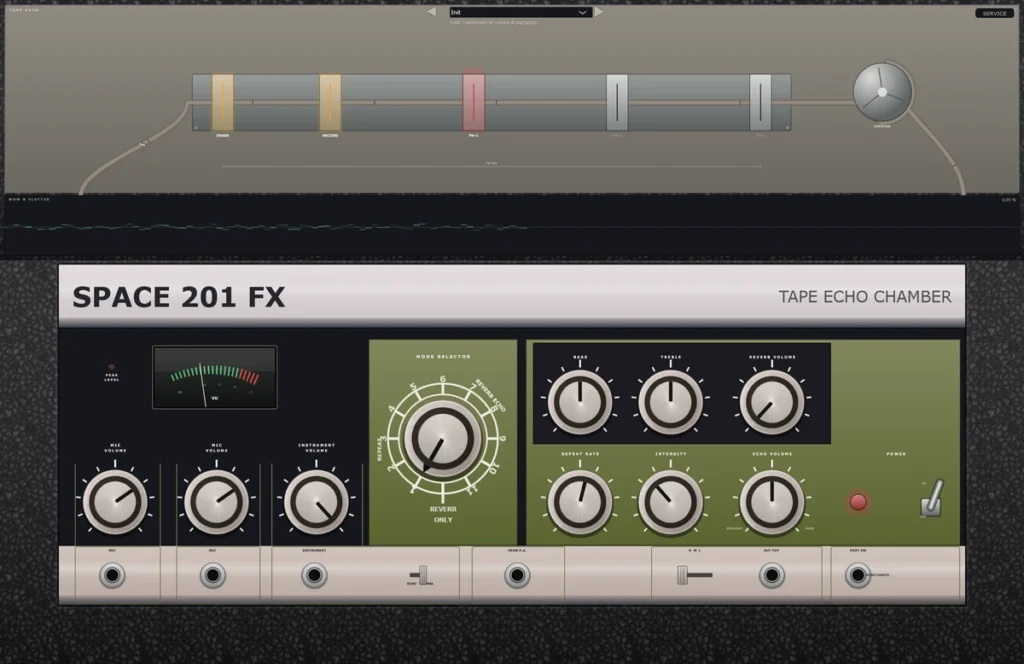
Three playback heads at 20 / 40 / 60 mm from the record head, and a motor running from 12 cm/s to 40 cm/s with real inertia. Turn REPEAT RATE and the tape actually accelerates: the pitch of what is already recorded slides, and all three echoes change together because they share one speed. From 50 ms to 500 ms, and not a millisecond more - that is the heads and the motor, not a choice.
VST3 + Standalone v1.0.0 Windows 64-bit


Coming soon
Not in the shop yet.
VST3 + Standalone v1.0.0 Windows 64-bit
One licence covers both formats. 12 months of updates from purchase; the plugin keeps working afterwards.
With the effect off the output is a bit-exact null.
Sample for sample, identical to the input. The dry path deliberately bypasses the output amplifier - on the real machine it does not, but a plugin that colours a mix at rest is not acceptable. The test bench checks it sample by sample.
Tape and transport
Three heads on one piece of tape, and one speed for all of them.
This is why the machine cannot be emulated with three fixed delay lines: the times are not independent, they are the distances between the heads divided by whatever the motor is doing right now.
Times in a fixed ratio
The three echoes always stand at 1 : 2 : 3, because that is the row of heads. It is also why this echo never quite locks to a grid.
The motor has mass
It accelerates faster than it slows - 0.18 s against 0.30 s - so a move on REPEAT RATE drags the pitch of the tape already written.
Wow from geometry
The flutter frequencies come from the diameters of the parts that turn: shaft 2.4 mm, pinch roller 13 mm, bearing 20 mm. Change the speed and they change with it.
Reachable range
50 ms to 500 ms. At mid travel: 86 / 172 / 258 ms.
Who it is for
For people who want the machine, not a delay with a tape button.
Everything that makes this effect recognisable is a side effect of how it works, so the controls behave the way the original does.
Dub and space
The feedback threshold moves with the number of heads: unity gain at 80 % with one head, 40 % with two, 27 % with three. Past it the loop grows and settles into tape saturation instead of exploding.
Slap and doubling
Down to 50 ms on the first head at full motor speed, with the repeat darkening on every pass.
Character on demand
5 machine conditions, from freshly serviced to twenty years neglected - the same settings on a different unit.
Saturation and losses
The distortion is the tape, and the bias has an optimum.
Magnetisation follows the Langevin anhysteretic curve averaged over the bias, which is the transfer function of AC-biased recording to first order. Move the bias either way and it distorts - it is not a one-directional drive curve. At correct alignment the distortion is sixteen times lower.
- Antialiasing in closed form: no oversampling, no latency
- Head losses depend only on f/v - spacing, coating thickness, gap width
- So echoes darken more when the tape runs slow: -10 dB per pass at 120 ms, -24 dB at 400 ms
- Head spacing is literally the wear: 0.5 µm freshly cleaned, 4 µm never touched

The tape chamber
The tape on the panel is the tape you are hearing.
Five heads at the distances of the model, with the 75 mm dimension drawn - so the picture explains why the third head is three times the first. The ones actually selected light up. The tape scrolls at the true speed, because its phase comes from the integral of the motor speed and not from an animation of its own: it accelerates with the machine's inertia and trembles with the wow you are listening to.

What is measured
The bench compares the model with physics, not with itself.
Head losses are checked against the exact reference formula, the motor law by closing the loop time to knob position and back, and the echo path gain stage by stage. Zero latency: no lookahead, no global oversampling.
The reference has never been arbitrated: no usable recording of the original machine exists in the public domain, and that is stated rather than glossed over. What is claimed here is what the model does, and every figure on this page comes from a measurement that runs in two seconds.


Specifications
In short
A tape echo where nothing is a parameter that should not be.
3 heads, 12 selector positions, a 3-spring tank, 28 programs in 6 families, zero latency - and a delay time that is a distance divided by a speed.
Downloads
Try Space 201
Space 201
The delay time is a distance divided by a speed
Three playback heads at 20 / 40 / 60 mm from the record head, and a motor running from 12 cm/s to 40 cm/s with real inertia. Turn REPEAT RATE and the tape actually accelerates: the pitch of what is already recorded slides, and all three echoes change together because they share one speed. From 50 ms to 500 ms, and not a millisecond more - that is the heads and the motor, not a choice.
No release for this instrument yet.