Slyce7 opens the old sampler discs

Point Slyce7 at a sampler CD-ROM and the browser fills up. The Roland S-760 disc we work with holds 159 patches and 647 samples. Click one, hit a key, and it plays, spread across the keyboard with its zones and key ranges.
Two families work. Akai programs and keygroups come in whole, with their original names, their key ranges and their loops: we have tried an S1000 sample CD; S2000 and S3000 discs share its layout, but we have not yet had one with samples to try. Roland patches come in with their samples and key ranges, not yet with their loops.
The block was a floppy track
Roland discs are laid out in units of 9216 bytes, which is 18 sectors of 512: one floppy track. It fits, because these CD-ROMs gather libraries that were born on floppy disks. We first read them in 64 KB blocks, and most samples came out silent or glued to their neighbours. On the right grid all 647 samples of the reference disc open on sound, and the four sax samples we checked play at the pitch written in their names. A saxophone is a saxophone, at the pitch it says on the tin.
The browser tells you what it can play
E-mu banks (.e3b, .e3x and .esi files) give up their samples, and those play; their presets are not decoded yet, so you bring in single samples, not programs. E-mu floppy sets can only be listed. For more than half of the Roland library, 374 samples out of 647, we could not prove the sample rate: we assume 22050 Hz, the only rate that came close to matching the notes in the sample names, so some of those samples may play at the wrong pitch. When a disc can be listed but its sound cannot be reached, Slyce7 says why, in amber, and switches Listen, Import and Favourite off: a favourite that can never load is a trap with a long fuse.
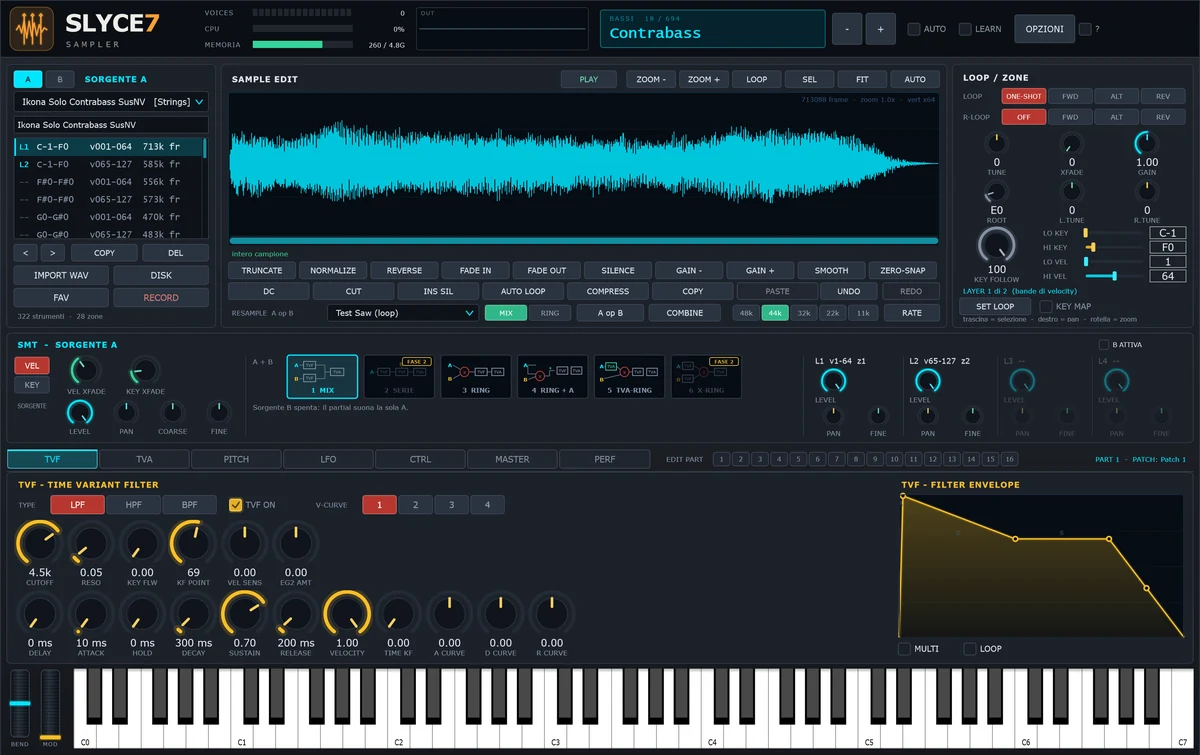
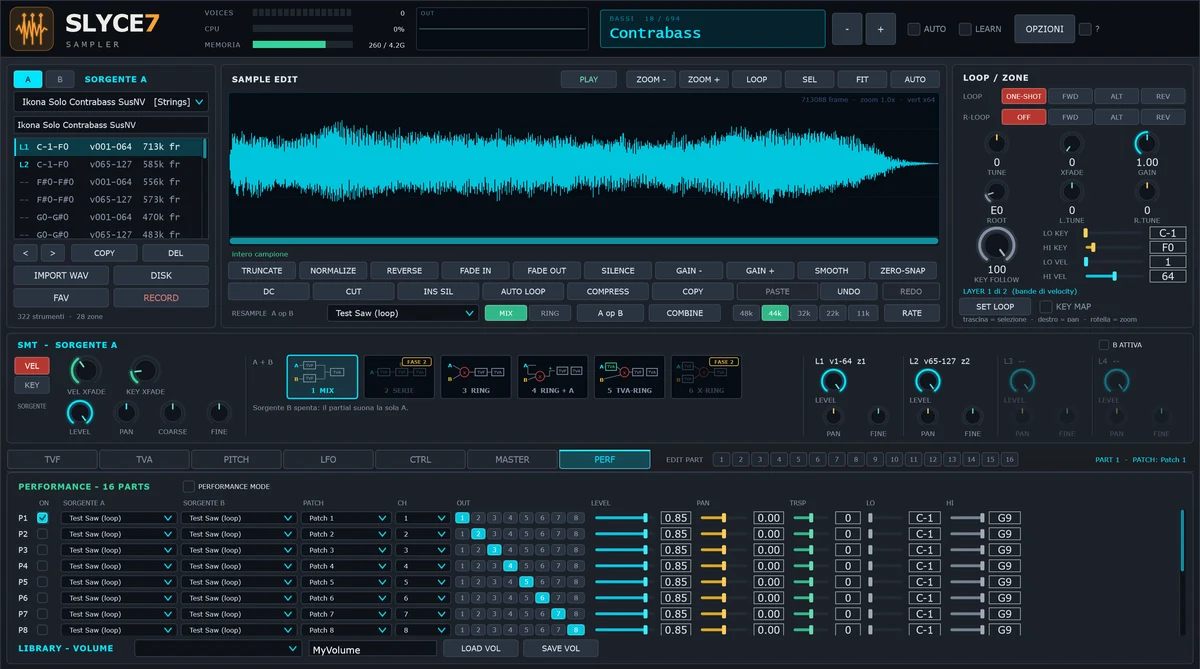
Take an Akai program off a disc, import it into Slyce7 and play it: the same key ranges and the same main loop, with filter and envelopes translated as closely as we could, not copied from the original machine. Stereo pairs come in as one stereo sound. The library on the shelf becomes an instrument in the session you are already working in.
The instrument
