Slyce7 follows your hand

Play a note softly in Slyce7, then lean on the same key. On an instrument recorded at several velocities, the timbre moves with your hand: it blends from one recording to the next instead of jumping. The sample answers like an instrument, not like a key.
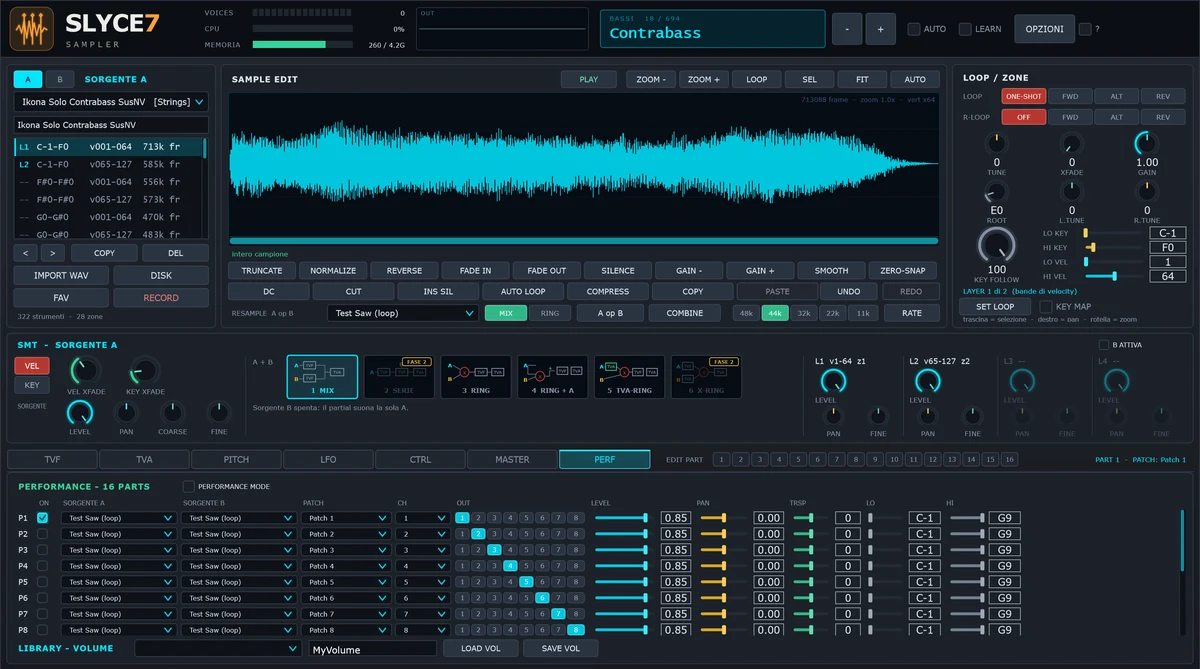
Each note can draw on up to four layers, and you choose how they blend: by velocity, with a crossfade width from 0 to 64 (at 0 you hear a hard switch), or by keyboard position, with a blend up to 24 semitones wide around the point where two recordings meet. The velocity blend starts at 16.
Two sources inside one voice
Every sound can have two sources, A and B, each with its own layers, its own blend and its own tuning. They are not two voices: A and B live in the same voice, sharing the filter, the envelopes and the LFOs, and combine as Mix, Ring (A x B), Ring+A or TVA-Ring. A bow under a breath, or two instruments ring-modulated against each other, still count as one note of polyphony. Of the 694 factory patches, 246 use source B, and each of the sixteen Parts is a complete engine with its own effects chain.
The library loads as you play
When Slyce7 starts, the catalogue comes first: every instrument, every zone drawn on the keyboard, every patch found by name. The audio arrives one instrument at a time, when you ask for it, and the ones you used last stay in memory, up to 768 MB by default. By default, the whole library is not loaded into memory at startup.
A note that is already sounding keeps its sample until it ends, even if you move on to another instrument. Choose a patch whose instrument is not in memory yet and Slyce7 loads it in the background: the patch applies at once and the sound follows as soon as the instrument is ready, a wait that depends on how big it is. The OPTIONS menu lets you choose how much to keep: only the patch in use, that plus the patches you star, or the whole library for the current session.
How much you can stack
Each Part allows up to 64 voices. How many your computer really carries depends on the instrument: a voice with several layers reads several streams of samples, so it costs more than a single-layer one. When the load gets too high, the engine lowers the voice limit to protect the audio, and notes that are already fading go first, then the oldest. Try it on your own machine, with your own instruments.
Load a multi-velocity instrument in Slyce7 and play the same key three times, with three different hands. What you hear change in those three notes is the whole argument.

The instrument
