Feedback delay network reverb
Chora
Chora
A true-stereo feedback delay network of 8, 12 or 16 modulated lines with coprime delays, three orthogonal recirculation matrices, and a layer of time-varying rotations above the matrix that keeps the tail from settling into a pattern.
v1.1.0

betadownload and try
Perpetual licence · 12 months of updates · full trial before you buy
In beta, and you try all of it
This is not a cut-down version: it is the complete instrument. We are asking you to use it and tell us what does not add up.
3 seconds at −18 dBFS · the clock restarts at every launch
v1.1.0
Every licence covers both formats. Until a licence file is activated the plugin runs in trial: the first 10 minutes of each session are clean, then a 3-second noise burst at -18 dBFS every 3 minutes, and offline renders are degraded.
The delays are coprime, from 23.11 ms to 113.3 ms.
Coprime lengths mean the echoes take the longest possible time to line up again. That is what separates a dense tail from a ringing one, and it is a property of the numbers - not something a modulation depth can rescue afterwards.
The network
3 matrices, 5 voicings, and a rotation layer.
The recirculation matrix decides how energy moves between lines. All three here are orthogonal, which means they redistribute energy without adding or losing any of it.
The matrices
Hadamard, Householder and a random orthogonal one. Each mixes the lines differently, and the difference is audible in how quickly the tail becomes dense.
Givens rotations
A layer of time-varying rotations sits above the matrix. With Mod depth above zero the network keeps turning while the tail decays, so the tail has no fixed pattern to settle into.
Nested diffusion
8 allpass stages at the input and 6 at the output, nested in the tank idiom, plus one allpass per line inside the loop.
Who it is for
For the reverb you keep coming back to.
There is a difference between a reverb you use for an effect and one you use as the room. This is built to be the second.
Mixing
5 voicings - room, hall, plate, chamber, shimmer - and 28 factory presets, exposed to the host as programs.
Long tails
Decay from 0.2 s to 20 s, lossless freeze, and a tail declared to the host so a bounce does not cut it off.
Dense mixes
Wet ducking and mid-side width from zero to double: the reverb can step back while the source speaks and open again after it.
Decay by frequency
4 bands, with free breakpoints.
A real room does not decay at the same rate at every frequency, and neither does this one. The decay EQ sets a decay time per band with breakpoints you choose, on top of a low shelf with its own corner and an air-damping term.
- 4 bands of decay time, with free breakpoints
- Low shelf with its own corner frequency, plus air damping
- Pre-delay from zero to 500 ms

Behaviour
Freeze, ducking, bypass and width.
Freeze is a key in the top bar: the band gains go to exactly one, the input closes, and the movement and the matrix rotation stop. The tail is held by the orthogonality of the matrix alone while Freeze is on - not a very long decay. Ducking pulls the wet down while the dry is present and lets it back up after. Bypass now sits in the same bar and is a host parameter: the output is the input, sample for sample, with a 10 ms fade either way, while the reverb keeps running underneath - so when it comes back, the tail is already where it would have been.
- Freeze - the tail holds while it is on, instead of slowly dying
- Wet ducking driven by the dry signal
- Bypass with a 10 ms fade; the tail keeps running underneath
- Mid-side width from 0 to 2x

Shimmer
A pitch shift re-injected into the network.
Shimmer transposes by up to 12 semitones and puts the result back into the network rather than beside it, so the transposed tail decays through the same room as everything else. It runs at double the sample rate with an anti-aliased saturator, because a pitch shift inside a feedback loop is exactly where aliasing accumulates.

The panel
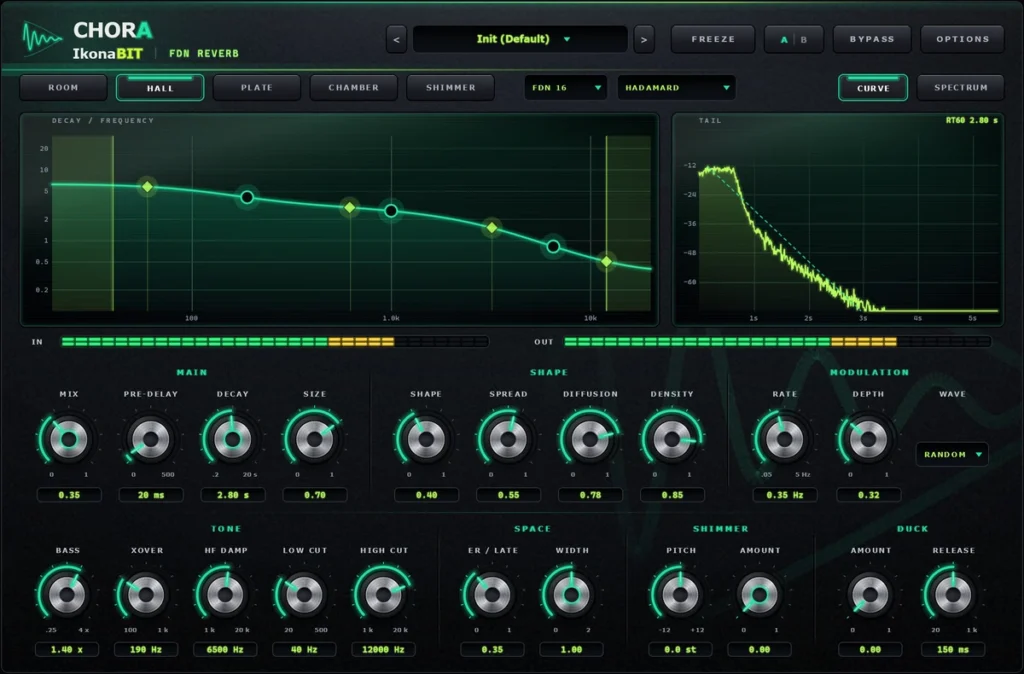
One bar, two views, seven groups.
The top bar is the one shared by the whole effects line: presets with their arrows, FREEZE, A | B, BYPASS and OPTIONS. Under it, the five voicings as five keys, the line count and the matrix as two selectors - construction choices, not mixing gestures - and the two views of the central band: CURVE, the decay curve beside the tail envelope, and SPECTRUM, a left/right analyser across the full width. IN and OUT meters read the peak of each channel. Below, 21 knobs in seven titled groups - MAIN, SHAPE, MODULATION, TONE, SPACE, SHIMMER, DUCK - each with its value always printed.
- A | B: two complete copies of the sound, saved with the session
- Every sound parameter has a control on the panel
- Panel of 1100 x 724, scalable from 50 to 200 % without a control moving

What is measured
Zero latency, and a number that is honest about itself.
No samples of latency are declared because none are used - nothing to compensate, nothing to explain. The tail declared to the host is 20 s, which is what a bounce needs to know to avoid cutting the end off.
The 35 automatable parameters are the thirty-four of the sound plus the bypass, and every one of the sound has a control on the panel: knobs, handles on the curve, the selectors of the mode row, FREEZE and BYPASS in the bar.


Specifications
Keep looking
Looking for something else?
The other instruments and effects are one click away.
Downloads
Try Chora
Each download is the Windows installer, a single .msi file. It installs for all users, so Windows asks for administrator rights; under each release there is also the .exe installer, inside a ZIP.
Chora
The reference reverb
A true-stereo feedback delay network of 8, 12 or 16 modulated lines with coprime delays, three orthogonal recirculation matrices, and a layer of time-varying rotations above the matrix that keeps the tail from settling into a pattern.
ikonabit-Chora-1.1.0 beta
VST3Standalone
File names and previous versions (1)
- ikonabit-Chora-1.1.0.msi
ikonabit-Chora-1.0.0 beta
VST3Standalone