Feedback delay network reverb
Chora Lite
Chora Lite
8 or 12 modulated lines with coprime delays, one orthogonal matrix instead of three, and the decay equaliser active with its breakpoints set by the presets. Everything that made the tail liquid is still here; what is gone is the part you had to decide.
v1.1.1

FREE
v1.1.1
FREE forever: no purchase, no time limit. To unlock it you need an account: get your FREE licence there, enter your computer's machine code and you receive the licence file for that computer. Until then the plugin runs in demo mode, like every ikonaDSP plugin. Both formats included.
The parameters are identical to those of the full version.
Same identifiers, same ranges, same behaviour. A project made with one opens in the other, and moving up is not a migration: it is a different plugin reading the same numbers.
The network
One matrix, and a real one.
The recirculation matrix here is Hadamard - and at twelve lines it is a genuine Hadamard matrix built by the Paley construction, not a stand-in that happens to be the right size.
Coprime delays
From 23.11 ms to 113.3 ms. Coprime lengths take the longest possible time to line up again, which is what separates a dense tail from a ringing one.
Givens rotations
The layer of time-varying rotations above the matrix is here too: the network keeps turning while the tail decays.
Nested diffusion
8 allpass stages in, 6 out, plus one per line inside the loop - the same tank as the full version.
Who it is for
For choosing a room, not designing one.
Most of the time a reverb needs to be picked and set, not built. This is the version for that.
Quick decisions
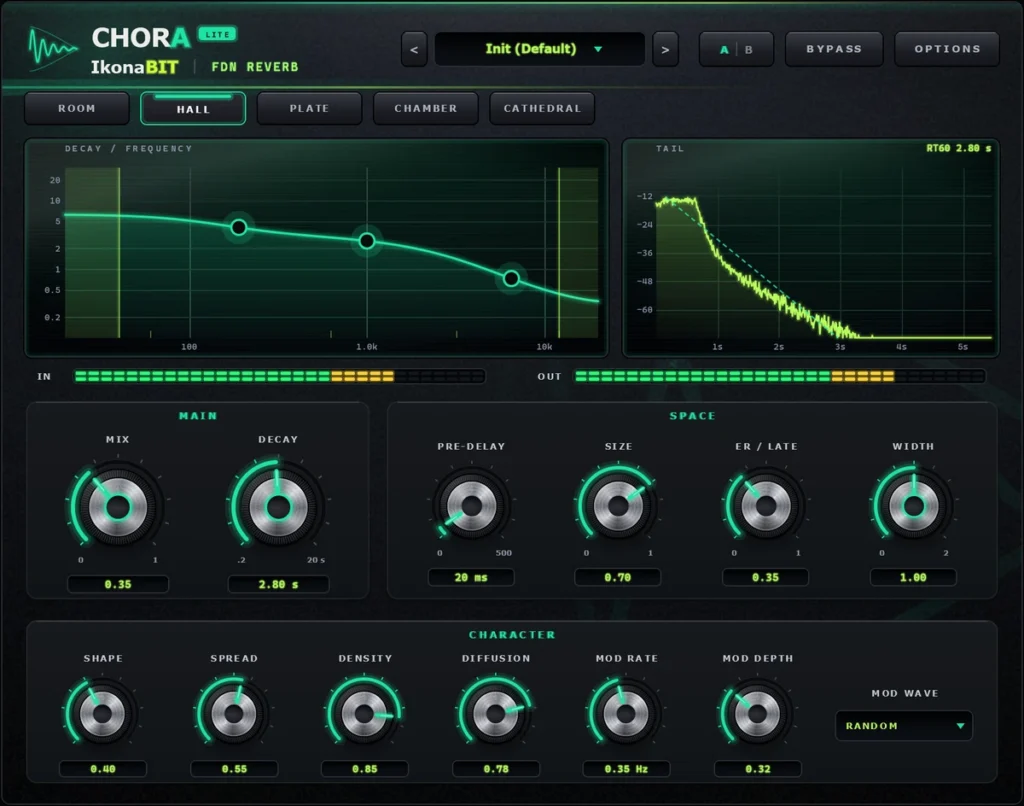
5 voicings and 21 factory presets on a panel of 880 x 692, with all 13 controls in sight.
Same sound
The network, the diffusion and the decay equaliser are the ones from the full version. It is smaller in controls, not in quality.
A way up
The parameters carry the same identifiers, so a session built here opens in the full version with everything where you left it.
Decay by frequency
4 bands, already placed.
The decay equaliser is active: its breakpoints are written by the presets and drawn on the curve as fixed marks, not handles. The curve itself is the tone control - five draggable handles for the low shelf (multiplier and corner), the decay, the air damping and the two cuts. What you lose is the decision about where the bands sit, which is exactly the decision most people do not want to make.
- 4 bands of decay time, breakpoints set by the presets
- Five handles on the curve: low shelf, decay, air, low cut, high cut
- Decay from 0.2 s to 20 s, pre-delay to 500 ms

Voicings
5, including one the full version does not have.
Room, hall, plate, chamber - and cathedral, which is this edition's own. Mid-side width runs from mono to double, and the tail declared to the host is 20 s, so a bounce does not cut the end off.

The panel
13 controls, none behind a click.
The same top bar as the full version, minus FREEZE: presets with their arrows, A | B, BYPASS, OPTIONS. Under it the five voicings as five keys, the decay curve beside the tail envelope, IN and OUT meters - and three titled boxes, all always visible: MAIN with Mix and Decay, the two largest knobs on the panel; SPACE with pre-delay, size, early/late balance and width; CHARACTER with shape, spread, density, diffusion, modulation rate, depth and waveform. The character controls no longer sit in a drawer: they are on the panel like everything else.
- Bypass: the output is the input, sample for sample, with a 10 ms fade
- A | B: two complete copies of the sound, saved with the session
- Panel of 880 x 692, scalable from 50 to 200 %

What is measured
Zero latency, and the same parameter count.
No samples of latency are declared because none are used. The automatable parameters are 35 - the same as the full version, because the engine is the same engine.
The panel measures 880 x 692 and scales from 50 to 200 %. Get your FREE licence in your account and activate it with your computer's machine code.


Specifications
In short
The same room, chosen instead of built.
8 or 12 lines, 5 voicings, 21 presets, zero latency - and the same parameters as the full version underneath.
Downloads
Try Chora Lite
Windows downloads are installers (.msi, or the .exe inside a ZIP); macOS downloads are .pkg installers.
Chora Lite
The same tail, fewer decisions
8 or 12 modulated lines with coprime delays, one orthogonal matrix instead of three, and the decay equaliser active with its breakpoints set by the presets. Everything that made the tail liquid is still here; what is gone is the part you had to decide.
ikonabit-ChoraLite-1.1.2 beta
VST3Standalone
ikonabit-ChoraLite-1.1.0
VST3AUStandalone
File names and previous versions (1)
- ikonabit-ChoraLite-1.1.2.msi
ikonabit-ChoraLite-1.0.0
VST3AUStandalone